

Legacy System Examples: Real Cases, Results, and Modernization Lessons
Legacy systems still support critical operations across industries. This article explores real examples, the strain they created, and what companies gained through modernization.

Mar 25, 2026
In practice, legacy systems rarely announce themselves as the biggest problem in the business. They keep orders moving, support billing, route work between teams, and sit behind customer-facing products without drawing much attention. That is part of why they last. In many companies, they still hold pricing rules, reporting logic, operational exceptions, and years of decisions the business still depends on.
The pressure shows up later, usually when the business changes first: a company adds a new product line, acquires another business, tries to connect systems that were never designed to work together, or shifts more activity into digital channels. What once felt stable starts slowing releases, creating handoff issues, and pushing teams into spreadsheets, side databases, and manual checks just to keep work moving.
You can see the pattern in very different industries. Legal businesses run into it when acquisitions expose conflicting workflows and disconnected records. Fintech teams see it when onboarding depends on too many internal touches. In agtech, platforms shaped by years of field expertise become harder to extend. Healthcare organizations feel it when scheduling, treatment planning, and communication still live in separate tools.
This article draws on that broader pattern, but also on what we have seen firsthand working with companies whose core systems still matter, even when they no longer support the next phase of growth. The underlying question is whether a platform still fits the way the business needs to operate now.
What counts as a legacy system today?
A legacy system is any software, platform, or workflow that still supports critical operations but no longer aligns well with what the business needs today in terms of speed, integration, scalability, or maintainability.
That can describe a monolithic internal platform, an aging on-premise application, a heavily customized industry tool, or even a core system that now depends on spreadsheets and manual workarounds to fill the gaps. The technology may still work. The issue is that teams have started adapting their work to the system’s limits instead of the system supporting the work cleanly.
That is usually the point where the label starts to matter. A system becomes legacy when it still carries business value, but also starts making change slower, integration harder, and growth more expensive.
If you want a deeper look at how to define a legacy system and why the term matters, read our article What Is Legacy System Modernization? A Complete Guide.
Why do companies still rely on legacy systems?
Most companies do not keep older systems because they are unaware of the problem. They keep them because those systems still handle critical work, and changing them means cost, risk, and time the business may not be ready to absorb yet.
A legacy platform may sit at the center of billing, scheduling, order processing, compliance, fulfillment, service delivery, or reporting. The logic inside it has often been refined over years, sometimes decades. Rebuilding that logic is one challenge. Untangling everything connected to it is another.
There is also the risk of getting the replacement wrong. When a platform touches revenue, customer support, claims handling, inventory, or regulated workflows, a failed migration is not just a technical setback. It can delay operations, disrupt service, and create new reporting problems before the old ones are gone.
Then there is the layer of adaptation that builds up around these environments. A report gets exported because the built-in numbers are unreliable. An approval moves through email because the workflow inside the system breaks at that step. One person on the team becomes the one who knows which fields to trust, which records need manual cleanup, and which process cannot be changed without breaking something downstream.
That kind of adaptation creates another barrier to change. Even when the business knows the current setup is limiting growth, replacing it means retraining teams, reworking familiar routines, and managing a period when productivity may dip before it improves. For many companies, that organizational risk feels just as real as the technical one.

That is usually when the limitations become harder to ignore. A company starts investing in automation, AI, or platform consolidation and discovers that the bigger issue is not the new initiative itself. It is the mix of dependencies, missing integrations, and inconsistent data underneath it.
Common types of legacy systems
Legacy environments do not all look the same. Some are large, visible platforms everyone in the company knows are hard to change. Others are less obvious. The strain shows up in the way work gets done around them.
These are four patterns we see often in legacy environments:
| Type of environment | Why it stays in place | What usually breaks first | Business impact |
| Monolithic platform | Supports core workflows | Change speed | Slow releases |
| On-premise application | Still operationally critical | Integration quality | Data silos |
| Customized industry system | Strong business fit | Scalability | Expensive changes |
| Shadow-system ecosystem | Flexibility | Consistency | Manual drag and low visibility |
Legacy system examples across industries
The clearest way to understand legacy architecture is through business context. The age of the stack matters less than what the current environment makes harder to do: launch faster, integrate new capabilities, support growth, or keep operations aligned as the company changes.
Agtech legacy systems
Agtech legacy systems typically persist because they encode decades of field expertise and operational knowledge that is difficult to replicate. They may still support the work well, but extending them, integrating them, or scaling them becomes more demanding over time.
VAS is a global agtech company and market leader in connected farm management systems, develops software that helps dairy producers track cattle, feeding, performance, and dairy economics. The company provides a suite of products that help dairy farmers track cattle, feeding, performance, and the economics of their dairies. With more than 40 years in the market and over 30 years of product development behind its dairy management suite, VAS needed to modernize its applications and move toward a platform that could scale more easily as new products were added.
In our work with VAS, the focus was on moving legacy applications into a modern cloud environment while improving the user experience and preparing the platform for future growth. The outcomes included faster information deployment, easier integration with other tools, lower operating costs, and broader geographic expansion. The case study also highlights a reported 30% cost reduction, along with a stronger foundation for long-term competitiveness.
This kind of case shows why legacy systems in agtech are rarely just old software. They often carry years of real operational knowledge, which means modernization has to strengthen what comes next without losing the value already embedded in the product.
Legal industry legacy systems
Legal businesses often run into a different type of legacy pressure. The issue is not always that the platform stops functioning. More often, the business grows, processes become more distributed, and the existing setup becomes harder to manage cleanly.
Esquire Depositions is a U.S.-based legal services company and Gridiron Capital portfolio company, provides court reporting and deposition services for law firms and legal teams.After the acquisition, Esquire needed to support both organic and acquisition-driven growth while improving operational efficiency and workforce performance. The challenge was not to replace a broken system, but to create a more scalable and centralized operating environment that could support growth with less friction.
In our work with Esquire, the priority was to centralize data and improve the way operations ran day to day. The results included 100% data centralization, a 40% boost in operational efficiency, and a 10% increase in enterprise valuation. The new environment also helped Esquire scale without adding headcount.
Remote Legal shows a different version of the same broader issue. Remote Legal, a prominent New York-based stenographic court reporting firm, provides remote court reporting and deposition support designed to recreate the in-person deposition experience digitally. Here, modernization was tied directly to a new delivery model. For Remote Legal, the work centered on defining and building a digital deposition platform that would support remote operations, nationwide expansion, and a faster setup process. The outcome was a 30% improvement in deposition setup time and a business model better aligned with digital delivery.
Taken together, these examples show how legacy pressure emerges in legal environments even when the tools still function. The challenge is often that the business has moved into a more distributed, digital, or acquisition-driven model than the original setup was built to support.
Fintech legacy systems
In fintech, older environments often show their limits first in the customer journey. The friction might not be obvious in the architecture diagram. It shows up when onboarding takes too many steps, information has to be checked in multiple places, or customers wait while teams piece together the next action.
CCI Puesto de Bolsa is a Dominican brokerage firm offering investment products and financial advisory services. As the company looked to modernize operations and reduce reliance on its sales team, it set out to create a stronger self-service experience for investors.
With CCI, the goal was to build a more autonomous digital investment journey, not just refresh the interface. The workflows behind onboarding and service delivery needed to change as well. The result was a fully digital experience that boosted investor engagement, accelerated growth, and freed up executives to focus on more strategic work. The case study highlights a 3x increase in user engagement, an 80 to 90% reduction in executive inquiry time, a 30% increase in investor sign-ups, and an onboarding conversion improvement from 22% to 40% after digital contract signing was introduced.
Auto Approve reflects another common fintech pattern. Auto Approve is a major U.S. auto loan refinancing company. In this case, the pressure was centered on call center operations, where high call volume, incomplete responses, missing documents, and limited access to real-time information were affecting both conversion and service quality.
In our work around this operation, the analysis focused on where AI and workflow improvements could produce the highest impact. It surfaced opportunities such as up to 25% fewer missed calls, 20 to 30% faster response times, and 15 to 20% more completed loans, depending on how staffing, data access, and automation opportunities were addressed.
This is a useful reminder that in fintech, legacy pressure often shows up operationally before it looks architectural. By the time the technical constraints are obvious, the business has usually been absorbing the cost through slower response times, heavier manual effort, and lower conversion.
Healthcare and connected care legacy systems
In healthcare and connected care, fragmentation is often the first sign that the current environment is no longer holding up well. Scheduling may live in one place, treatment planning in another, communication somewhere else, and collaboration depends on people stitching everything together.
Opya is a U.S.-based healthcare company focused on autism therapy, providing personalized care services and digital tools that support children with autism spectrum disorder and their families. The company wanted to streamline services for patients and families through connected applications while preserving the quality and confidentiality required in that environment.
For Opya, the need was to connect communication, treatment planning, scheduling, and collaboration across users who depended on the same information but were working through different touchpoints. The result was a user-centered, HIPAA-compliant suite of applications, including a web application, an internal messaging app, and a parent-facing mobile experience. That work made communication easier across therapists, clinicians, and families, strengthened team-based collaboration, and helped create a better patient experience overall.
This kind of modernization is less about replacing one isolated tool and more about reducing the coordination gaps that build up across scheduling, communication, and care delivery.
Animal health and commerce platforms
Vetsource is a major U.S.-based animal health and commerce company that provides home delivery, pharmacy, payments, and e-commerce services for veterinarians, clinics, and pet owners. As the company expanded its e-commerce, payments, and pricing capabilities, it needed to streamline operations and support growth with more scalable tools.
In our work with Vetsource, the focus was on modernizing key operational areas through cloud-based tools, updated payments, pricing automation, and conversion-focused digital improvements. The outcomes included a 2x increase in customer base, an 18% increase in e-commerce conversion rate, and a 10x boost in project profitability tied to one payments initiative. The work also streamlined operations across more than 190 veterinary practices.
This is where many modernization efforts begin. Not with a dramatic failure, but with a business that has outgrown the way the current environment handles scale, coordination, and change.
When a legacy system becomes a business risk
There is usually a long stretch where a legacy system feels inconvenient, but still manageable. Teams know where it slows them down. They know which report needs to be checked twice, which workflow breaks at handoff, and which approval still happens outside the system. The business keeps moving, so the issue does not always look urgent.
That changes when the workarounds stop feeling contained.
A release that should take days takes weeks because too many dependencies surface late. Finance and operations are looking at different numbers because data is being pulled from different places. A customer request stalls because one team cannot see what the other already did. A manager has to wait for the one person who knows how to fix the report before decisions can move forward.
At that point, the cost is no longer limited to IT maintenance. It starts showing up in execution, reporting, customer experience, and leadership visibility.
Some of the clearest warning signs look like this:
- Small changes take too long to release
- Teams reconcile data manually before they trust it
- Important approvals happen outside the platform
- Integrations with cloud, analytics, or AI initiatives are brittle or expensive
- Key workflows depend on a few people who know how to navigate exceptions
- Customer-facing improvements are slowed down by back-end constraints
- M&A integration becomes harder because systems, records, and processes do not line up cleanly
Growth tends to expose these problems faster. So do acquisitions, new digital channels, and any effort to automate work across systems that were never designed to operate together.
By the time a company starts asking whether the architecture has become a business risk, it usually has been one for a while. The cost has just been spread across too many small delays, manual fixes, and reporting gaps to stand out all at once.
Making Sense's roadmap for legacy system modernization
There is no single modernization path that fits every company. Some systems still contain valuable logic and support critical work well. Others are creating too much drag around reporting, integrations, ownership, or change management. Most environments sit somewhere in between.
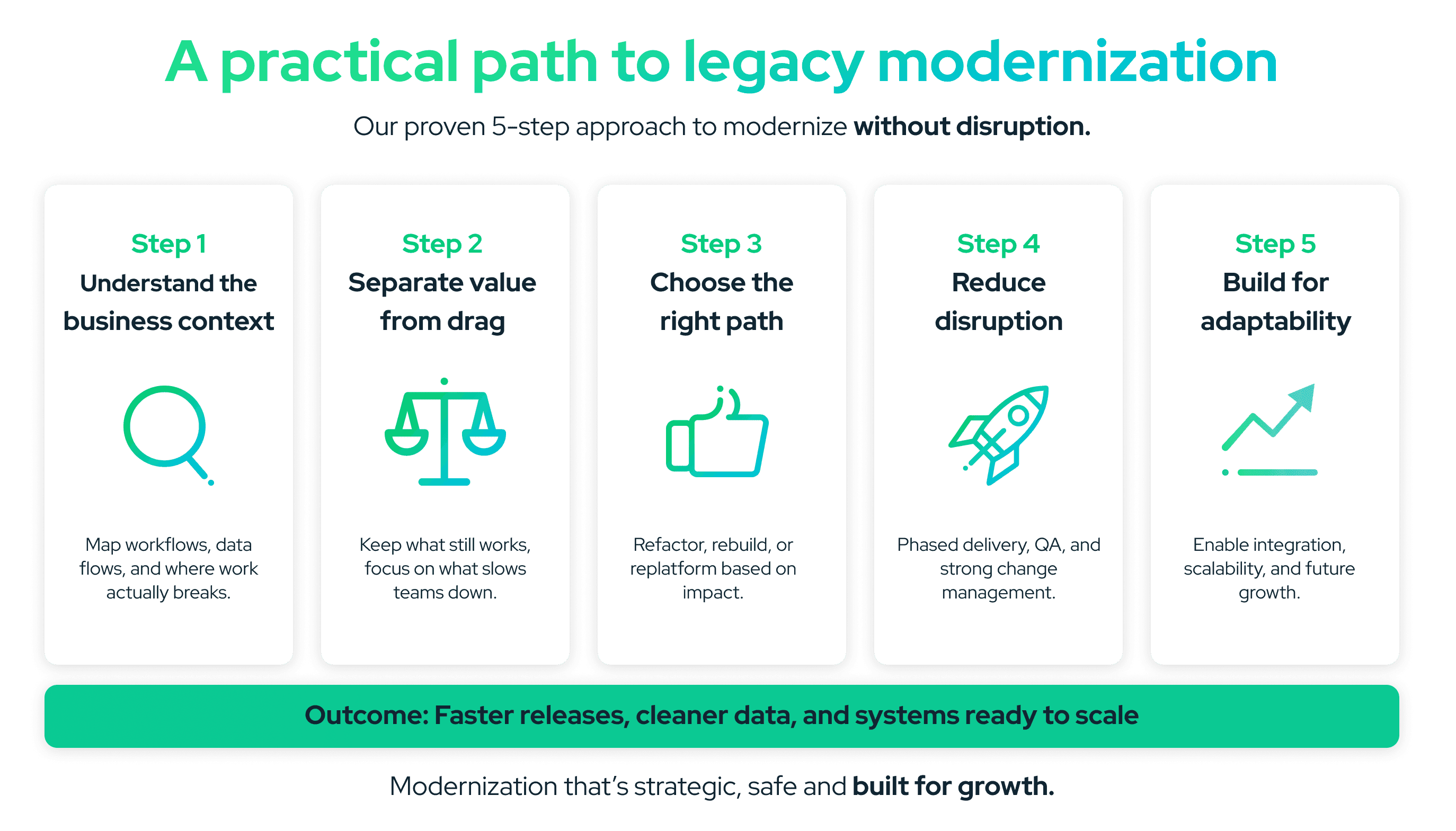
That is why, in our work, the process starts before any technical decision is made.
1. Understand the business context
The first step is to look beyond the architecture diagram. We map workflows, dependencies, data flows, bottlenecks, and risk areas to understand how the current environment supports the business day to day. That often reveals issues that are easy to miss when the focus stays only on code or infrastructure.
A team may think the problem sits in the platform itself, then discover the bigger issue is how data moves between systems, where approvals stall, or how much manual reconciliation is happening before leadership sees a report.
2. Separate what still creates value from what creates drag
Not every component needs to be replaced. In many cases, the smarter move is to preserve the logic that still supports the business well and focus change on the parts that are slowing releases, creating inconsistent data, or forcing teams into workarounds.
This matters because modernization is rarely about wiping the slate clean. It is about understanding which parts of the current environment still deserve to stay and which ones are making the business harder to run.
3. Choose the right path
Once that picture is clear, the path forward becomes easier to shape. Depending on the case, that may mean refactoring, replatforming, selective rebuilding, API enablement, or phased movement toward cloud-native services.
The right answer is not always the most ambitious one. Sometimes the highest-value move is to modernize one layer, reduce the operational friction around it, and build from there.
4. Reduce disruption during execution
Execution matters as much as direction. A modernization effort can make perfect sense on paper and still create unnecessary risk if the rollout is not handled carefully.
That is why phased delivery, QA, observability, and change management are so important. The work affects more than the application itself. It changes how teams interact with systems, how information moves, and how decisions are made during the transition.
5. Build for adaptability
The goal is not simply to replace older technology with newer technology. It is to create an environment that is easier to evolve, easier to integrate, and easier to grow with.
That includes cleaner data flows, better visibility, more resilient operations, and a stronger foundation for future initiatives, whether that means AI, automation, expansion, or product growth.
Why modernization starts with business context

These legacy system examples point in a consistent direction. The issue is rarely the age of technology alone. It is what the current environment is asking the business to tolerate: slower execution, more manual effort, weaker visibility, harder integrations, and less room to change cleanly.
That is also why effective modernization does not begin with a solution. It begins with understanding how the business actually works today, where the strain shows up first, and which pain points teams have been absorbing for years. A workflow may still get completed, but only because people know where to step outside the system, who to ask for the correct data, or which approval needs to move another way.
That is the kind of context that matters before any technical decision is made. It helps clarify what is still working, what is creating drag, and where a change will affect not only systems, but also routines, ownership, and day-to-day coordination across teams.
It also matters for adoption. In older environments, people have often built their work around the current setup for years. Modernization changes more than tools. It changes habits, expectations, and the way work moves. If teams are not involved early, the company risks replacing one set of frustrations with another.
In our experience, the strongest modernization efforts protect the value already embedded in critical systems while reducing the friction that has built up around them. That is where companies start to regain speed, clarity, and room to grow.
If your team is working around architecture that no longer fits the business, explore our Legacy System Modernization Services. For a broader view of how priorities in this space are evolving, continue with our article on legacy modernization trends.
Mar 25, 2026