

From UX to Designing Context: What Changes When AI Starts Using Your Website
Interfaces still matter, but they are no longer the only place where decisions are made. How information is structured, interpreted, and acted on now plays an equally important role.

May 5, 2026
Search used to return ten blue links. Now it returns an answer, and fewer users click through. Underneath it, a deeper shift is happening in how websites are used: a new type of user is emerging, one that the UX practices most teams rely on were not built for it.

What product design assumed for years
For a long time, digital product design operated under a simple assumption: whoever is using the website is a person, and the interface is how they find their way around.
That assumption shaped everything. Navigation, layout, and flows were designed to guide users step by step, building understanding along the way. Until recently, there was no reason to question it. But in the last two years, that assumption stopped being enough.

AI systems now read pages, fill out forms, compare options, and complete tasks without ever navigating the interface the way a person would. The interaction still happens.It just does not happen where or how the designer intended.
This raises a more practical question: If a growing share of how your website is used happens without anyone navigating the interface, how should it be designed for that?
The shift from browsing to resolving
Digital experiences were built as journeys. It means a user reads, compares, and decides, and each step is designed as part of a sequence. The design shapes how that logic is experienced, often as a sequence of steps.
In many cases, that logic is refined by observing how people move through the site, where they hesitate, what they skip, and what they misunderstand.
But AI systems do not move that way. They take an intent, extract what matters, and return a result. This is not a user journey in the traditional UX sense. An AI system does not move through the interface or build context through layout, hierarchy, or visual cues the way a person does.
Pages are still the entry point. At the same time, for AI systems, what matters is how their content is structured, how clearly information is defined, and how consistently it is represented.
Many teams still treat their website as if the interface is where most of the value lives, but this shift exposes the limits of that assumption.
When the interface is not enough
The interface, and the person using it, is not always part of the decision anymore.
That same logic is applied to your site: an AI system is not navigating pages or interpreting visual layout, it is reading whatever has been explicitly defined, including the content, the structure, and how information is organized. This is where a gap starts to appear.
Making context explicit
In many websites, meaning depends on how the page is designed to be read. A person builds context as they move through the experience. An AI system does not and this is why designing for this context means making certain things explicit instead of relying on the interface to convey them:
1- What the site actually offers. Not in marketing terms, but in precise language.
Take a simple example like a discount. On a website designed for people, it is common to see a crossed-out price next to a new one, sometimes with a badge that highlights the promotion. A person understands this instantly: the original price, the discount, and the current price.
An AI system does not read that visual logic. It needs the same information defined explicitly: the original price, the current price, the discount rule, and how long it applies.
2- The conditions and constraints that determine how it works.
A pricing page may present a plan clearly, but only after starting the signup flow does the user discover special deals, limits, regional restrictions, or minimum requirements.
The condition exists, but it is not defined upfront.
When AI systems rely on that information, the impact is immediate. A price may appear higher than it actually is because a discount only applies after login, or a restriction only becomes visible later in the flow. The system makes a decision with incomplete data, and the outcome suffers.

3- The business rules that shape how the site behaves.
Take a service request form. On the surface, it may look simple: company size, industry, country, budget, timeline, and type of service needed.
But behind those fields, there are often rules that determine whether the request is accepted, rejected, prioritized, or routed to a specific team. A company below a certain size may not qualify. A region may be unsupported. A low budget may trigger a different flow.
Those rules shape how the site behaves, but they are rarely defined in one place. They only appear when someone submits the form, receives an error, or is redirected.
For a person, that context can be discovered through interaction. For AI systems, it is not there. The system makes a decision based on incomplete information, and the outcome breaks later in the process.
That raises a more fundamental question: Can an AI system read your site consistently, understand what it means, and act on it without supervision?
UXA: extending UX beyond the interface
At this point, a new layer starts to become visible. Some teams refer to this shift as UX for agents (UXA): the idea that websites need to be designed not only for human interaction, but also for how they are interpreted and operated by AI systems.
UX does not go away. It expands. UX is about how a person uses a website. UXA is about how an AI system reads it, understands it, and acts on it.
The two coexist.
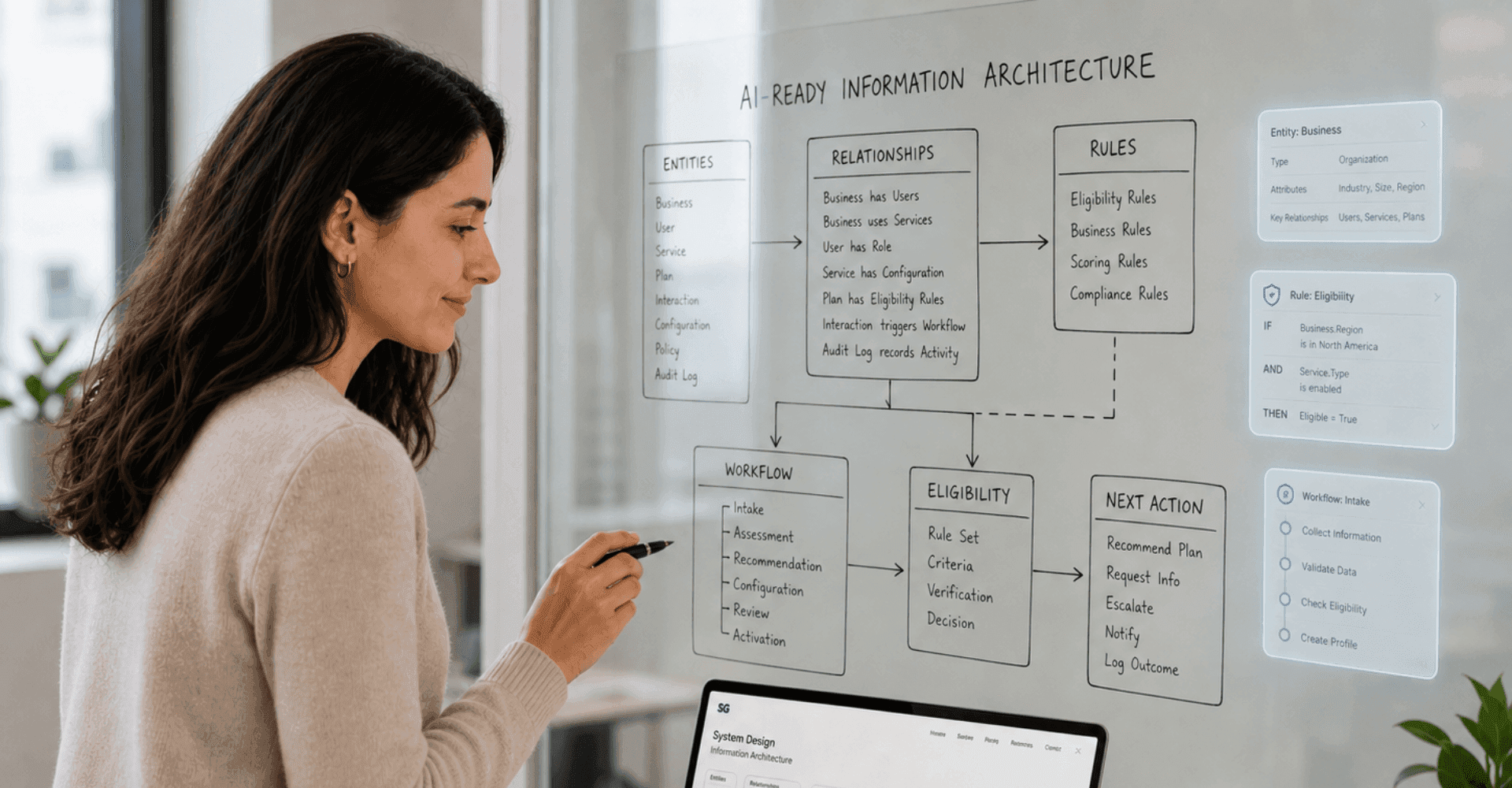
What UXA brings forward is what traditional UX never had to make explicit:
- Entities defined clearly, not just described across pages.
For example, instead of a service being explained through multiple sections, its key attributes, scope, and pricing are defined in a structured way. - Relationships made explicit, not implied.
What a service includes, who it is for, and what it depends on are clearly connected, instead of being scattered across the site. - Business rules written down, not embedded in flows.
Pricing conditions, eligibility criteria, or limitations are defined directly, instead of only becoming visible during a form or checkout process. - Workflows understood as processes, not just sequences of screens.
The logic behind a signup or request is clear without having to navigate the entire experience.
The real shift is that what used to be implicit now needs to be made explicit.
From interpretation to execution
Understanding what is on a website is only the first step. Acting on it is the next.
Designing for execution means making sure that what your site communicates is not only understandable, but also usable in practice.
Instead of relying on someone to interpret a page and decide what to do next, the site makes the underlying logic clear: what is being offered, under what conditions, and what should happen in each case.
When that information is not clearly defined, an AI system has to infer it, just like in the hotel and the wine examples. And when interpretation is required, outcomes become inconsistent.
This does not remove human judgment. It ensures that execution does not depend on it at every step.
What this looks like in practice
This shift is already visible in how websites are used.
In some cases, search no longer sends users to pages, it returns an answer directly. In others, recommendation systems skip the comparison step and present a decision. Even onboarding flows are starting to shrink, because systems fill in information that used to require user input.
Across all of these cases, one pattern repeats:
The quality of the result depends on how clearly the underlying information is defined.
When it is not:
- outputs become inconsistent
- automation requires oversight
- efficiency gains are lost
How should you prepare your website for AI systems?

Addressing this shift does not require rebuilding your website from scratch. It starts with asking better questions.
- Which parts of your site only make sense if someone is looking at the screen?
- Where do decisions rely on interpretation instead of clearly defined rules?
- Which pieces of information are scattered across pages instead of structured in one place?
- Could your site be understood without its interface?
From there, the first changes are usually straightforward. Business logic becomes explicit instead of implicit. Rules are centralized instead of distributed across flows. Workflows are treated as processes, not just navigation paths.
None of this makes the system simpler. It makes it readable by AI.
A broader definition of experience
Interfaces are not going away. What is changing is not the interface itself, but where the experience is defined.
As AI systems become part of how a website is discovered, evaluated, and used, the experience extends beyond what is visible. It includes how information is defined, how it is structured, and how actions are executed without direct interaction.
This shift also changes the experience for people. Users now arrive with the expectation that what they need is already there, not something they have to piece together across multiple pages. When key information is not clearly defined, the result is friction, even if the interface itself looks well designed.
The companies that move fastest here will not be the ones with the most polished interfaces. They will be the ones whose websites are easier to read, easier to trust, and easier to operate, both for people and for the systems acting on their behalf.
If AI is becoming part of how your business operates, the question is not only which tools to adopt, but whether your systems provide the information and logic those tools depend on.
That is where most companies run into friction.
At Making Sense, we work with teams to identify those gaps and redesign how information is structured, so systems can operate on that information reliably.
If you are starting to see these challenges in your organization, we can help you assess where to focus first. Let’s talk about where to start.
May 5, 2026