

The Hidden Cost of Not Showing Up in AI Search Results
Your SEO metrics look fine. But a growing share of demand is being resolved before users ever reach your site. Here’s what that’s costing you.

Apr 23, 2026
Picture a fairly ordinary moment: someone needs to make a decision and looks for guidance. They open ChatGPT, type a question in plain language, and get a structured answer back in seconds. Maybe it names a specific solution. Maybe it describes what to look for and one option fits the description almost exactly. Either way, the decision is already taking shape, and no website visit happened.
This is not an edge case. ChatGPT crossed 900 million weekly active users in February 2026, more than double the figure from a year earlier, and continues to grow rapidly. At the same time, the way people are using these tools, researching products, comparing vendors, and evaluating services before making contact, mirrors the behaviors that mid-market companies have always relied on to fill the top of their funnel.
The uncomfortable part is that none of this shows up as a loss in your analytics. Traffic can hold steady, rankings can stay where they are. But a portion of the demand that would have found you is quietly getting resolved somewhere else.
The shift that doesn’t appear in your dashboard

For two decades, digital visibility largely meant one thing: your position in a list of links, whether earned through SEO or paid placement. Search engine optimization was, at its core, about earning a high enough rank that users would choose your result over the others. The assumption was simple: users search, see options, click, and land on your site, where you have a chance to influence the decision.
That assumption still holds for a meaningful share of queries. But a new layer has formed on top of it. Google now uses AI to generate direct answers at the top of the page, often reducing the need to click through multiple results.
Beyond that, tools like ChatGPT and Perplexity take a step further: instead of presenting a list of links, they generate a synthesized answer built from selected sources, one that often feels complete enough to act on.
AI Overviews have already reduced click-through rates for top-ranking Google content by 58%. That number applies to content that is ranking well, content that theoretically won the SEO game. The issue is no longer just where you rank, but whether your content is included in the answer at all, shifting the challenge from positioning to participation.
This is the distinction between SEO, AEO (Answer Engine Optimization), and GEO (Generative Engine Optimization). They’re not competing philosophies. They operate on different surfaces. SEO is still necessary. But it now shares the stage with a layer where your content either gets cited or it doesn’t, and there’s no ranking to show for it either way.
The funnel didn’t break. It moved upstream.
From a business perspective, this is no longer just about missing a trend. The point where customers form an initial preference has shifted, and many digital strategies have not caught up with it yet.
The traditional model assumed that users arrived at your site still evaluating their options. They had a need, they had done some browsing, and you had a full page, a clear value proposition, and a conversion path to work with. What’s changing is that a growing share of those users now arrive having already encountered an explanation of the problem. An AI answered their initial question and, in doing so, named certain types of solutions, certain characteristics to look for, occasionally certain brands. By the time they reach your site, if they reach it at all, part of the decision has already been made.
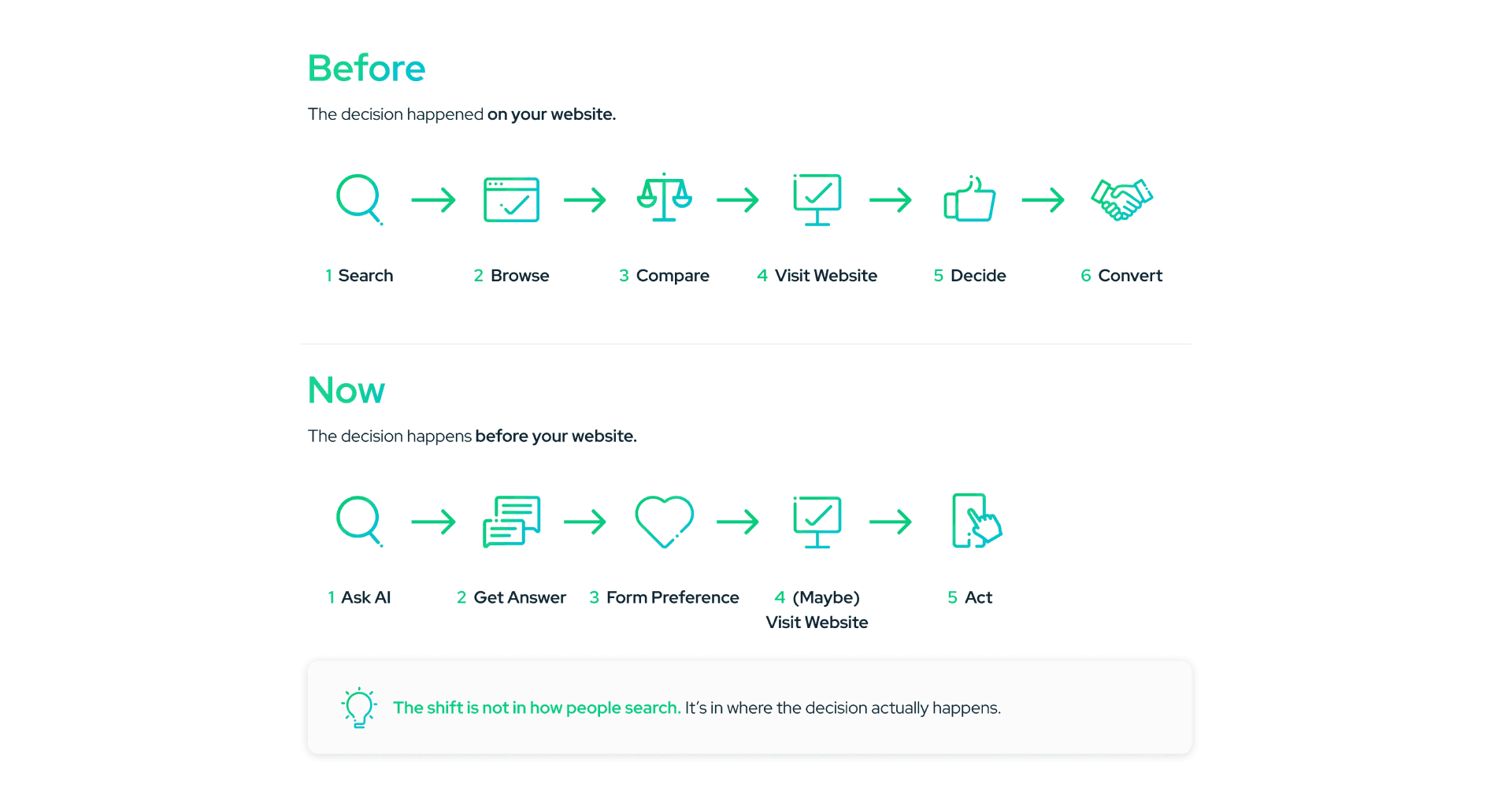
For companies selling to other businesses, this pattern is especially relevant. Forrester reports that 89% of B2B buyers have adopted generative AI as a key source of self-guided information throughout their purchasing journey. The research phase, where you used to compete for attention through content marketing and SEO, is increasingly happening in environments where you either have a presence or you don’t. There’s no organic middle ground.
The downstream effects are real, even when they’re hard to attribute. Over time, they start to show up in core business metrics:
- Conversion rates from organic traffic may decline as users arrive with more defined expectations.
- Sales cycles can lengthen when prospects come in with a view of the market that doesn’t include your positioning.
- Paid acquisition costs tend to rise as companies try to replace the organic visibility they’re no longer capturing.
None of these signals clearly point to an AEO problem. But that doesn’t mean it isn’t one.
Who gets cited, and why it isn’t random

The natural question at this point is what actually determines whether a brand appears in AI-generated answers. The answer is less mysterious than it might seem.
Large language models (LLM’s) are trained to prioritize sources that are authoritative, clear, and easy to extract meaning from. When they generate a response, they’re looking for content that directly addresses the question, is structured in a way that allows relevant passages to be identified, and comes from a source with external credibility signals backing it up. A well-designed homepage, on its own, is rarely enough in this context. Content that clearly explains what a product does, the problem it solves, and who it’s for is far more likely to be used in these answers. For example, a page that directly answers a question like “how can I get my pet’s medication delivered?” is easier for an AI system to incorporate than one that only describes features or company messaging.
A few factors consistently improve citability across industries:
- Direct answers to real questions. Content organized around how people actually phrase problems, not just around product categories or service names.
- Explicit structure. Headers that label information clearly, definitions that don’t assume prior knowledge, summaries that make the core argument extractable without reading the full page.
- Original data or proprietary perspective. LLMs heavily favor content that contains original statistics, proprietary research, or unique datasets. Generic content that restates industry consensus is rarely cited.
- External consistency. What your site says needs to be corroborated by what third parties say about you. Reviews, media mentions, partnerships, and case studies all contribute to the trust signals that AI systems use to evaluate source reliability.
In one industry snapshot, 26% of brands had zero mentions in AI Overviews. The brands that do appear tend to appear repeatedly, reinforcing their position each time. This is not a level playing field, and it is becoming less level as early movers build up citation history.
What the gap is actually costing
The business cost of not being included in AI-driven results is not a hypothetical. It shows up in real operating metrics, just not always where companies think to look.
Consider what happens when a competitor’s platform gets consistently cited in answers to questions about your category. Their name gets associated with the solution before any direct comparison happens. Users who engage with that answer arrive with a point of view already shaped, often one that doesn’t include your brand. That’s not impossible to overcome, but it adds friction at every subsequent touchpoint.
A 2025 analysis by TNG Shopper shows that early AEO adopters are already capturing 3.4x more traffic from AI search compared to those relying on organic SEO alone. The gap between those companies and the ones that haven’t adapted is not dramatic yet in most mid-market verticals. But gaps that start small tend to compound. The brands establishing citation authority now are doing so at a time when competition for those positions is still relatively limited.
Paid acquisition is the most visible pressure point. When organic and AI-referred traffic underperforms, the default response is to increase spend. That can sustain pipeline in the short term, but it doesn’t solve the underlying problem: that a portion of demand is being shaped before it reaches any paid or owned surface. Spending more on bottom-of-funnel activity doesn’t recover top-of-funnel influence.
Why structure matters more than volume
Most mid-market businesses with a serious digital presence have invested in content for years. The issue is not a lack of information, but how it’s structured and how easy it is to actually use.
This shows up in subtle ways. A site can have strong product pages, a compelling homepage, and a library of content, and still miss the moment if none of it directly answers the kinds of questions users are now asking.
That gap is not just about content. It’s a cross-functional challenge that spans content strategy, information architecture, technical implementation, and how the brand shows up across external sources, requiring coordination across engineering, product, and other teams involved in shaping that presence.
Where to start
This isn’t about rebuilding everything, but about getting a clearer view of where the gaps are.

A simple way to start is to look at four areas:
- Query coverage. Identify the specific questions your target customers are asking AI tools about your category. These often differ significantly from the keyword sets your SEO strategy is built around.
- Extractability. Review your highest-value pages and ask whether they answer real questions directly, or whether they describe your offering without ever fully addressing the “why you” question.
- Proprietary content. Identify expertise, data, or perspectives your company holds that aren’t currently published as citable content. Internal benchmarks, operational insights, and category-specific experience are all candidates.
- External signal consistency. Audit what third parties say about your brand across media, review platforms, and industry references. AI systems cross-reference this heavily when evaluating source authority.
None of this calls for a large initial investment, but it does mean taking a clear-eyed look at what your digital presence is actually doing at a layer of the funnel that most measurement systems still don’t track well.
The question that’s worth asking now
SEO is not going away. The rankings your team has worked to build still matter, and they’re not irrelevant to AI visibility either, many of the authority signals that feed traditional search rankings also influence which sources AI systems trust. But SEO operating alone, without a parallel strategy for how your content performs inside AI-generated answers, leaves a growing portion of demand unaddressed.
The question worth sitting with is straightforward: when a potential customer asks an AI about the problem your company solves, do you appear in the answer? And if you do, what happens next when they arrive?
Because visibility is only part of the equation. The experience that follows determines whether that opportunity turns into a result.
For mid-market companies with real digital presence and competitive pressure, this is the kind of gap that’s much easier to close early than to recover from after competitors have established the ground. The window to move first in most verticals is still open. It won’t stay that way indefinitely.
If you want to understand where your company stands and what it would take to close the gap, let’s talk. A focused conversation is usually enough to identify where the real leverage is.
Apr 23, 2026