

The Automation Ladder: A CFO’s Framework for Scaling AI Without Losing Control
Each step, from preparing information to executing within a workflow, changes the level of financial risk. For CFOs, the challenge is deciding how much autonomy to grant, what evidence to require, and when the business is ready to move further.

Jun 23, 2026
Once the value case is clear, the next question is how much autonomy the business can justify giving AI. That is where the automation ladder becomes useful. I use the term to describe a staged approach to AI automation, where a system moves from preparing information, to recommending actions, to executing within defined limits only after it has earned that level of responsibility.
For CFOs, this distinction matters because autonomy has a price. Each level changes the risk profile, the control requirements, and the evidence needed to justify further investment.
In my previous article, “How to Build an AI Business Case Your CFO Will Actually Approve,” we looked at the financial questions every AI initiative should answer before receiving budget approval: what decision are we improving, how will we measure impact, what happens if it fails, and who is accountable for the result?
This article looks at the next layer of that conversation: how to scale AI automation without losing financial control.
The automation ladder
The value of the ladder is that it makes autonomy easier to discuss. Instead of treating AI automation as one broad category, it helps separate automation into levels, so the organization can decide what the system should prepare, recommend, or execute, and what evidence is needed before its role expands.
That distinction matters because many AI proposals describe the destination before they explain the first step: faster approvals, lower operating costs, fewer manual exceptions, better use of working capital, and less time spent reconciling information across systems.
But the financial question is whether the organization has a measurable path for getting there.
Companies don’t need to choose between manual work forever and full automation tomorrow because there are levels in between, and those levels are where a good implementation creates confidence. In fact, there are four stages: manual, assisted, semi-automated, and automated within defined limits.
Level 0: manual
At Level 0, the process is fully manual. That works when the people involved are capable, but the process is slow, inconsistent, and difficult to audit.
Accounts receivable is a useful example because the same process can move through each level of the ladder. At Level 0, someone reviews aging, customer history, disputes, payment behavior, and internal notes before deciding which overdue accounts need attention first. The process is familiar, but it creates decision latency and makes it hard to know whether delays come from lack of information, lack of ownership, or lack of capacity.
The issue at Level 0 is visibility. When the work depends on manual context-gathering and individual judgment, it becomes harder to measure delays, compare decisions, identify bottlenecks, or know what should improve first.
Level 1: assisted
At Level 1, the system prepares and the human decides.
In the same accounts receivable process, an AI assistant could identify past-due accounts, summarize customer history, flag recent disputes, and recommend which accounts deserve attention first. The collections manager still decides what action to take.

Level 1 is usually the best place to start when a company is moving from manual work to AI-supported automation. At this stage, AI prepares the work, but a person still decides. This is often described as a human-in-the-loop approach: the system gathers context, consolidates evidence, identifies patterns, and proposes a next step, while the person remains accountable for approval, rejection, or adjustment.
It also starts building the evidence needed for the next conversation: how accurate were the recommendations, how much time did they save, which exceptions required correction, and where did the system struggle?
At this level, the goal is not full automation. It is measurable assistance.
Level 2: semi-automated
At Level 2, the system moves from preparing information to preparing actions for approval.
Using the same accounts receivable example, it might draft the follow-up sequence, assign priority, prepare account notes, and queue the action for review. The human still approves the work, but no longer assembles it from scratch.
Level 2 can create more operational leverage because AI is no longer only helping people understand the work. It is preparing the work for review, which can reduce manual preparation, coordination, and rework. But because the recommendation is now closer to execution, the controls need to be stronger: approval rules, exception thresholds, audit trails, and escalation paths.

This is also where the metrics should become more concrete. I would expect the business to track approval cycle time, cost per resolved exception, reduction in manual preparation hours, DSO, error rate, rework, or capacity gained without additional headcount.
If those metrics are not being tracked, the company may be increasing speed without building the evidence needed to justify the next level.
Level 3: automated
At Level 3, the system executes within defined limits.
This is the level many people imagine when they hear the word automation, and it should require the most evidence before approval.
A Level 3 process only makes sense after the organization has enough proof that the output can be trusted, measured, audited, and stopped when needed. Execution should be limited by clear boundaries, such as dollar thresholds, risk scores, customer segments, policy conditions, or exception types.

It also needs operating controls: audit trails, sampling reviews, circuit breakers, and escalation paths. Without them, a process can be autonomous and still poorly governed, or it can move faster and still create downstream cost if the business cannot explain, reverse, or audit what happened.
Level 3 is valuable when the controls rise with the autonomy.
The simplest way to read the ladder is this:
| Level | System role | Human role | Main question |
| Level 0: Manual | No active role. Work depends on people, spreadsheets, and informal judgment. | Owns the full process. | Where are delays, hidden costs, or inconsistencies showing up? |
| Level 1: Assisted | Prepares context and recommends a next step. | Decides and remains accountable. | Did better information improve speed or decision quality? |
| Level 2: Semi-automated | Prepares actions for approval. | Reviews, approves, and handles exceptions. | Are the prepared actions accurate, useful, and auditable? |
| Level 3: Automated | Executes within defined limits. | Sets thresholds, monitors outcomes, and owns business impact. | Can execution be trusted, measured, audited, and stopped when needed? |
What should move up the ladder first?
Not every process is a good candidate for automation, and not every good candidate should move at the same speed.
Before funding an AI automation initiative, I would look for four characteristics:
- High frequency. The process should happen often enough for the business to learn quickly. Daily or weekly processes are usually better candidates because the feedback loop is shorter and the ROI accumulates faster.
- High impact. The process should affect cash, margin, customer retention, risk, or operating capacity. Automating a low-value task may be useful, but it will not justify much executive attention unless it connects to a larger operational bottleneck.
- Reversibility. Early automation should favor actions that can be corrected without major damage. This reduces the risk of starting and gives the organization room to learn.
- Clear evidence. The system should be able to explain its recommendation using data the company already has. If the recommendation depends on unclear assumptions, missing context, or information no one can validate, the process is not ready to move very far up the ladder.
The first automation opportunity should be the one where the organization can learn the fastest with the least unnecessary risk.
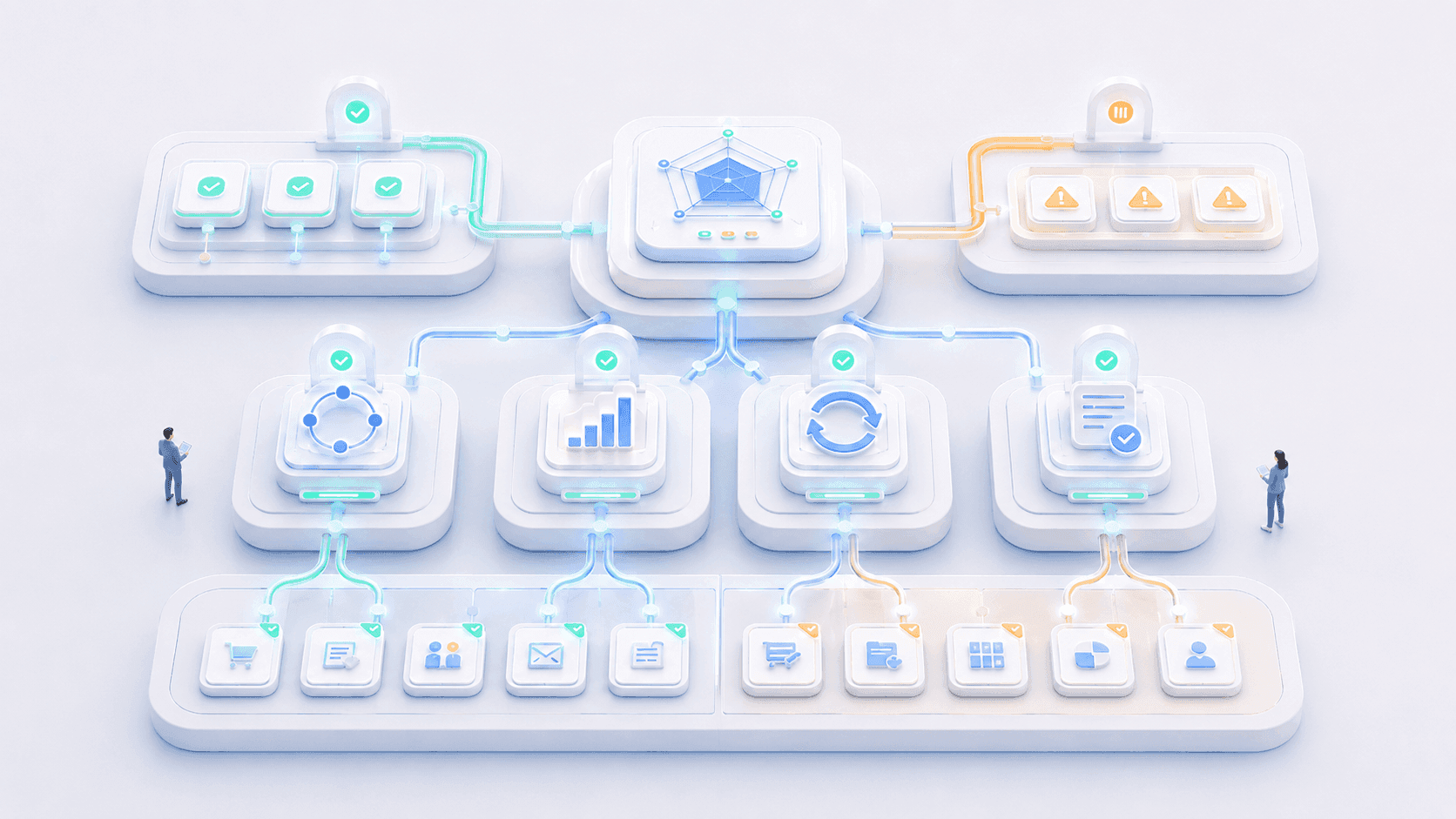
Some examples are more likely to fit that profile than others:
| Process | Why it works | Likely starting level |
| Collections and accounts receivable | Frequent, tied to cash, and supported by aging and customer history. | Level 1 to 2 |
| Vendor payment proposals | Structured, repeatable, and connected to treasury capacity. | Level 2 |
| Order exception resolution | Cross-functional, evidence-based, and often slowed by handoffs. | Level 1 to 2 |
| Weekly KPI briefings | Recurring reporting work with clear inputs and visible executive value. | Level 1 |
| Scope change classification | Useful in services businesses where classification affects billing and disputes. | Level 1 to 2 |
What these areas have in common is the nature of the process: the work is recurring, the business impact is visible, and the recommendation can usually be supported with evidence.
The financial logic of progressive automation
I see the automation ladder as a practical way to turn a vague investment into a sequence of measurable decisions. At each level, the business should be able to answer what work moved from people to the system, what decision still belongs to a human, what metric improved, and what evidence would justify moving forward.
For CFOs, that makes the budget conversation more practical. The question is no longer only “What will the full implementation cost?” It becomes “What should we fund now, what return should this stage produce, and what proof do we need before expanding autonomy?”
Accountability has to follow the same logic:
- At Level 1, the system prepares and the human decides.
- At Level 2, the human approves prepared actions.
- At Level 3, the system may execute within limits, but the business still owns the outcome.
That is why every automation initiative needs a business owner, not just a technical owner. The technical team can answer whether the system works, but is the business owner the one that has to answer whether it is improving the right metric, within the right risk limits, for the right reason.
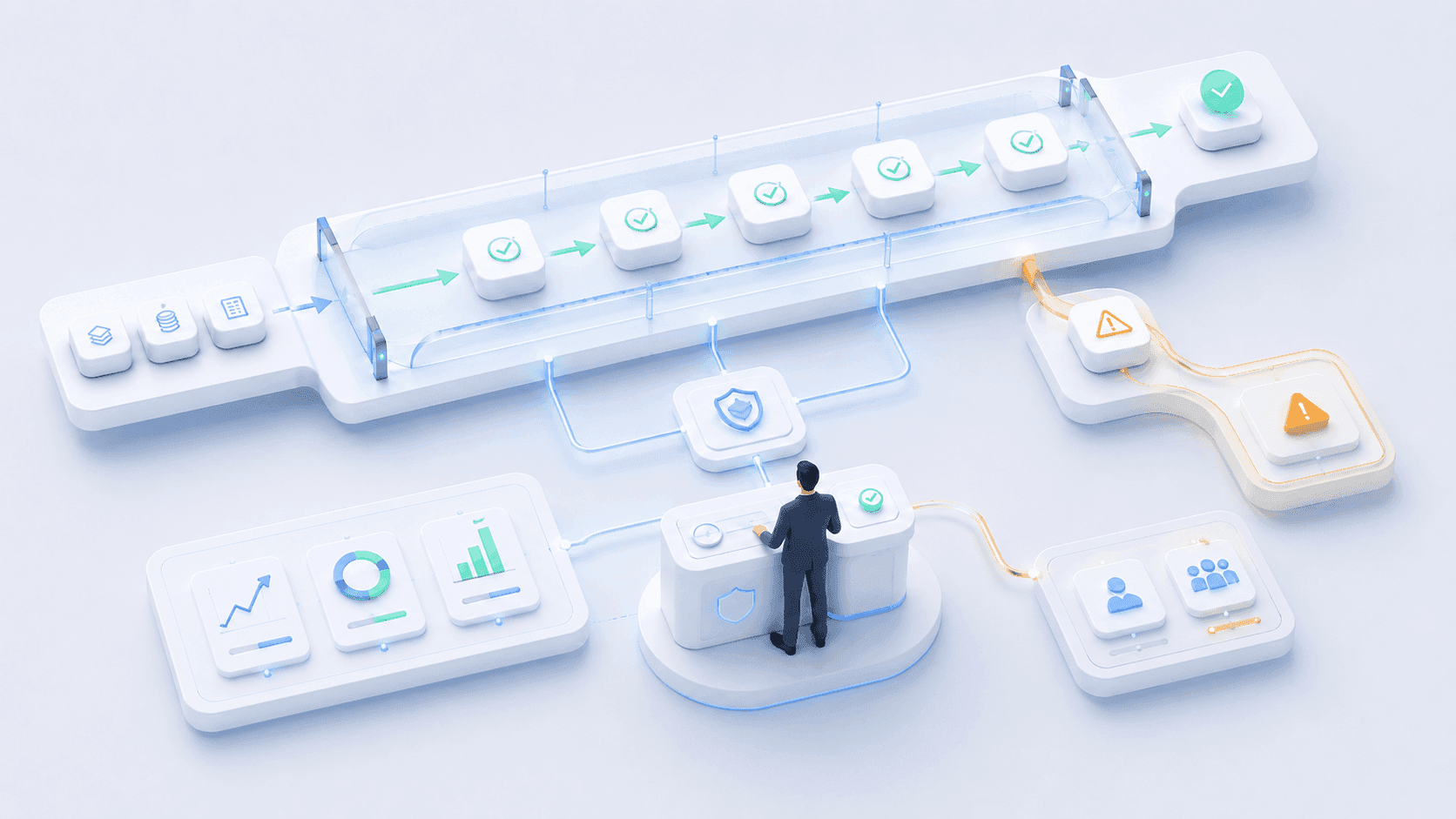
If an AI system prioritizes accounts receivable, who owns the time it takes the business to collect payment? If it routes exceptions, who owns resolution time and customer impact? These questions determine whether automation is operationally real, or just another workflow with unclear ownership.
Before moving up a level, I would reduce the decision to one question: what evidence justifies giving this workflow more autonomy? If the answer is unclear, the project may still be valuable, but it is probably not ready for more autonomy.
As autonomy increases, accountability has to become more explicit, not less.
When to move up the ladder
Once the business case is clear, the organization still needs to decide how autonomy will be introduced.
If the process is manual today, the next step is usually not full automation. It is assisted work, measurable improvement, better evidence, and then a decision about whether the system has earned more responsibility.
That may sound less dramatic than the way AI is often sold, but it is how durable value is usually created.
AI automation should scale, yes, but it should scale with financial control, operational visibility, and accountability that becomes stronger at every level.
For any organization starting this work, the first question should be: what is the next decision we can improve, and what evidence would prove that it worked?
At Making Sense, we help organizations design and implement AI solutions that align autonomy with business objectives, governance, and financial accountability. If you're exploring how to move from experimentation to scalable operational value, let's start the conversation.
Jun 23, 2026