

Decision Latency Is the Next Frontier of AI Value
AI already accelerated the analytical side of the workflow. Many organizations are now discovering that the delay often starts after the recommendation appears.

May 21, 2026
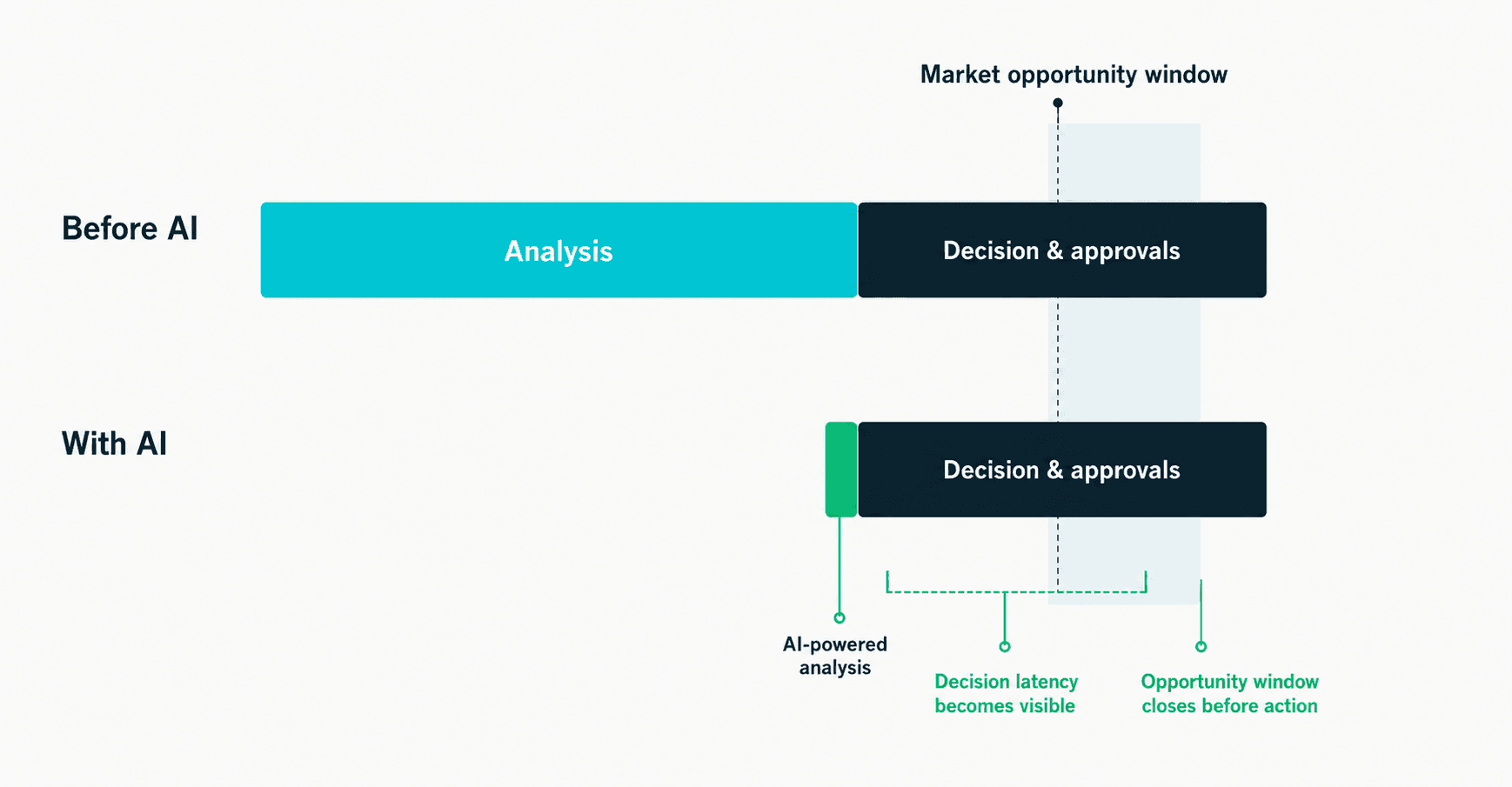
A pricing recommendation is generated Tuesday morning. The model identifies a short-term opportunity: increase prices on a group of products for the next 48 hours while demand is high and competitors are out of stock. The recommendation moves through finance, revenue operations, and regional approvals. The final sign-off arrives the following Tuesday. By then, the opportunity is gone.
This is the kind of gap more companies are starting to notice as AI becomes part of daily operations. Not because approvals suddenly became slower, but because the analytical work before the decision became dramatically faster. That gap between “the insight is ready” and “the action actually happens” is what many teams are starting to call decision latency.
The important part is that decision latency is not new. Approval flows, reviews, and cross-functional sign-offs have always existed inside companies. For years, they felt normal because the analytical work upstream also took time. A five-day approval process inside a three-week market analysis did not feel unreasonable, and AI changed that equation.
The first wave of AI value already came from compressing the analytical layer. Teams spend less time gathering information and more time focusing on higher-value work. That alone is already a meaningful operational win. But once analysis gets dramatically faster, something else becomes visible: the organization is often still making decisions at pre-AI speed.
Not every decision should move faster
The problem is not that every decision should happen instantly. Some decisions deserve long review cycles. Budget reallocations, vendor negotiations, compliance reviews, and major strategic changes often require careful validation.
What AI is creating, though, is a new category of situations where the value of a decision can decay inside a normal approval window. That is what makes decision latency economically important.
That dynamic connects closely to something Cesar DOnofrio, our CEO, wrote earlier this year about AI and legacy infrastructure: AI does not fix a broken operating model. It exposes one. And if you're willing to look honestly at what it's revealing, that's actually an opportunity, but only if you respond with real redesign rather than another layer of workarounds.
The same thing is now happening around decision-making. Many organizations are discovering that the surrounding operational structure did not evolve at the same pace as the analytical systems themselves.
Where decision latency starts affecting results
Not every delayed decision creates meaningful business impact. Some workflows can move slowly without creating major consequences. If a vendor contract takes a few extra weeks to negotiate, the outcome may not change much.
But AI is increasingly generating recommendations whose value depends heavily on timing. In those environments, delays that once felt operationally acceptable can now reduce how much value the organization captures from the recommendation.
Some of the clearest examples are starting to appear in industries where AI systems are already influencing operational decisions in real time.
Healthcare and veterinary triage
AI systems can now identify urgent cases faster than traditional first-come-first-served workflows. In veterinary telemedicine, for example, a system may detect that a prescription refill request or symptom intake requires faster attention than other routine requests.
Many operational structures in healthcare and veterinary environments were designed around manual queues, where urgency was identified gradually by humans reviewing requests one by one.
That creates a new operational challenge. When the system identifies a high-priority case immediately but the requests still move through the same review queues and approval process as before.

In that environment, the delay is no longer just a process inefficiency. It can directly affect patient outcomes, clinician workload, operational efficiency, and customer experience.
Fraud and credit review in fintech
Fraud review existed long before AI, but many older systems relied mostly on hard rules: blocked geographies, suspicious transaction sizes, known fraud patterns, or predefined thresholds.
Modern models now surface a different category of cases: transactions that look statistically unusual without clearly violating a rule. The signal is more nuanced, but the timing becomes more important.
If the analyst reviews the case six hours later, the transaction may already have been completed or blocked unnecessarily. One outcome creates financial loss. The other creates friction for legitimate customers.
In many cases, the model is identifying the signal much earlier than before. The real shift is that the surrounding operational process was not redesigned for a world where those signals arrive continuously and require faster prioritization, escalation, or response.
Decision latency usually appears in different ways
Companies tend to encounter decision latency through a few recurring operational patterns. These situations may look similar from a distance, but they usually come from different underlying problems.
Approval latency
In some workflows, the recommendation is already clear and the model confidence is high, but the process still depends on multiple layers of review before action can happen.
This becomes especially visible when the people approving the decision were not directly involved in the analytical process and need additional context before feeling comfortable signing off. The faster the system produces recommendations, the more noticeable these approval layers become.

In many organizations, those structures were originally designed to reduce risk in slower-moving operational environments. They now sit on top of workflows that may be generating recommendations continuously instead of weekly or quarterly.
Exception latency
Many AI systems handle standard cases effectively. The friction usually appears around exceptions: ambiguous inputs, unusual customers, incomplete information, or situations where the model confidence drops below a threshold.
Those cases get routed to human review, and over time those queues can become a bottleneck of their own if the workflow was never redesigned for continuous AI-generated escalations. This is also closely connected to what we explored in our article The cost of decision friction and exceptions: when exception handling is not intentionally designed into the workflow, the bottleneck often just relocates instead of disappearing.
Coordination latency
In these situations, the issue is often less about technology and more about how decisions are structured operationally. Finance may optimize for risk, operations for efficiency, and commercial teams for revenue growth, which means even relatively small decisions can require alignment across multiple groups before action happens.
Faster systems place pressure on coordination processes that were originally designed for slower operational environments.
In many cases, reducing that friction depends on redesigning how decisions move across teams. For example, instead of requiring approval from finance, operations, and commercial leadership for every pricing adjustment, organizations may define pre-approved execution ranges where smaller changes can happen automatically while only higher-risk situations require escalation.
The goal is to keep oversight where it matters, while reducing the coordination required for decisions that no longer carry the same operational risk they once did.
Why leadership teams are starting to pay attention to decision latency
For many companies, the first phase of AI adoption already delivered real operational value. Teams reduced manual analysis, accelerated reporting cycles, improved forecasting speed, and automated repetitive work that previously consumed large amounts of time. What leadership teams are starting to notice is that generating insights faster does not automatically mean the business responds faster.
This is how decision latency affects outcomes: a company may technically have real-time forecasting capabilities while inventory decisions still happen weekly. A fraud model may identify suspicious activity instantly while review capacity continues operating in batches. A support organization may detect urgent cases immediately but still route them through the same queue structure that existed before AI became part of the workflow.
That gap becomes difficult to ignore eventually, because the organization can clearly see that the insight arrived earlier, but the surrounding operational process did not change at the same pace.
The deeper question is that AI accelerated the production of insight much faster than many companies redesigned the workflows, approvals, and coordination structures around it. This is also what a recent MIT Sloan Management Review study, The Emerging Agentic Enterprise, found across organizations adopting agentic AI: capability is spreading faster than leaders can redesign processes, assign decision rights, and put governance in place.
That is why decision latency is increasingly becoming a leadership concern. Once organizations improve the analytical layer, the next constraint often becomes the speed at which the business itself can respond.
How decision latency becomes measurable
For years, most companies never measured the time between “the insight is ready” and “the action actually happens” because, if analysis itself already took days or weeks, it was difficult to isolate how much time came from approvals, coordination, or queue management. The entire process simply felt slow as a whole. AI changes that dynamic.
Now the delay becomes easier to isolate operationally because the analytical layer is no longer consuming most of the cycle. That is why many companies are starting to look more closely at workflows that made sense when analysis itself moved more slowly.
Measuring decision latency is often less complicated than it sounds. Most organizations already have the necessary operational data inside approval systems, workflow tools, ticketing platforms, or timestamps. The harder part is defining the workflow clearly enough to understand where time accumulates between recommendation and action.
The next layer of AI value is starting to happen after the insight
As organizations become more comfortable integrating AI into operational workflows, many are starting to use AI not only to generate insights, but also to support the decision process around those outputs. That often means helping teams navigate context, urgency, prioritization, and escalation more efficiently once a recommendation already exists.
One emerging pattern is pre-decision context assembly. Rather than simply surfacing an alert or recommendation, the system also prepares supporting evidence, historical comparisons, likely objections, alternative scenarios, or operational context before the decision reaches a reviewer.
Another pattern is prioritization. In many operational environments, the constraint is no longer lack of information, but understanding which decisions require attention first. AI systems can help identify which opportunities expire fastest, which cases create the highest operational risk, or which situations genuinely require escalation instead of treating every item in the queue equally.
None of this removes human judgment from the workflow. If anything, it reflects the opposite trend: as organizations generate more insights more frequently, helping humans navigate decisions efficiently becomes increasingly important operationally.
Closing the gap between insight and action
For years, most organizations focused on improving how quickly they could generate information. AI accelerated that shift dramatically, allowing companies to analyze patterns, identify risks, surface opportunities, and produce recommendations much faster than before.
Now a different question is starting to emerge inside many operational environments: once the insight already exists, how quickly can the organization actually respond to it? That question is becoming more important as AI systems move closer to real-time operations.
The faster companies generate recommendations, signals, and opportunities, the more visible the surrounding approval structures, coordination loops, and operational response times become.
For many mid-market companies, the next layer of AI value may depend less on producing more insight and more on reducing the distance between knowing what to do and actually doing it.
If that gap is starting to become visible inside your workflows, we'd be glad to talk about what reducing it can look like operationally.
May 21, 2026