
Why Structured AI Workflows Outperform ChatGPT for Business Automation
A PE firm asked us how our AI solutions differ from just prompting ChatGPT. Here’s the answer, and why it matters for any company serious about scaling automation.

May 11, 2026
A few weeks ago, I was presenting one of our AI automation solutions to a private equity firm: a platform that screens investment proposals against user-defined criteria, extracts KPIs, and interprets qualitative information to surface deeper insights, delivering an approve/reject recommendation with full argumentative reasoning. The whole process takes seconds. The old version took analysts hours of reading and manual scoring.
They liked what they saw. But the first question they asked was the one we hear most often from executives who already use AI tools daily: "How is this different from just using ChatGPT?"
It’s a fair question. And the honest answer starts with a concession.
Yes, you can do this with ChatGPT
You can absolutely get answers with ChatGPT, Claude, or Gemini. You feed them data, write a prompt, and get a result. It works. I say that openly because pretending otherwise would be dishonest, and because the real issue is a different one entirely.
The gap between "works" and "works reliably at scale, with consistency, at a predictable cost, and in a way your CFO or auditor can actually verify" is enormous. That gap is where most AI automation efforts stall.
A Futurum Group survey of 830 IT decision-makers published in early 2026 captured this shift clearly: enterprises are moving away from measuring AI by productivity gains and toward measuring it by direct P&L impact. Productivity as the top success metric dropped nearly six percentage points year over year, while financial outcomes like revenue growth and margin improvement almost doubled in priority.
That changes the question. "Can I do this with ChatGPT?" becomes "Can I trust this in production, at volume, across my team, and prove what it’s doing?"
What an agentic workflow actually looks like
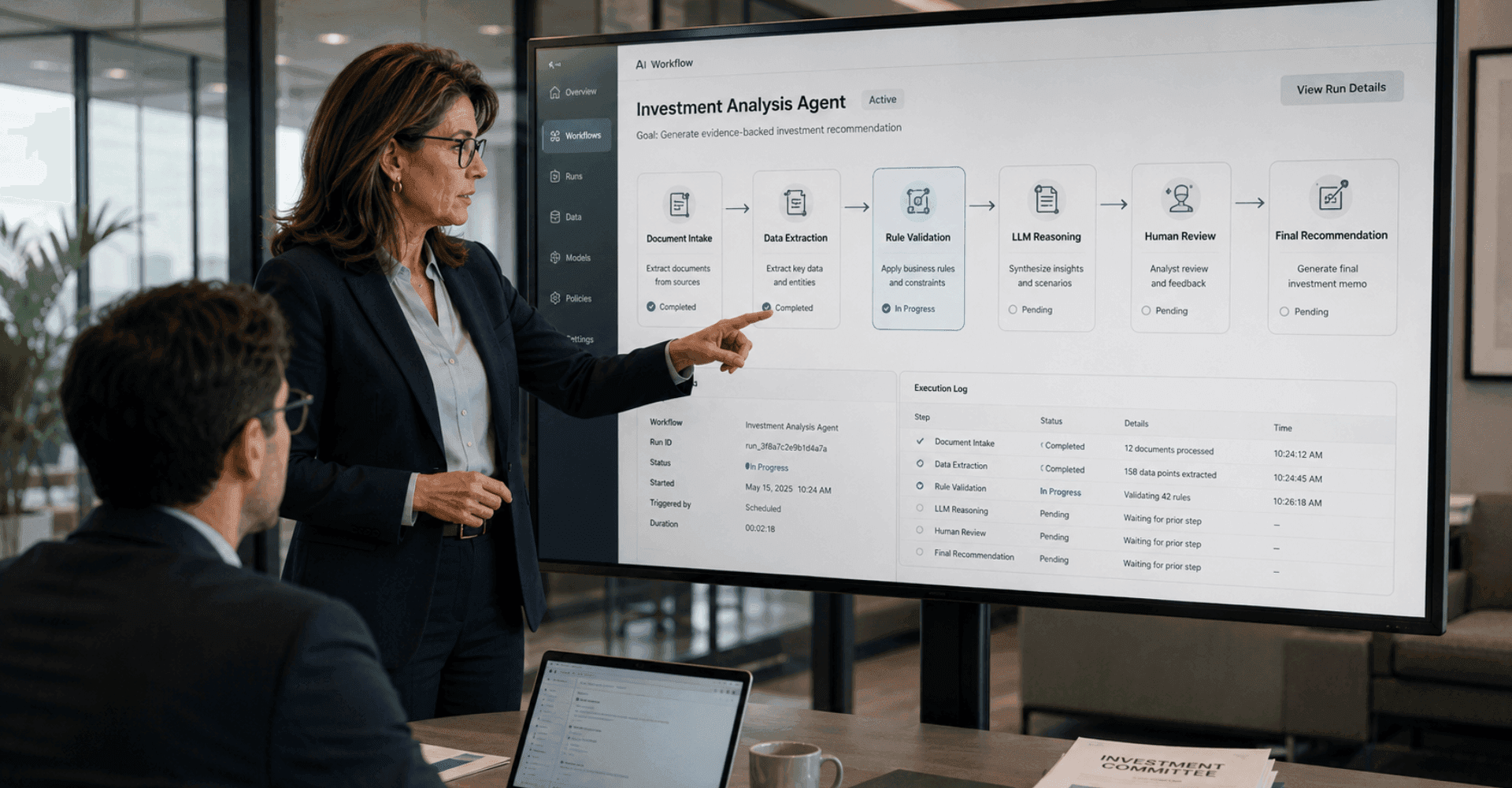
When you use ChatGPT for a business task, the model reasons through the entire problem from scratch every time. You send input, you get output, and everything in between is opaque. If something goes wrong, there’s no way to pinpoint where or why.
We build what are called agentic workflows, using frameworks like LangChain and LangGraph. The structure is simple: individual nodes, each with a specific job, connected by explicit logic. One node picks up a document. Another extracts data from it. A third validates that data against a set of rules. A fourth routes it somewhere. Most of these steps run on pure deterministic logic: conditions, criteria checks, data transformations. The language model only comes in when the task genuinely requires reasoning or interpretation of something unstructured.
ChatGPT vs. Agentic Workflows
Two approaches to the same task. Tap to compare how each one processes a business document.
That’s the key distinction. The LLM is one component in the chain, not the whole system. And because each step is separate and visible, you can troubleshoot, improve, or replace any piece independently.
Because the LLM is one component rather than the entire system, swapping providers is a configuration change, not a rebuild. If GPT-5 stops fitting the use case (or your security team decides it should) you replace that node with Claude, Gemini, or a self-hosted model without touching the rest of the workflow. With a pure ChatGPT-based automation, that same swap means rewriting everything.Say you're processing 1,000 invoices per month. 950 fit standard criteria: the fields match, the vendor is recognized, the amounts align with existing purchase orders. All of that gets handled by fixed rules, the kind of if/then logic that always produces the same result for the same input, no AI involved. In our workflows, the LLM only runs on the 50 edge cases: a line item that's ambiguous, a new vendor that needs to be categorized, an amount that falls outside expected ranges. That's a 95% reduction in AI compute compared to prompting ChatGPT for every single invoice, and the 950 standard invoices produce identical results every time, with no variability.
That reduction matters most on the AI cost side. Even if an employee could upload all 1,000 invoices to ChatGPT in a single batch, the model would still process every document in full and charge for the tokens used on each one, whether the invoice was routine or genuinely complex. With a structured workflow, the LLM only handles the 50 cases that require heavy reasoning. The other 950 still pass through LLM-powered nodes where needed, but for simple, lightweight tasks, keeping costs to pennies per document, flat as volume grows. At scale, that gap becomes a meaningful line item, and it widens every month.
Two advantages that compound over time

Structured workflows bring several advantages, but two tend to decide whether an AI solution actually gets adopted or dies after a pilot. Executives need to know that costs won't spiral as volume grows, and PE firms and regulated industries need to show exactly how the system makes its decisions. Everything else is secondary until those two boxes are checked. Those two requirements map directly to the advantages we see compound over time:
1. Consistency and cost control
As we saw with the invoice example, using AI only where it's needed gives you direct control over processing costs at scale. But for industries like healthcare, financial services, and legal, cost is only half the equation. They also need the output to be identical every time. When a workflow runs 950 invoices through fixed rules, those 950 produce exactly the same result today, tomorrow, and six months from now. No temperature variability, no drift in how the model interprets the same input on different days. That kind of predictability is what makes AI viable in environments with strict compliance requirements. Without it, the safer choice is to not use AI at all.
2. Governance and auditability
This is the one that changes the conversation for PE firms and compliance-heavy organizations. In a structured workflow, every decision is traceable. You can see which criteria were applied at each step, when those criteria were last updated, and what the system did when it encountered something unexpected. If the AI flagged an invoice as anomalous, you can pull up the exact node where that determination happened and the data it was working with.
MIT Sloan reported earlier this year that in one enterprise deployment of agentic AI, roughly 80% of the implementation effort went into data engineering, governance, and workflow integration. The model was the easy part. The infrastructure to control it was what made it production-ready.
More importantly, the system learns in a controlled way. As edge cases surface and new patterns emerge, you update prompts, refine criteria, and add decision rules intentionally. You’re not relying on the model to learn autonomously. You’re building institutional knowledge into the workflow itself, and that knowledge compounds. Feedback loops, governed and documented, let you track whether a change to a criterion improved or degraded outcomes. As MIT Sloan Management Review put it in a recent analysis of agentic enterprises, organizations that fail to develop governance frameworks for agentic AI risk compliance failures and misaligned outputs, while those that get governance right can scale capabilities without the usual constraints of hiring and training.
With ChatGPT, reconstructing why the model classified something a certain way three weeks ago requires dedicated logging and observability tooling on top of the model itself. In a structured workflow, that traceability is built into the architecture by default, every node logs what it received, what it did, and what it passed forward.
How this works in practice: screening investment proposals with AI
The solution that caught the PE firm’s attention is a good illustration of these principles in action. It’s an investment screening tool we built to automate the initial review of deal proposals, the kind of document that typically lands on an analyst’s desk and takes hours to work through manually.
The workflow is straightforward:
- A deal (a CIP, a teaser, any standard deal document) enters the screening pipeline automatically through the platform's integration with the fund's existing deal flow systems.
- The AI agent processes the deal against a set of user-defined investment criteria, spanning hard filters (revenue thresholds, EBITDA range, equity ticket size) and softer qualitative parameters (geographic focus, industry fit, strategic alignment), each weighted according to its importance to the fund's mandate.
- Within seconds, the platform delivers an approve/reject recommendation, a summary of the AI’s reasoning for each criterion, extracted KPIs (revenue, EBITDA, headcount, client base), and a full argumentative justification for the final verdict, all of which feeds back into the pipeline to drive the deal's next step.
- The complete analysis exports to a structured Excel report, which serves as the audit trail: what was evaluated, against what criteria, with what result.
None of this is magic. What makes it work is the architecture behind it. The document ingestion, the criteria matching, the KPI extraction, and the output formatting all run on structured logic. The LLM handles the reasoning layer: interpreting ambiguous language in the proposal, evaluating whether a company’s geographic expansion plans meet the fund’s criteria, synthesizing scattered financial data into a coherent assessment. Each responsibility is separated, traceable, and refined independently.
And when the fund’s investment criteria change (as they always do, between funds, between market cycles, between partners), the analyst updates the criteria in the platform. No re-engineering required. The workflow adapts because it was built to accommodate evolving business logic from the start.
What comes next
The temptation right now is to put AI everywhere, often without the technical judgment to know where it actually helps. Companies that build structured workflows will be the ones that scale their AI operations without scaling their costs alongside them. The ones that keep running everything through a chatbot will eventually hit a ceiling: either the spend becomes unsustainable, or the lack of governance catches up with them.
If you want to figure out where that line falls in your organization, we can help.
May 11, 2026





