
Human-in-the-Loop AI: What It Is, How It Works, and Why It Matters
AI agents are taking on real decisions, not just real tasks. Human-in-the-loop is how companies keep judgment in the workflow without losing the speed automation was supposed to deliver.

Jun 8, 2026
An AI agent processes two hundred loan applications an hour. It pulls credit data, runs the risk model, updates the customer record, and sends the approval notice. No human reads every decision, and no one could. That's the whole point. And it's exactly what makes the next question unavoidable: when is that acceptable, and when is it not?
This is the question every company adopting AI now has to answer, and it has a name.
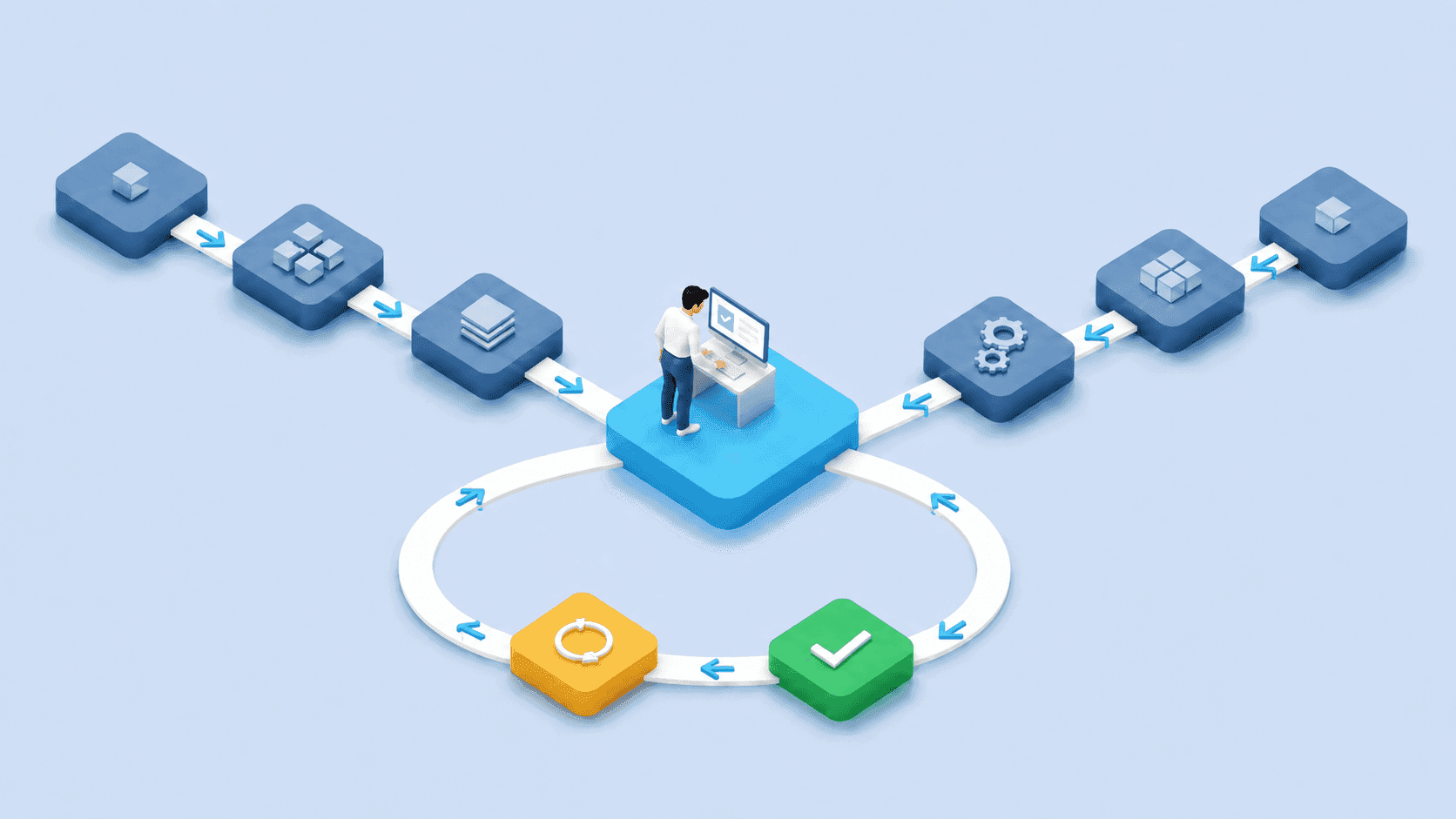
Human-in-the-loop (HITL) is the intentional integration of human oversight into AI workflows at the points where decisions carry risk, require judgment, or have consequences that are difficult to reverse.
It is not a feature you turn on. It is a design choice about where machines act on their own and where people still need to be in the room.
A concept older than generative AI
HITL did not arrive with ChatGPT. The pattern has existed for as long as automated systems have been making decisions, and the examples are familiar in industries that were dealing with this question decades ago.
On a factory floor in the 1980s, a welding machine could repeat a seam thousands of times a day, but a quality inspector reviewed the cases where the sensors flagged irregularities. The machine handled volume. The inspector handled the cases where automation fell short. Radiology followed the same pattern when computer-assisted detection became standard in the 1990s: the algorithm pre-screened images and surfaced areas of concern, but the radiologist made the call. Even code review in software development is a version of this: automated tests catch what they were built to catch, and a senior engineer reviews anything that falls between.
What changed with AI is the kind of decision the machine is now capable of making. The welding robot performed one narrow action that an inspector could verify visually. The diagnostic tool flagged a region of an image for a person trained to read it. The volume was high, but the scope of each decision was tight, and the human review was straightforward.
Today, a generative AI agent can draft a vendor contract, flag clauses that deviate from a template, calculate the financial impact of each deviation, and email a revised version to legal. That is four decisions, each one built on the last. If the model misreads a clause in step two, everything after it is wrong. The human in the loop is not just reading the final email. The human needs to be somewhere in the chain before it gets that far.
The three levels of human involvement
HITL is one point on a spectrum. Practitioners and regulators use a wider vocabulary to describe how much autonomy a system has and how that autonomy is governed.
| Level | What it means | When it applies |
|---|---|---|
| Human-in-the-loop (HITL) | The AI reaches a decision point and pauses. A person reviews the output and approves, rejects, or corrects it before the process continues. | High-impact, regulated, or irreversible decisions |
| Human-on-the-loop (HOTL) | The system runs autonomously. It alerts a person when something falls outside expected parameters. That person can step in, but does not need to approve every action. | High-volume flows with low individual risk |
| Human-out-of-the-loop (HOOTL) | The system runs and decides without any human review. Humans defined the rules upfront and may audit results later, but no one approves or monitors individual decisions as they happen. | Standardized tasks with reversible consequences |
Most real workflows use all three, sometimes within the same system. A customer service agent might handle routine returns on HOTL and route refund disputes above a certain threshold to HITL. A document-processing system might run HOOTL on form extraction and HITL on signature validation. In both cases, the level of oversight follows the level of risk. The skill is not picking one model for the whole system but knowing which level belongs at each step.
How human-in-the-loop works in practice
HITL is not a single mechanism. Companies running it in production tend to use four patterns, sometimes alone but more often combined.
Approval flows
Approval flows are HITL implementations where the agent pauses and waits for explicit human validation before continuing. For example, an AI that drafts contracts could generate a proposed version and pause for review before sending it to any party. A reviewer approves, rejects, or edits the document, and the workflow resumes from there. It is the most visible form of HITL, and the most common in legal document generation, large financial transactions, and customer-facing communications.
Confidence-based routing
Not every AI output comes with the same level of certainty. When the system is uncertain about an output, confidence-based routing pauses the workflow and sends that specific decision to a human, instead of proceeding automatically. In practice, most modern models produce a numerical score that estimates how likely their output is to be correct. When that score is high, the system acts. When it is low, the case escalates. Routine cases flow through, ambiguous ones get a person's attention. The work is in setting the threshold so escalations are meaningful and the queue does not become noise.
Feedback loops
Feedback loops turn human corrections into training data for the next iteration of the model. Over months, the system gets better at the cases that used to require intervention, and the volume of routed cases drops. This is the difference between supervision as a cost and supervision as an investment.
Audit logging
Running fast and staying accountable are not mutually exclusive. Audit logging lets the workflow run uninterrupted while recording every action the system takes, so that if something goes wrong, there is a complete trail of what happened and why. A person is not in the loop in real time, but the trail exists to investigate when something goes wrong, satisfy auditors, and build the dataset that feeds future improvements. This sits closer to HOTL on the spectrum, but it belongs in the same toolkit.
These four patterns usually appear together in production. A well-designed AI workflow uses approval flows where reversibility is low, confidence routing where volume is high, feedback loops to compound learning, and audit logging across everything.
When and why HITL is non-negotiable
After nearly two decades helping mid-market companies and PE-backed portfolios design technology workflows, four categories of decisions consistently demand human involvement in the AI systems we build today. The argument is operational, and it shows up in the cost of getting it wrong.
- Regulatory decisions in finance, healthcare, and legal. A credit denial from a model that cannot explain itself can trigger fair-lending complaints. Acting on a diagnostic recommendation without a clinician's review moves into territory that practice regulations do not allow. When an autonomous agent changes a contract clause without legal review, the disputes that follow can cost more than the automation ever saved.
- Irreversible actions like deleting customer records, sending a binding offer, updating financial entries in a system of record, closing a position. The math here is simple: if undoing a mistake costs more than reviewing the action would have, a person belongs in the loop. The list of irreversible actions in any given business is usually shorter than executives assume, but missing one of them is expensive.
- Ambiguity. When the model cannot classify a case with enough confidence, escalating is cheaper than guessing. Routing one ambiguous case to a person costs minutes, but getting it wrong can cost a regulatory complaint, a churned customer, or a public mistake. The numbers back that up: the Stanford HAI AI Index recorded a 56.4% jump in publicly reported AI incidents in its most recent annual tracking, the largest single-year increase since the index began. This means failures concentrate in scenarios where systems acted in conditions they were not designed to handle.
- Empathy and external context. Take a high-value customer flagged as churn by a model that does not account for the relationship between that customer and their executive sponsor, or a key vendor downgraded by a scoring algorithm trained on data that does not reflect a recent renegotiation. These are the cases where the model is technically correct and operationally wrong. The only fix is a person who knows the context the system does not have.
Standards for regulated AI systems
The EU AI Act gives this spectrum legal weight. Article 14 makes human oversight a design requirement for any AI system in a high-risk category, including credit scoring, employment decisions, medical devices, and certain public services.
Although it is European regulation, it applies to any company whose AI system produces outputs used in the EU, which means U.S. mid-market companies serving European customers or operating European subsidiaries are subject to it. The pattern is following GDPR closely: even companies not directly covered are aligning to the standard because regulators in other jurisdictions are likely to converge on similar requirements.
Agentic AI and the new stakes for human oversight
Until recently, most AI systems in production delivered outputs. In practice, a model would classify, predict, recommend, or generate something, and a person would decide what to do with the result. That is changing. Agentic systems now execute actions autonomously, chaining decisions across several steps and systems within a single workflow. They send messages, update records, kick off downstream processes, and react to what comes back. The question is no longer whether to use HITL. It is where to put it inside a sequence the agent runs without supervision.
This is where the HITL, HOTL, HOOTL spectrum becomes practical instead of theoretical. A ten-step agent workflow probably does not need a person at every step. Some steps can run autonomously, as long as every action is recorded for later review. Others demand a hard checkpoint. Designing this well is the difference between automation that actually works and automation that gets paused after the first incident.
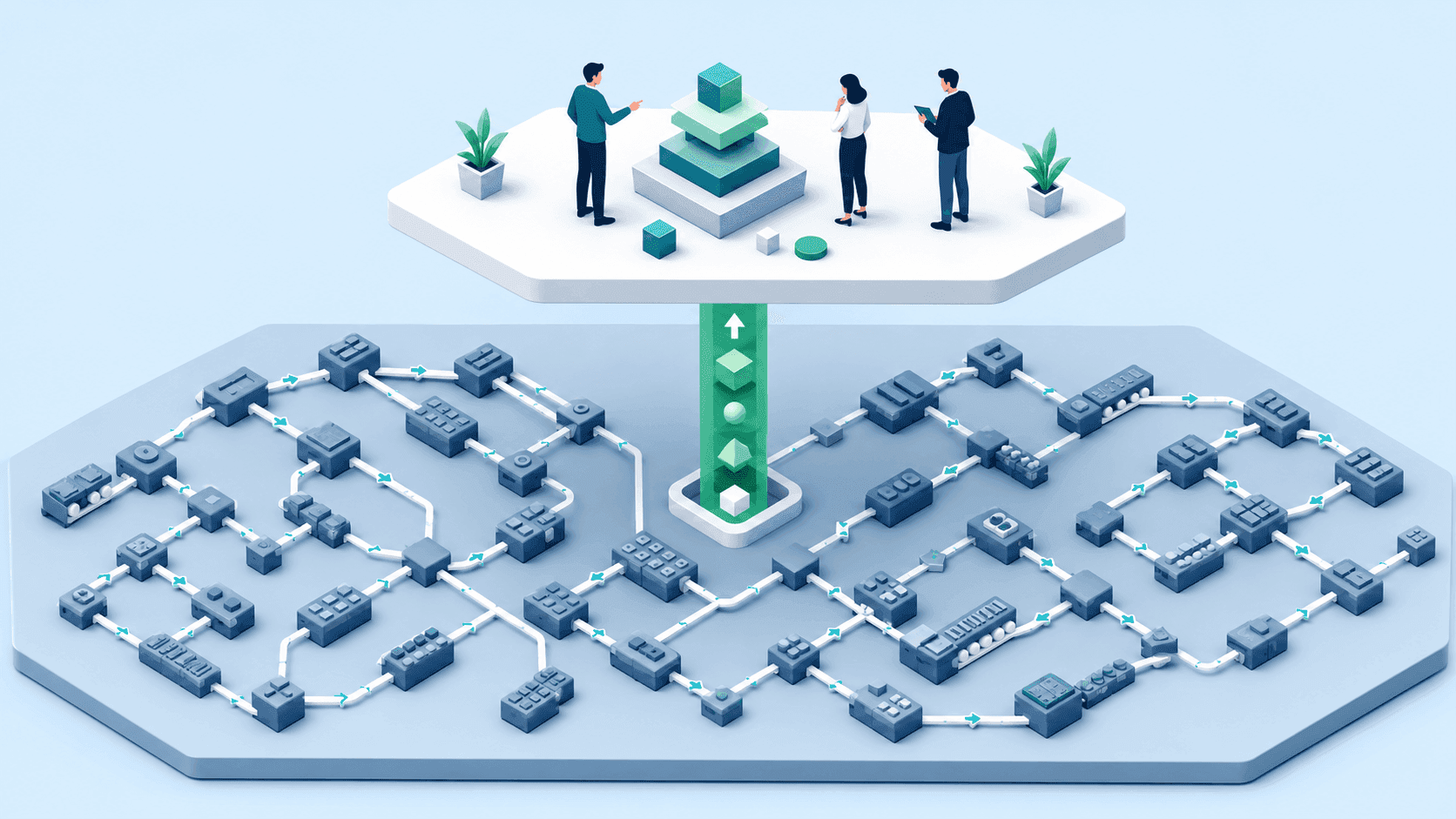
A useful example from our own work: Making Sense recently built an AI agent for one of the largest e-commerce and fintech platforms in the Western Hemisphere outside the United States. The agent automates complex market and campaign analysis that previously required senior analysts working for hours, sometimes days, on a single review. Three design principles made that shift possible:
- Model flexibility uses multiple AI models, each selected for a specific part of the analysis, so the system produces accurate results without the back-and-forth that a single generalist model would require.
- Adaptive workflows define how information is gathered, processed, and synthesized across different inputs, keeping outputs consistent whether the analysis covers one region or several.
- Human-in-the-loop validation at the review stage means senior analysts only engage with conclusions that are ready to act on, not the hours of data gathering that produced them.
Together, they turned a process that once took a full day, sometimes several days for complex cases, into one that now runs multiple times a day.
What is notable is how the human role changed. Analysts who used to spend time gathering data, validating sources, and assembling reports now spend it reviewing the agent's output, refining its reasoning, and applying judgment to budget and campaign decisions. The agent moves faster. The analysts work at a higher level. Neither replaces the other. That is what good HITL design looks like inside an agentic system.
How to implement HITL without slowing everything down
The most common objection to HITL is that it slows automation down, but that objection assumes humans review every step, and they do not. In practice, human judgment is only needed at specific points: when an error would be difficult to reverse, when legal exposure is involved, or when the decision falls outside what the model can handle confidently. Mark those, leave the rest alone, and the workflow keeps moving.
A useful supplement is the AI lifecycle frame. Human involvement looks different at each stage:
- In training, humans label data and shape behavior.
- In testing, they probe edge cases the team did not think of.
- In deployment, they validate the cases the model flags.
- In monitoring, they investigate drift and incidents.
This is the work that defines whether AI adoption produces results or produces incidents. At Making Sense, our AI and data strategy work starts with discovery: mapping where decisions are made today, where they could be automated safely, and where they need to stay under human review. The goal is not to maximize automation. It is to put the right level of human involvement at each point so the system runs at the speed of its safest design.
What this means going forward
MIT Sloan Management Review research found that agentic AI reached 35% enterprise adoption in just two years, with another 44% of organizations planning to deploy it soon. For comparison, generative AI took three years to reach 70%. Agentic systems are scaling faster than the governance practices designed to oversee them. Companies that build oversight into their workflows from the start will scale AI without scaling the volume of incidents to fix later. Those that retrofit it pay for both the automation and the cleanup.
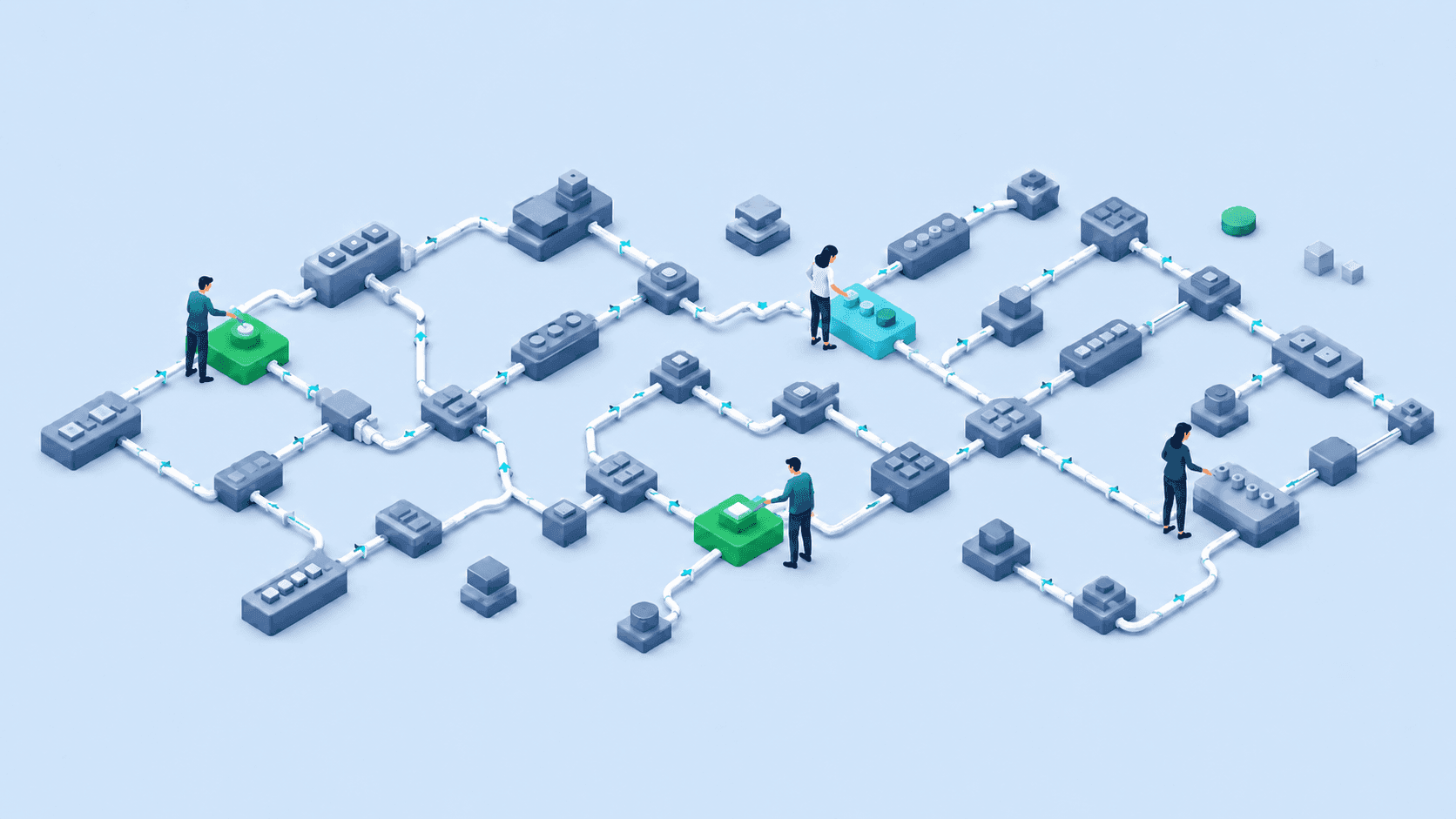
Moving fast is the point, but knowing which decisions should not move fast is the skill.
If you are designing AI workflows where some decisions need human judgment and others do not, book a discovery call to map the oversight checkpoints in your highest-stakes workflow.
Frequently asked questions about human-in-the-loop AI
What is the difference between human-in-the-loop and human-on-the-loop?
In HITL, a person actively approves or rejects each decision before the system acts. In HOTL, the system acts on its own while a person monitors and can step in if needed. HITL is for high-stakes, low-volume decisions. HOTL is for high-volume flows where individual cases carry low risk.
What is human-out-of-the-loop AI?
Human-out-of-the-loop (HOOTL) describes systems that operate with no real-time human supervision. It applies to standardized tasks with reversible consequences, such as routine categorization or low-risk recommendations. Logs and post-hoc audits replace live oversight.
Is human-in-the-loop required by the EU AI Act?
Yes, for high-risk AI systems. Article 14 of the EU AI Act requires that high-risk systems be designed so that people can effectively oversee them while in use. The regulation applies to any AI system whose outputs are used in the EU, including those built outside Europe. The form of oversight required depends on the risk level and context.
How do you decide where to add HITL checkpoints in an AI workflow?
Three criteria help: reversibility (can the action be undone affordably), model confidence (can the system reliably know when it is unsure), and regulatory or reputational impact (does the action carry legal or brand consequences). If any of these triggers fire, a checkpoint belongs there.
Does HITL slow down AI automation?
Not when it is designed well. The point is not to review every step. It is to put oversight where it changes outcomes. A well-designed HITL system escalates only the ambiguous or high-risk cases, while the rest flow through automatically.
What is the difference between HITL and active learning?
Active learning is a machine learning technique where the model identifies which examples would most improve its accuracy if labeled, then requests labels for those examples. HITL is broader: it describes any workflow in which humans intervene in AI operation. Active learning is one specific application of HITL during training.
What industries need human-in-the-loop the most?
Industries with regulated decisions, irreversible actions, or high-stakes ambiguity. Finance, healthcare, legal, insurance, and any sector with significant compliance exposure. Public-sector AI use cases also typically require HITL by policy.
How does HITL improve AI model accuracy over time?
Through feedback loops. When a person corrects an AI output, that correction can be fed back into training, improving the model on cases similar to the corrected one. Over time, the volume of cases requiring human intervention should drop while overall accuracy rises.
What is reinforcement learning from human feedback (RLHF)?
RLHF is a training method in which human evaluators rank or rate model outputs, and the model is fine-tuned based on those ratings. It is the technique behind much of the alignment work done on large language models. RLHF is a form of HITL applied during training rather than at runtime.
Can human-in-the-loop be implemented after a model is deployed?
Yes. Many companies retrofit HITL onto existing AI systems by adding approval queues, confidence-based routing, or audit logging without retraining the underlying model. The retrofit is often less elegant than designing HITL in from the start, but it is a common path for systems already in production.
Jun 8, 2026