
What Is an AI Maturity Assessment?
Most companies have more AI activity than they can account for. A maturity assessment establishes what is actually in use, who owns it, and what the next investment should fix.

Nov 27, 2026
An AI maturity assessment is a structured evaluation of where a company stands in its AI adoption. It looks at how well the organization understands the technology, how teams use it today, what role it plays in business decisions, and whether there is internal support to sustain it. What it measures is what the company can already demonstrate, not what it plans to do, and the result is a starting point: which gaps to close, and in what order.
Picture a mid-market firm where Marketing generates content with AI, Finance automates reports, Operations tries out new applications, and Development works with coding assistants. Each team has found its own uses. But when leadership asks what is happening overall, nobody has a complete inventory, results are hard to compare, and it is unclear where the next investment should go.
That is where an assessment helps. It pulls those separate activities into one view of what the company is actually running, who is responsible for each piece, and what needs attention before the next investment.
What AI activity alone cannot tell you
AI adoption takes very different forms inside the same company. One employee uses ChatGPT or Copilot to move faster through individual tasks, while a team configures an agent on a cloud platform to handle a recurring job. Another department connects systems and cuts manual work with an automation tool such as n8n, and Engineering builds a custom AI application into an existing business process.
All of it counts as AI activity, and the four cases differ enormously in what they touch and who answers for them. Knowing that a team runs an AI agent tells leadership almost nothing on its own:
- What task does it handle?
- Which data can it reach?
- Who reviews what it produces, and what happens when it gets something wrong?
- Is it saving time, improving the process, or adding one more tool to the stack?
An assessment looks past the count of tools in use. It asks what each one does, how it fits into the way the business runs, who owns it, and whether anyone can tell if it is working.
Internal questionnaires help, and most assessments include one, because they capture what people believe about AI in the business. The problem starts when the questionnaire is the whole exercise, because a result built only on perceptions reflects confidence as much as capability.
What an AI maturity assessment measures
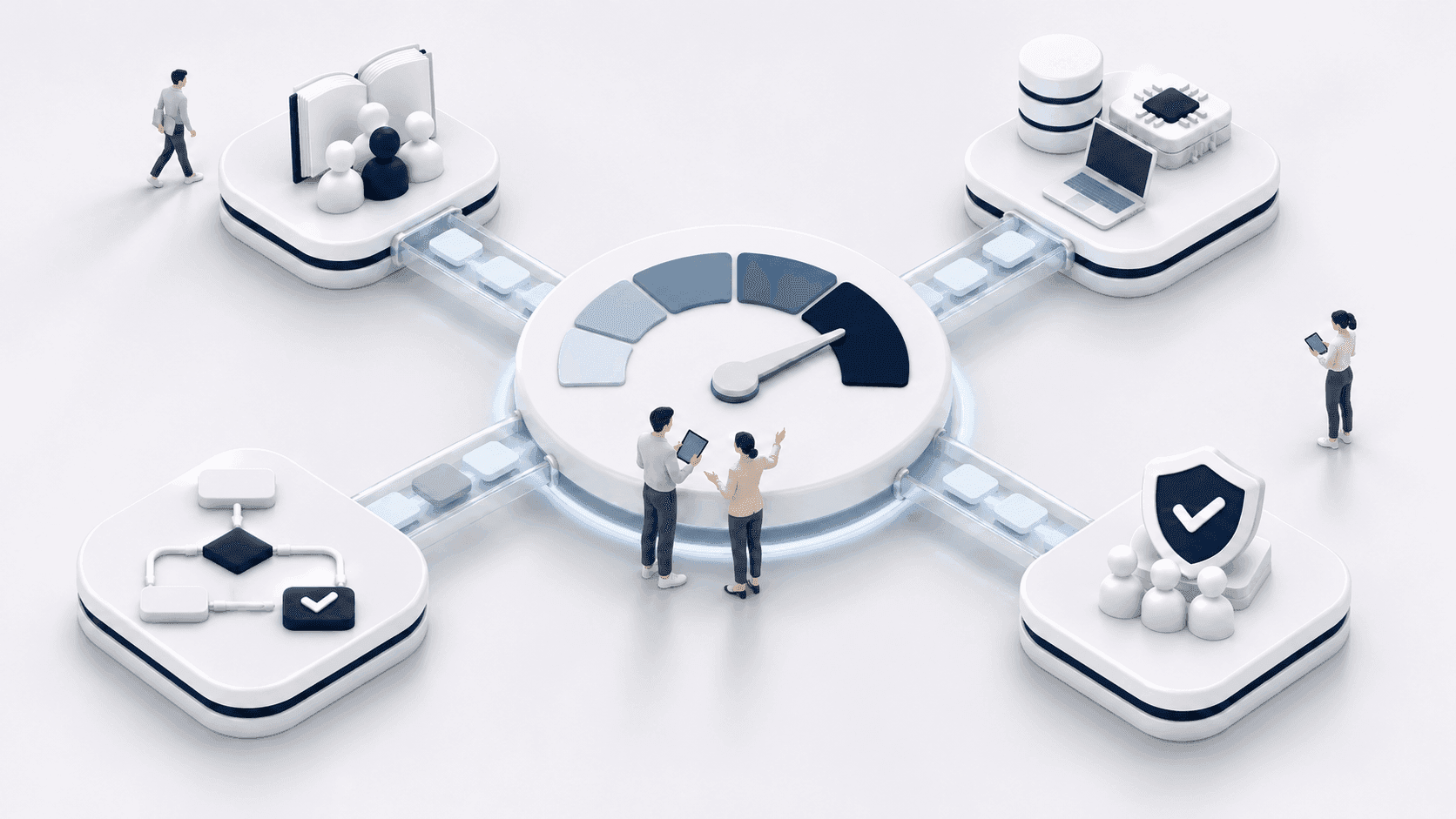
The evaluation covers four areas. In each one, the useful question is what can be observed rather than what gets reported.
1. Understanding of AI
This area looks at how well decision-makers and the teams working with AI grasp the technology: what these tools do well, where they fail, and how to apply them to a specific business need. It also shows whether that understanding sits with one enthusiast or is spread across the leadership team.
2. Current usage patterns
Here the review maps what is actually running: which tools, in which department, under whose account, what data each one can reach, and whether the output gets back into the systems where the work happens.
This is usually the first surprise. Companies find tools nobody ever put in a budget, and two departments paying for the same product because neither asked the other.
3. How AI factors into decisions
The third area asks whether AI output informs real decisions or sits beside them. A summary nobody reads before the meeting is not adoption, and neither is a recommendation that gets followed with no record of who approved it. What the review is after is the role AI plays in everyday judgment calls.
4. Organizational support for adoption
The last area covers what keeps a system working after launch: ownership, budget, training, who maintains the prompts, who reviews output quality, and what happens when a model changes underneath you.
Cost deserves particular attention. A company can describe every AI tool it uses in detail and still take a week to say what it spends on all of them together, and without that figure, comparing initiatives is guesswork.
Why mid-market companies need an AI maturity assessment
The gap between using AI and integrating it shows up even among the largest companies in the country. Researchers at MIT FutureTech and Carnegie Mellon analyzed a decade of SEC filings from 510 S&P 500 companies and found that by 2025, only 11% had AI deeply integrated into core business processes, with another 10% using it in production. The working paper covers large public companies rather than the mid-market, but it establishes the shape of the problem: experimenting with AI and running it as part of the business are different stages, and the second one is far less common than adoption figures suggest.
In a mid-market company, this usually shows up at the pilot stage. Two pilots demo well and neither one scales, because the data behind them comes out of a reporting extract instead of the system where the work actually gets recorded. A third one gets funded over those two, and nobody can explain the criteria, because none of the three defined what success would look like before it started.
None of that is a technology failure. It is a question of order, and the cost of getting the order wrong is money spent on the wrong priority.
There is a second reason, specific to companies with investors. When a buyer or a sponsor evaluates the business, the AI story gets tested the way the rest of the technology does. Being able to produce an inventory, an owner per system, and a cost per use puts a company in a different position than one describing intentions.
AI maturity assessment vs. AI readiness assessment
The two terms get used interchangeably, and the difference is not about timing.
Maturity asks how far along the company already is: what is in use, how consistent it is, and how much of it is built into the way the business runs. AI readiness asks whether the organization is prepared to implement or scale a specific initiative, which is a question that applies just as much to a company already running AI as to one starting out.
The two can diverge in the same company. A business with real day-to-day maturity in how its teams use AI can still be unprepared to put an autonomous agent into a process where a mistake reaches a customer. The data may be fine and the governance may not be. That is a readiness question, and a maturity assessment will not answer it.
In most engagements both views matter: where the company stands, and what its foundations will support next.
The four levels, and what moves a company up one
Our enablement programs are built around four levels of AI maturity, because the work that helps a company is different at each one.
- Starters: AI Awareness & Leadership Alignment. Little or no AI experience. The work here is understanding where AI could create value before committing to anything.
- Experimenters: Pilot Readiness & Use-Case Prioritization. Teams are exploring AI without a clear path forward. The work is prioritizing use cases that connect to real business needs and shaping pilots around them.
- Implementers: AI Integration & Governance. Early pilots or successful use cases are in motion. The work shifts to ownership, governance, and integrating AI into day-to-day operations with some consistency.
- Pioneers: Advanced Enablement & Co-Innovation. AI is established and the company is ready to push further, which is less a program than an ongoing partnership around more ambitious opportunities.
What moves a company up a level is rarely a better model. It starts with knowing what is actually in use. Then someone has to own each initiative, because a pilot with no named owner does not survive contact with production. The last part is the hardest: new work ships with monitoring and review already attached, instead of getting them added after something goes wrong.
Governance belongs at every level, scaled to the risk rather than to the level. A company at the Experimenters stage does not need an enterprise AI governance program before it can run a pilot, but any company handling customer data, personal information, or regulated processes needs controls proportional to that exposure from the first day it touches those systems.
How an assessment is carried out
Assessments of this kind are built on evidence gathered from the organization rather than on a form someone fills in. That usually means interviews with the people who run the work day to day, a review of which tools are in use and what they connect to, and a look at whatever documentation exists around ownership, approvals and spend. IT is involved for anything touching systems and access.
Two things separate a review that holds up from one that produces a slide. The first is who gets interviewed: executive interviews describe the intended state, operators describe the actual one, and the distance between the two is usually the finding. The second is what counts as evidence. A credible report notes, for each conclusion, whether it was observed directly, reported by the team, or left unknown. Without that distinction, the document reads more confidently than the evidence behind it.
From findings to decisions
The value of the assessment is in what it tells you to do next. A few common findings and where they lead:
| Finding | Business implication | Recommended next step |
| AI tools in use across departments with no inventory | Duplicated spending, and no view of where company data is going | Inventory and consolidate what exists |
| Pilots with no success metrics | Leadership cannot compare initiatives or justify the next investment | Define measurable outcomes before scaling anything |
| AI output moved between systems by hand | Gains stay capped at whatever one person can process | Prioritize the integration that removes the manual step |
What makes these findings useful is rarely the finding itself. The people closest to the work often know the inventory is missing or that a pilot has no metric. The assessment puts those findings in context and helps leadership decide which problems to address first. A company that skips the inventory and jumps to scaling tends to rediscover the inventory problem later, at a worse moment. Sequence is not the only thing that derails an AI implementation, but it is the part a diagnostic can fix before the spending starts, which is also why an assessment comes before an AI strategy roadmap rather than replacing it.
Start with where you actually stand
The point is to make the next AI investment match what the business needs and can realistically support, rather than whichever initiative had the best demo.
Find out where your AI adoption efforts stand, what is holding them back, and what to prioritize next. Talk with our AI Adoption & Enablement team about an AI maturity assessment.
Frequently asked questions
How is AI maturity measured?
Area by area, against what the company can show rather than what it reports. The review gathers evidence from interviews, from the tools themselves, and from whatever documentation exists on ownership and spend. Results come back for each area separately instead of as one overall verdict, because a company can be strong on usage and weak on ownership, and a single verdict hides the part worth acting on.
How is this different from technical due diligence?
Technical due diligence serves a transaction and covers the whole technology stack for a buyer. A maturity assessment serves the operating business and looks only at AI capability. The evidence standards are similar; the audience and the decision are not.
Can we run one internally?
An AI maturity assessment can be run internally up to a point. The inventory and the spend data are easier to gather from the inside. Judging where the company actually stands is harder, because the distance between what leadership believes and what teams actually do is difficult to surface from inside the same reporting line.
How often should it be repeated?
An AI maturity assessment is worth repeating annually, or ahead of a major investment decision or a transaction.
Nov 27, 2026