

When AI Adoption Gets Ahead of AI Strategy
AI didn't wait for a formal rollout. Here's how to build the strategy, ownership, and culture that turn what's already happening into something that actually scales.

May 19, 2026
For most companies, AI didn't arrive through a formal announcement or a top-down initiative. It showed up gradually: someone using ChatGPT to draft meeting summaries, a team lead building a small automation to handle a recurring report, IT deploying Copilot for a handful of users, and so on. Over time, scattered experiments became a pattern, and now leadership is looking at a situation that nobody quite planned: AI is already inside the organization, operating in pockets, with no consistent framework for how it's used, who's responsible for it, or where it goes next.
This is, by a wide margin, the most common situation we encounter, and it's not a failure! It's a starting point.
Most of this happened faster than any reasonable planning cycle could have anticipated. The gap between where adoption stands and where organizational strategy needs to be is real. Closing it requires more than a training initiative.
What it looks like when adoption runs ahead of strategy
The patterns are recognizable across industries and company sizes. No single person or team has a clear mandate to lead AI internally, so questions about what to use, how to use it, and what's permitted tend to go unanswered or get answered differently depending on who you ask.
Some teams are actively experimenting. Others haven't started and aren't sure where to begin. A portion of the workforce is genuinely uncertain about AI and hasn't had a structured space to work through that uncertainty. Different departments have developed their own practices, sometimes overlapping, sometimes contradictory, with no shared guidelines connecting them.
What tends to be absent is governance: clear policies on which tools can be used with which data, defined ownership over AI decisions, and a process for evaluating new capabilities before they spread informally. Without that structure, even the teams getting real value from AI have nowhere to scale what they're doing.

The security exposure most organizations don't anticipate
There's a risk that often goes unaddressed until something goes wrong. When teams use AI tools without guidelines, sensitive company information, client data, or proprietary processes can end up in external systems not covered by any data agreement. A widely reported 2023 incident illustrated this clearly: Samsung engineers inadvertently submitted confidential source code and internal meeting notes to ChatGPT while using it for work tasks, prompting the company to temporarily ban the tool across its operations. The incident drew significant attention precisely because it wasn't an edge case. Without governance in place, it's a predictable outcome.
Training is the starting point, not the finish line
The instinct, when adoption feels scattered, is to invest in training. Building AI literacy genuinely matters, and it belongs in any serious adoption effort. But organizations that treat it as the primary lever tend to see limited progress.
Part of what makes this gap persistent is that AI tools are designed to be immediately useful to individuals, which is precisely what makes them hard to adopt organizationally. In my experience, when a person gets value from a tool in their first few minutes, there's little internal pressure to coordinate. Individual productivity gains don't automatically translate into organizational capability, and the two require fundamentally different approaches.
The Stanford HAI 2025 AI Index Report found that AI tool deployment has accelerated sharply across industries while measured productivity gains remain uneven. The MIT NANDA 2025 GenAI Divide Report documents a similar pattern: organizations with high tool access but low organizational readiness consistently underperform compared to those that paired deployment with structural changes.
Motivation and capability are rarely the bottleneck. What tends to be absent is a shared framework: clarity on priorities, ownership of specific use cases, and cultural context that makes new behaviors stick. When someone completes an AI course and returns to a team with no guidelines, no champion, and no structure for applying what they learned, most of that investment dissipates quickly.
Adoption is both a capability challenge and an organizational change challenge. The organizations seeing real results are working on both at the same time.
What building real AI capability looks like
The organizations that move from scattered experimentation to consistent adoption tend to share a few characteristics. None of them involve buying more tools.
1. An internal owner with a real mandate
This referent provides a center of gravity: someone with the visibility and organizational support to set priorities and direction, and keep momentum going. At Making Sense, it's something we've built into our own structure. The role matters so much that one of the first questions we ask any company starting an AI initiative is whether someone like this exists. The answer shapes everything that follows.
2. A visible, low-friction space for sharing
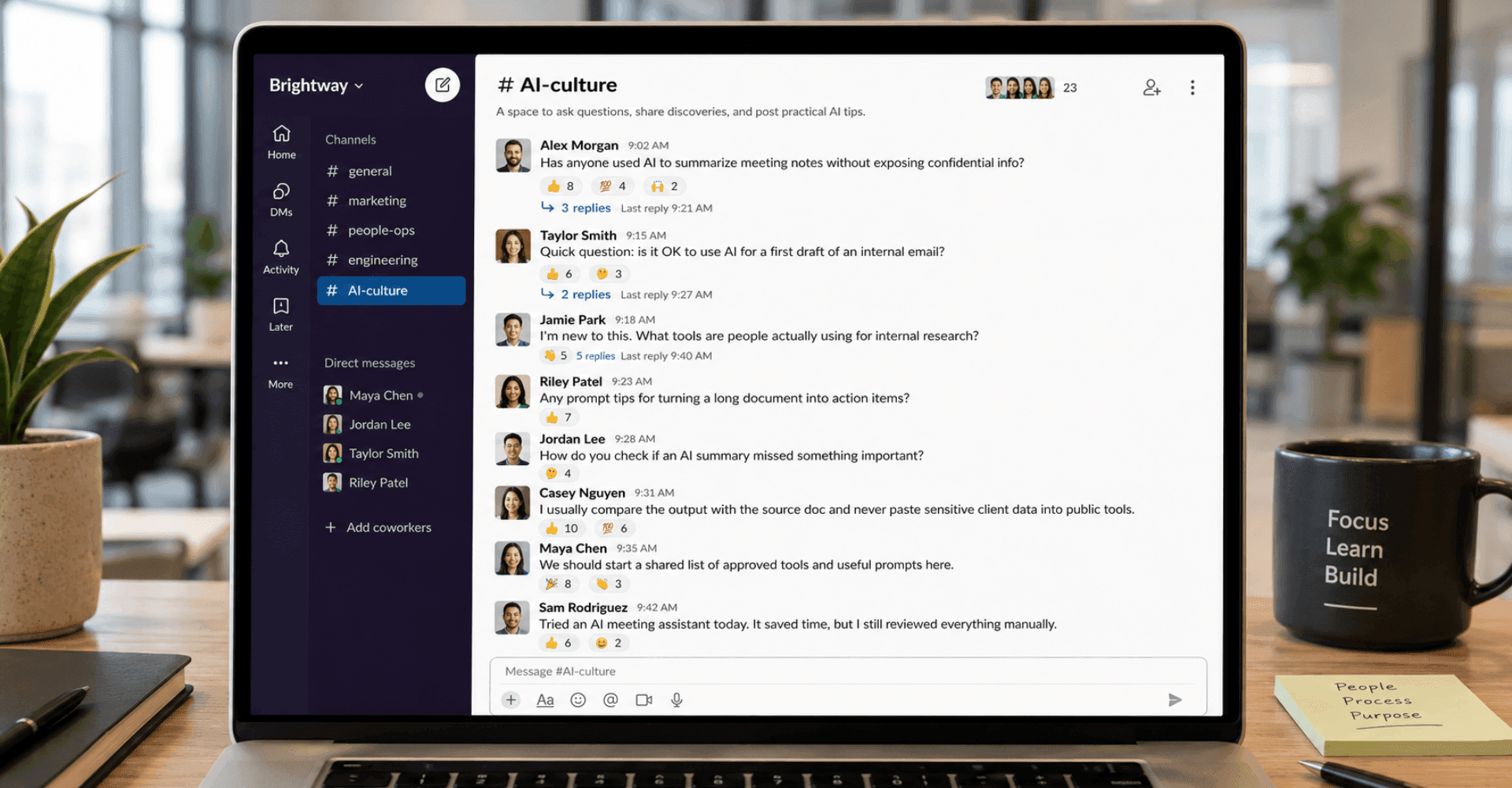
Before governance structures or formal training programs, teams need somewhere to ask questions without judgment: a shared channel, a recurring touchpoint, any space where AI conversations can happen organically. At Making Sense, that looked like an open Slack channel where anyone in the company can ask questions, share discoveries, and post practical tips without a formal process or approval required. AI culture doesn't start with a policy document. It starts with conversations.
3. AI integrated into actual workflows
The shift from experimentation to adoption happens when AI becomes part of how work gets done, rather than a separate tool people have to remember to open. One way we've done this internally: connecting AI agents to our Slack channels so teams can access information that previously lived in scattered files and documents, without leaving the context where the work is already happening.
4. Concrete, specific use cases over broad rollouts
AI works best when it solves a defined operational problem: drafting first-pass content, retrieving information, handling repetitive formatting, scaling output that bottlenecks on a small team. The use cases that stick are narrow and specific, which is precisely what makes them reliable. At Making Sense, one early win was using AI to help teams outside Marketing create presentations that stayed aligned with brand guidelines and design best practices, reducing dependency on the marketing team for routine deck creation.
These four elements don't need to arrive at once. Ownership tends to unlock the others: with a referent in place, a shared channel has somewhere to point, workflow integrations have someone to prioritize them, and the governance structures that follow have a person to lead them. The sequence starts there.
The compounding advantage
The urgency narratives around AI adoption are everywhere. Most of them frame the moment as a race, which pushes organizations toward reactive decisions rather than sound ones.
A more useful frame: every capability built now, makes the next AI investment faster to deploy and more likely to generate returns, whether that's an internal champion, a shared governance structure, or a team fluent enough to identify good use cases. The foundation compounds. Companies that build it deliberately set the pace for how they operate two and three years from now.
That's the actual opportunity at this moment.
If your organization is working through any of the patterns described here, our AI Adoption & Enablement programs are designed to meet companies at their current level of readiness, whether that means aligning leadership around AI priorities, building governance structures that make adoption scalable, or developing internal champions who can carry the work forward independently.
Book a free 30-minute call with our team to map out your next step.
May 19, 2026