

Vibe Coding at Work: From Fast Prototype to Reliable Software
Teams across the business can now turn ideas into working software, giving leaders a new responsibility: deciding what can remain lightweight and what is ready to grow.

Jul 20, 2026
In the conversations I have as CRO at Making Sense, one pattern now appears with remarkable consistency: CEOs, CTOs, operating leaders, and investment teams tell me that someone inside the organization has already built a useful tool with AI. Sometimes it is a dashboard created by finance, a workflow assembled by operations, or a small application that helps a commercial team answer a recurring question. The person behind it may have little formal engineering experience, yet the tool works well enough that other people have started using it, creating a meaningful advantage for the team while prompting leadership to ask how it was built, what data it touches, who will maintain it, and what would happen if it failed.
Those questions are understandable because business leaders remain accountable for every tool that becomes part of the operation, regardless of who created it or how informal the first version may have seemed.
My view is that these situations deserve to be treated as opportunities. Vibe coding gives teams a faster route from an idea to something tangible, especially when engineering capacity is limited and the value of the use case has yet to be proven. Once that value becomes clear, the organization needs a practical way to maintain the momentum of the original experiment while adding the engineering judgment required for broader and more dependable use.
The first working version is no longer the hard part
In practice, a marketing team can describe a dashboard to an AI coding assistant such as Claude Code, Codex, or Cursor, and begin testing it that same day, while an operations analyst can build an interface for cleaning customer records and a finance team can automate part of a recurring spreadsheet process, all without waiting for a formal software initiative to reach the top of the backlog.
A few years ago, those requests would have competed with customer-facing features, platform maintenance, security priorities, and other work tied directly to revenue. Fortunately, AI has loosened that constraint by placing a usable form of software creation in the hands of people who understand the business problem, even when they do not know how to design an architecture or write production-ready code.

One report I keep coming back to is the 2026 Stanford AI Index because it captures how quickly this change is unfolding: organizational AI adoption reached 88% in 2025, while performance on SWE-bench Verified, a benchmark based on real software issues, rose from 60% to nearly 100% in one year. Those figures help explain why more teams now feel capable of moving from a request to a functional draft on their own.
The term vibe coding may sound informal, but to me, it accurately reflects how software creation is evolving as more people use AI to turn business knowledge into working solutions. Vibe coding also gives teams another way to determine whether an idea deserves investment. Now they can put a rough version in front of users, observe where the workflow breaks, and confirm whether the expected value exists before committing to a broader build. The people closest to a problem often understand its nuances better than anyone receiving the requirement through a ticket, so giving them a way to create a prototype can surface opportunities that might otherwise remain buried in spreadsheets, emails, and manual handoffs.
Companies should therefore feel comfortable using vibe coding for disposable prototypes, one-time scripts, small internal dashboards, and isolated workflows whose results can be checked easily. These cases benefit from a lightweight process because their reach is limited, their assumptions are still being tested, and any failure can usually be contained without affecting the broader operation.
The real shift happens when a tool outgrows its original purpose
While a first version only needs to work within the narrow conditions under which it was created, business software carries a different responsibility: it must remain dependable as data changes, usage grows, integrations multiply, and the original builder moves on.
A common example I use in these conversations is a dashboard created by a sales operations analyst. At first, it reads a CSV file and helps one manager prepare for a weekly meeting, but three months later, several teams may rely on it, the dashboard may connect directly to the CRM, and its output may shape forecast decisions. By that point, the analyst who created it has quietly taken on responsibility for support, even though nobody formally assigned that role.
This is exactly the point I ask leaders to watch closely, because useful experiments can accumulate business weight long before they gain ownership, testing, monitoring, or documentation. A quick solution can gradually turn into invisible infrastructure, with the dependency only becoming apparent when the tool produces an incorrect result, stops working, or can no longer be maintained.
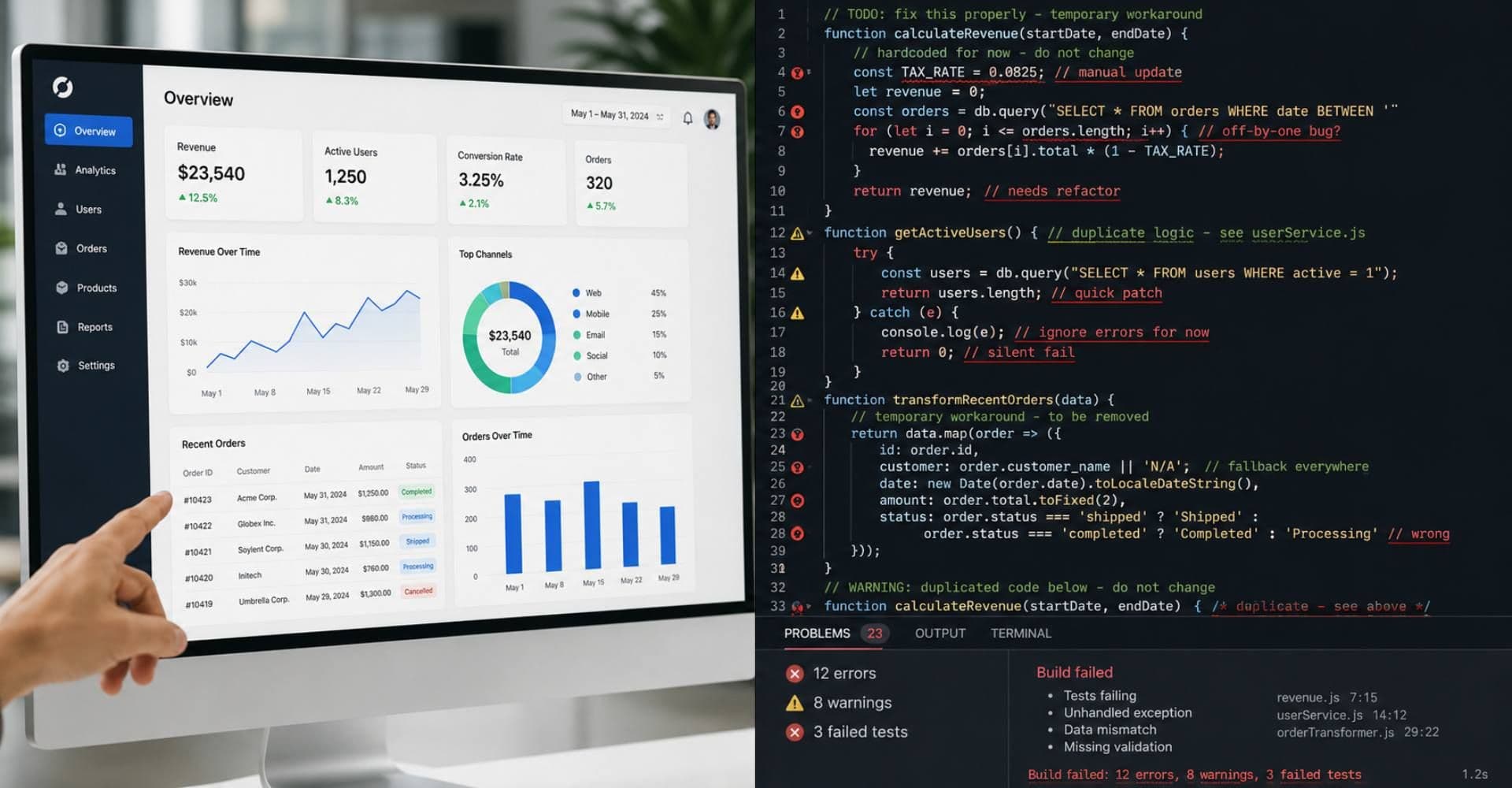
As AI takes on more production work, teams can also lose opportunities to develop the review habits required to understand what was created, challenge its assumptions, and determine whether it remains fit for purpose. A recent Harvard Business Review article gives useful names to part of this pattern: capability debt and judgment debt.
In the context of vibe-coded internal tools, capability debt often takes the form of role overload: the person who created the tool is expected to maintain it while continuing to carry a full set of existing responsibilities. Useful applications also tend to experience scope creep, the gradual expansion of a tool beyond its original purpose as teams keep adding one more field, integration, or workflow each time it proves helpful somewhere else. Every addition increases its value and complexity while concentrating more knowledge and undocumented decisions around someone whose role was never designed to support a growing software product. Judgment debt emerges alongside it when those decisions move forward without enough experienced review.
Exposure creates a clearer path for each tool
The gap between the responsibility a tool has acquired and the discipline surrounding it is what ultimately determines whether a useful experiment remains an asset or starts creating hidden exposure. Classifying tools by that exposure helps teams decide when they can continue moving independently and when a different level of review is appropriate.
A simple dashboard can create meaningful exposure when it accesses sensitive information or influences important decisions, while an ambitious prototype may remain low risk when it is temporary, isolated, and easy to verify. For that reason, I recommend looking at what the tool touches, who depends on it, and what would happen if it failed, then placing it into one of three broad categories:
- Low-exposure tools have limited reach, produce results that are easy to verify, and carry consequences that can be contained.
- Medium-exposure tools support recurring work, serve multiple users, or connect with operational systems.
- High-exposure tools affect sensitive data, customer-facing actions, systems of record, payments, permissions, or decisions with material consequences.
This classification gives teams room to experiment while establishing a clear threshold for escalation as a tool’s role in the business evolves.

So, should teams vibe code?
My answer is usually yes, provided the organization understands where experimentation ends and operational responsibility begins. Applying the full process of an enterprise software initiative to every internal dashboard would eliminate much of the speed these tools provide, while allowing a useful prototype to take on business-critical work without review would create exposure that the organization could have avoided.
The practical question is how to recognize when an experiment has taken on enough responsibility to require a different level of review.
Questions worth asking before you scale it
When someone asks me how to determine whether an AI-built tool needs more structure, I usually recommend starting with a small set of practical questions.
| Question | What it reveals | Before it scales |
| Does it touch customer data, payment flows, regulated information, or a system of record? | Whether the tool is exposed to sensitive or business-critical information. | Require engineering review before it moves beyond a pilot, to review data safeguards, exposure and regulatory compliance. |
| Would anyone notice if it returned the wrong result? | Whether a failure would be immediately visible or could continue silently and influence future work. | Add monitoring, logging, or a human review point. Identify biases and feedback loops that might snowball into bigger problems. |
| Can someone else maintain it if the person who built it leaves tomorrow? | Whether the tool depends too heavily on one person and the knowledge they carry. | Add documentation, defined ownership, and a clear support path. |
| Does it write data back into another system? | Whether it can change records, trigger actions, or affect downstream workflows. | Treat it as higher exposure and review the write-back logic before production. Create a plan for maintenance as any other system, so that changes in the upstream system will not break flows. |
| Is there a way to pause, roll back, or recover if something goes wrong? | Whether the tool can be safely stopped or corrected before the problem spreads. | Keep it out of production until a recovery path is in place. |
These questions turn the exposure framework into a practical decision about the level of ownership, review, and engineering support the tool requires.
What changes when a prototype becomes operational
Once a tool begins carrying real business weight, its operating model needs to mature with it. A business stakeholder and a technical owner should become accountable for changes, support, access, and eventual retirement, while the software itself needs a maintainable foundation that allows it to be reviewed, supported, and improved beyond the involvement of its original builder.
That foundation includes appropriate controls around testing, integrations, permissions, observability, and recovery, with the depth of each control determined by the tool’s exposure and operational role.

I also pay attention to what real-world code studies are beginning to show. One large-scale analysis of AI-authored commits found that issues introduced during AI-assisted development can remain in codebases for months, particularly when changes are merged without sustained review. The study does not compare AI-generated code with purely human-written code, but it reinforces a broader point: as AI becomes part of everyday software development, experienced review remains essential to long-term code quality, and as such, of the business impact that code has.
Hardening the tool without losing momentum
One concern I hear frequently is that bringing engineering into the process will turn a fast experiment into a long project. In practice, hardening a vibe-coded tool does not have to begin with a full rebuild or require months before the business sees progress. Even when the broader path depends on the tool’s complexity, integrations, and exposure, teams can often begin seeing tangible improvements within the first two weeks.
That initial work focuses on understanding what has already been built, identifying the gaps that create the greatest risk, and addressing the issues that most directly affect reliability and broader use. Depending on the tool, early results may include clearer ownership, more stable integrations, stronger access controls, better error visibility, or a safer deployment process.
From there, the solution can continue evolving according to the responsibility it carries within the business. An internal dashboard used by one team will require a different level of hardening than a system connected to customer data or payment flows, so the work should remain proportionate to the tool’s actual role rather than following a fixed process designed for every possible case.
At Making Sense, we approach this work as a software development company with AI embedded in the core of how we discover, design, build, test, and scale solutions. That perspective allows us to preserve the momentum teams have already created and add the engineering discipline each tool needs to support its next stage, without forcing a bounded use case into a process designed for a much larger platform.
Governance should protect useful experimentation
When leaders discover AI-built tools created outside a formal development process, their first instinct may be to restrict them, especially when they lack visibility into how the tools work or what information they access. Yet many of these solutions improve productivity without creating meaningful exposure, such as an internal dashboard that simply shows whether pending tasks have been completed, so applying blanket restrictions would add friction to a useful workflow without addressing a significant business risk.
The more productive response is to match governance to the use case. MIT Sloan describes this approach as minimum viable governance, where oversight is calibrated to risk and embedded into existing workflows so organizations can keep innovating responsibly without slowing every initiative.
For vibe coding, that can begin with a lightweight registry of active tools, their owners, users, data sources, and integrations, supported by clear thresholds that trigger technical review.

A clear operating model also helps teams understand the boundaries of experimentation before they begin. When people know what they can build freely, what should be disclosed, and what requires engineering involvement, they can move faster while giving leadership the visibility needed to make sound decisions.
From isolated tools to sustained AI capability
The broader lesson I take from these conversations is that individual tools are only one part of the challenge. As experimentation spreads, organizations need a repeatable way to identify worthwhile use cases, establish appropriate boundaries, and bring in technical support at the right moment.
This is where AI Adoption & Enablement becomes essential, helping companies turn scattered experimentation into a more structured and sustainable capability. At Making Sense, our role is to help organizations build that capability and, when an experiment proves its value, bring the software engineering depth required to prepare it for broader use.
Before you close this out, here's what I'd want a leader to walk away with:
- Vibe coding was never the risk. Not knowing which tools have quietly become part of how your business runs is.
- Classify tools by what they touch, not by who built them. A dashboard that reads a CSV needs far less review than one connected to your CRM.
- Ownership has to have a name attached to it. If nobody in the room can say who's accountable for a tool, that's already the answer you were looking for.
- Governance should scale with risk, not shut down experimentation. The goal is fewer blind spots, not fewer people building.
- Making a tool production-ready doesn't mean rebuilding it. Most of the time, it just means giving it the testing, security, and review it never got the first time around, and that can start within two weeks.
If your teams are already building with AI, the opportunity is to make that activity visible and give the most valuable use cases a clear path forward.
Jul 20, 2026