

Sensemaking Is the Real Work in Every AI Project
Most AI projects don't fail at the technical level. They fail when people can't agree on what's happening and why it matters.

Jun 12, 2026
Not long ago, I sat in a discovery session with a client, product, engineering, and business leadership all in the same room. We were there to align on the problem we were solving. What struck me was how differently each person described it. The business lead kept coming back to efficiency gains, while the product team was thinking through the user experience and engineering was already moving toward possible solutions. Each perspective made sense on its own, but together they revealed something important: the project did not yet have a shared map. That moment, before a single line of code, before any tool selection, was where the real work needed to happen.
That moment has a name. It's called a sensemaking breakdown, and it's more common in AI projects than most teams expect.
Sensemaking is a concept from organizational theory, introduced by Karl Weick in the 1970s, that describes something deceptively simple: the process by which people build a shared understanding of a new or ambiguous situation, one that's solid enough to act on. Not consensus, not agreement on every detail. Just a common enough picture of what's happening that a team can move in the same direction.
AI projects are, almost by definition, sensemaking challenges. The technology is still new, its outputs are not always predictable, and the effect it has on people’s work usually becomes clear only when they start using it. AI also tends to reshape workflows instead of fitting neatly into them, which leaves room for people on the same team to interpret its role in very different ways.
What sensemaking actually is
The term comes from Karl Weick, an organizational theorist who spent decades studying how people navigate uncertainty at work. Before a team can decide anything, they have to construct a shared enough picture of the situation to act on. A plausible one, built through conversation, observation, and trial, that gives people enough common ground to move.
That distinction matters more than it sounds. Sensemaking is about building just enough shared understanding to move forward together, even when the full picture is still forming.
When I work with clients, I see what that shared picture makes possible in very specific ways:
- A kickoff where every department arrives with the same working assumption about what the AI system will do.
- A mid-project review where the results land clearly and the team agrees on what they mean.
- A conversation where the hard questions come up early, get answered, and the room moves forward.
Those moments are the ones that determine whether a project gains traction and holds it.

Why AI projects create the perfect sensemaking challenge
Earlier technology adoptions had a certain legibility to them: a new CRM has a user interface, and a new reporting tool produces a report. People could actually see what it did and fit it into their existing understanding of their work.
AI systems are different. The logic isn't visible. The outputs vary depending on inputs, context, and configuration. Two people using the same tool for the same purpose can have completely different experiences of what it does. And because AI touches decision-making, not just execution, it raises questions that go beyond how something works: who decides when to follow the AI's recommendation? What happens when it's wrong? What does accountability look like now?
What I see repeatedly working with clients is a specific pattern: the team agrees on "let's use AI" long before they agree on what that means for them. And that gap, between the general commitment and the shared operational picture, is exactly where projects stall. Not because anyone is resistant. Because no one has yet done the work of making sense of it together.
The questions that open the conversation
Sensemaking happens in conversation, when the right questions bring the right tensions into view at the right time.
When I sit down with a client team at the start of an engagement, the first thing I want to understand is whether the people in the room are actually working from the same set of assumptions. Usually, a few questions reveal whether they are:
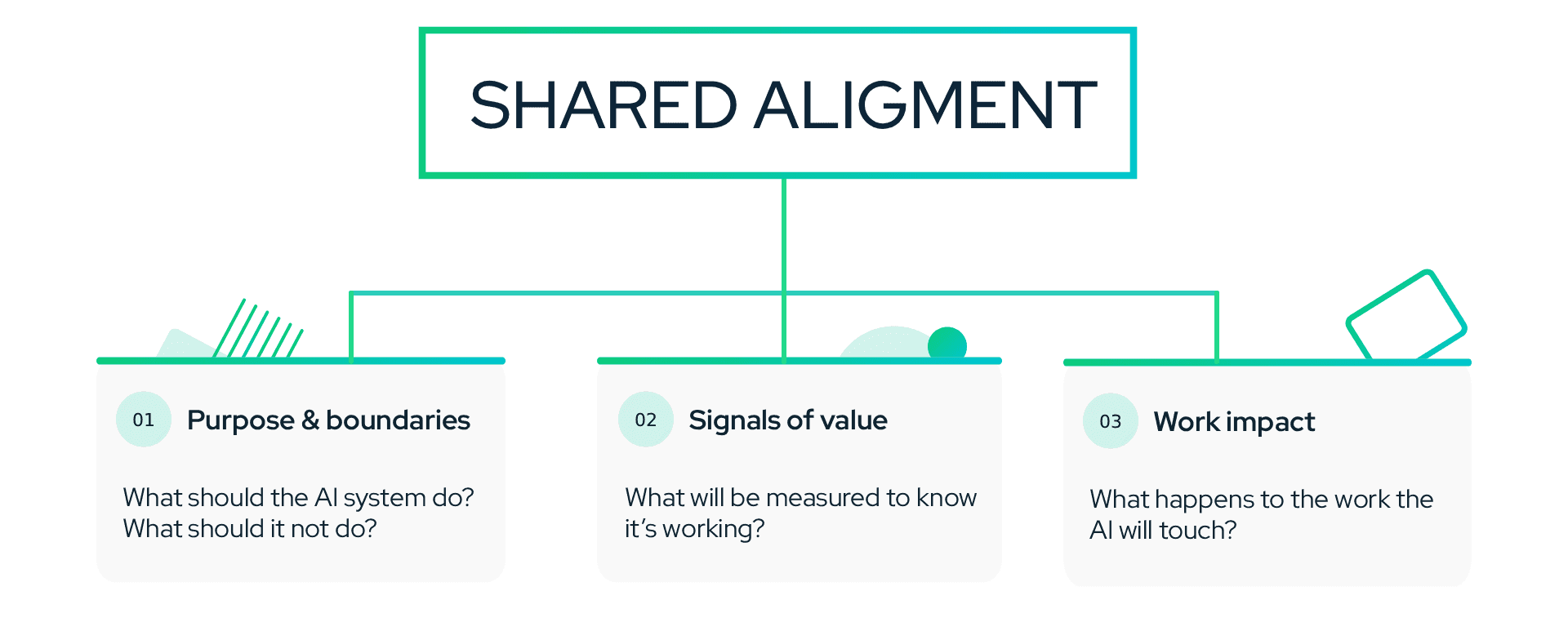
- Ask what the AI system should do, and then ask what it should not do. The answers are often different from person to person.
- Ask what they'll measure to know it's working. This brings out expectations about outcomes that haven't been made explicit.
- Ask how AI will affect the work. This is where most process gaps appear.
Going through those questions as a team, even when the answers take time, is what builds the shared foundation that carries implementation forward. The friction is part of it.
This is also where the Discovery phase of a project earns its value. Getting business leaders, product and technical teams in the same room, working through the same questions, produces something that a roadmap alone doesn't: alignment on what they're building and why. For an in-depth look at what happens when that clarity is missing at the process level, Hernan Fino's analysis of decision friction and exceptions maps that cost in concrete terms.
When the shared picture doesn't exist yet
Sensemaking is not a phase that happens once at the beginning of a project. It's something the work requires every time the scope shifts, a new stakeholder joins, or the outputs start raising questions nobody anticipated. That shared understanding has to hold all the way through.
When it's missing, most organizations never identify it as the problem. Different teams carry different interpretations of what the AI should do, different assumptions about what it can actually deliver, different ideas about what success looks like, and none of that gets named as a gap. It just shapes the decisions.
When technology choices get made before there is clarity on what they're actually trying to resolve, or when metrics get set around what's available to measure rather than what matters, the project will move forward. It will deliver outputs. The question is whether those outputs ever become the outcomes the business was looking for.

Why this is hard to resolve from the inside
When a team tries to work through that kind of misalignment on their own, the conversation rarely goes where it needs to, mainly because the people who should be in the room aren't always there and organizational dynamics determine what gets raised and what stays quiet. Questions about ownership or accountability get deferred because surfacing them feels risky. In other words, what should be a conversation about outcomes ends up shaped by the relationships and hierarchies already in the room.
An external partner changes that dynamic. Not because they bring answers the team doesn't have, but because their presence is what makes the conversation possible in the first place. In my experience, some of the most important shifts happen when the right people finally sit down together and the questions that had been floating around the room for months get asked out loud. Before we recommend anything, we map the operation. That's where the work starts.
If your team is moving fast on AI but alignment is still the hardest part, let’s talk.
Jun 12, 2026