

Why Product Definition Matters More as Development Gets Faster
AI is helping Engineering move faster. Product now has an opportunity to evolve alongside that capacity and help companies decide what to build next, and why.

Sep 10, 2026
For a long time, the rhythm between Product and Engineering was fairly predictable. Product would define what came next, Engineering would spend weeks or months building it, and Product would use that window to research, validate ideas, talk with stakeholders, and prepare the next part of the roadmap.
That rhythm made sense because development was usually the longest part of the cycle. AI is starting to change it.
Engineering teams now complete parts of the build much faster. When building stops being the slowest part of the cycle, definition becomes the bottle neck. The queue doesn't disappear, it moves.
Most companies are staffed for the old rhythm, where there was always a build window to think in. That raises one of the most important product leadership questions of the AI era: how do we redesign the product decision-making process to take full advantage of what Engineering can now do?
Getting from information to a decision is where the leverage sits
For me, the answer starts with looking at how Product gets from information to a decision.
A lot has to happen before a team can confidently say, “This is the problem we should work on next.” Product needs to understand the customer need, connect it with a business priority, evaluate the data, involve the right people, make the necessary trade-offs, and define enough of the opportunity for Engineering to move.
That process still requires judgment, but several parts of it can now happen much faster.
AI can help teams synthesize customer interviews, organize feedback from support and sales, explore product data, prepare research, compare alternatives, and create useful first drafts. Used well, those capabilities can reduce the time Product spends processing information and create more room for the conversations and decisions that require experience, context, judgment, and prototyping.
I think this is where Product has an opportunity to evolve alongside Engineering.
If development capacity increases while Product improves how quickly it can turn data into a clear direction, the entire cycle becomes more responsive. Teams can reach decisions sooner, Engineering can start with greater context, and Product can stay focused on the next meaningful opportunity rather than spending most of its time preparing inputs.
The goal is to make good decisions easier to reach and easier to act on. That is what allows Product to make better use of the speed Engineering is gaining.
The 2026 AI Index from Stanford HAI summarizes studies showing 26% productivity gains in software development, with some of the strongest gains appearing in structured work where outputs can be clearly evaluated.
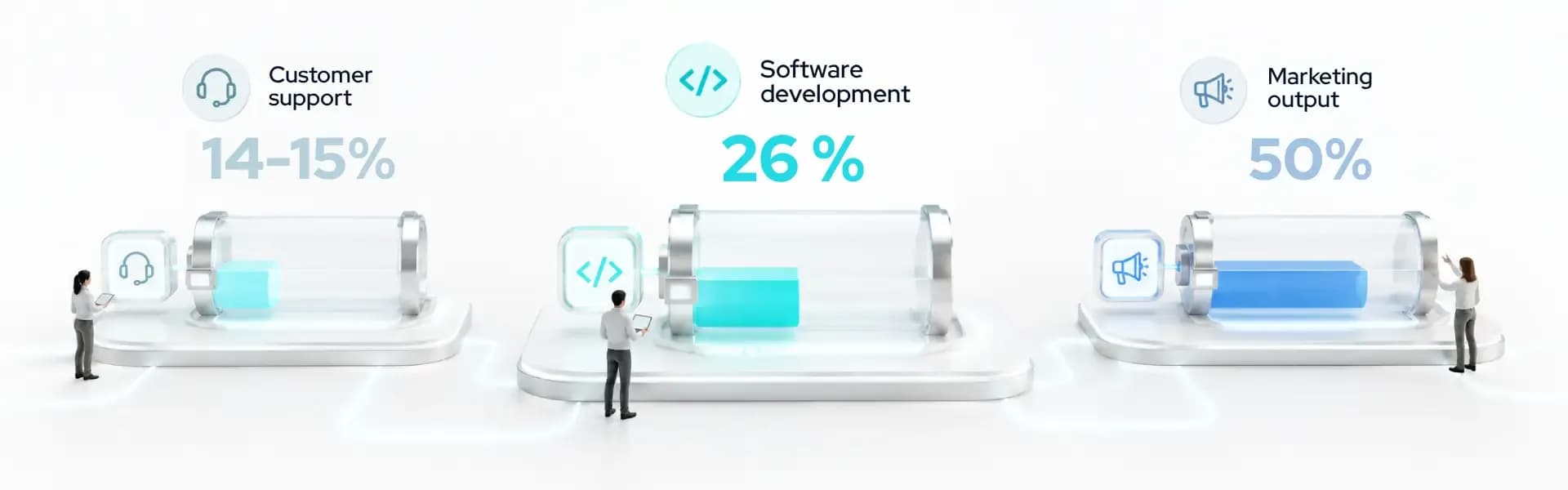
As those gains become part of everyday software delivery, improving the path from product insight to product decision becomes an increasingly valuable source of speed.
What a faster product operating model looks like
Several years ago, I wrote about treating the product roadmap as a living document: a shared direction that evolves as the team learns more about customers, the business, and the product itself.
That principle becomes especially useful when delivery cycles get shorter: Product has less time between one development decision and the next, so learning, prioritization, and decision-making need to happen closer to the work already in progress.
AI is also changing the shape of the teams doing that work: smaller, more autonomous teams stay closer to the problem, reduce handoffs, and move through shorter cycles, which makes the way Product gathers signals and turns them into decisions even more important.
I am also starting to see a rebalancing between Product and Engineering. As AI allows smaller engineering teams to produce more, some companies are putting more capacity on the Product side. Building is not a constraint anymore, deciding what to build and why is. Anthropic offers a recent example: its growth organization was reportedly encouraged to hire more product managers as Claude Code increased engineering throughput.

I do not think this means every company simply needs more product managers. What matters is having enough Product capacity to stay involved as development moves forward, rather than defining an initiative, handing it off, and moving on.
In practice, I would focus on three areas that help make that involvement work:
- Product learning that keeps running while delivery is underway
- Clear ownership of each decision
- A read on where product decisions actually stall
Keep learning running alongside delivery
Continuous learning gives Product a way to capture new signals and connect them back to the roadmap.
Support, Sales, product analytics, interviews, and Engineering all generate useful inputs. What's changed is how quickly those inputs can be synthesized and connected back to the roadmap while current initiatives are still moving forward.
At the same time, a structured Discovery process remains essential for aligning stakeholders, understanding constraints, and framing the right problems at the start. Discovery creates that initial foundation, while learning continues throughout delivery and as the product evolves.
Make decision ownership explicit
Smaller, more autonomous teams can move quickly when people are clear about which decisions they can make and when they need input from others.
Many Product decisions cross functional boundaries, so the team needs to know who owns the final call. Clear decision ownership defines where a team has room to move independently, which stakeholders need to be involved for a particular type of decision, and when enough information is available to move forward.
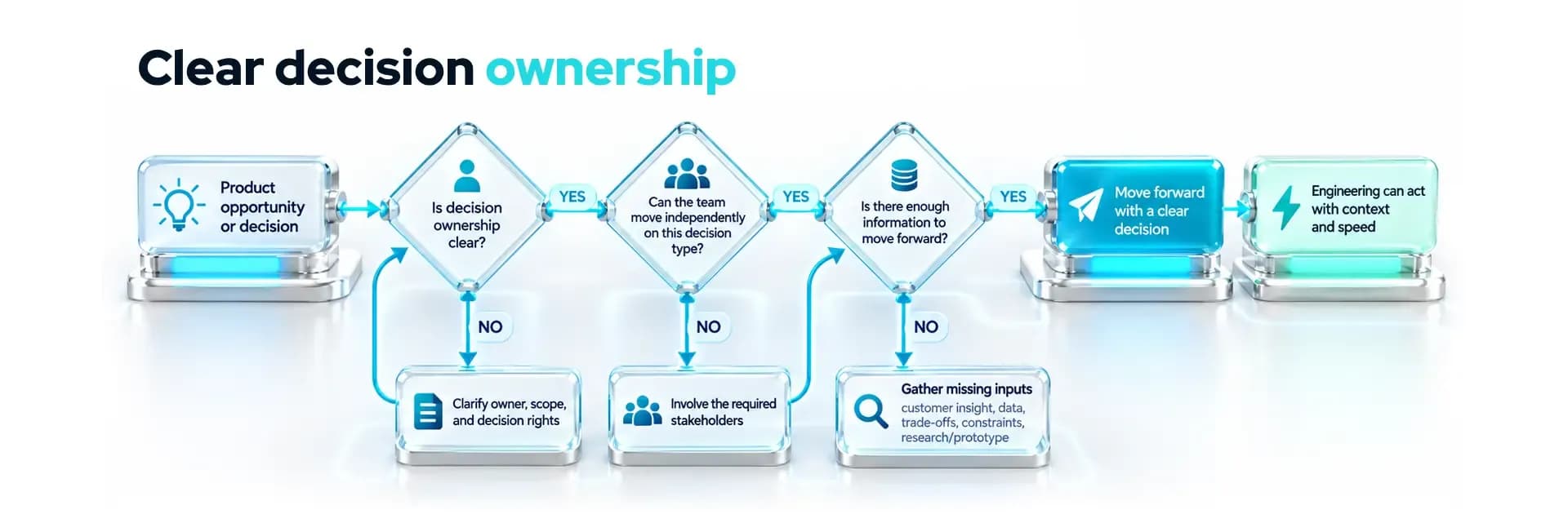
For me, this is closely connected to autonomy. Product can collaborate where collaboration adds value and keep moving where the team already has the context and authority it needs.
Look at where product decisions actually lose time
I would also pay attention to where time is being spent between identifying an opportunity and making a decision about it.
Sometimes the longest part of the process is research. In other cases, the team already has enough information, but the decision moves through several conversations or waits for input. This dynamic is explored further in "Decision latency is the next frontier of AI value", which looks at the time between having enough information and actually making the call.
Understanding those patterns can help Product identify where unnecessary friction exists without sacrificing the quality of the decision.
For PE-backed companies, earlier product decisions can bring value forward
I find this shift especially relevant in private equity because timing has a very tangible relationship with value creation.
A portfolio company has a defined period in which to execute its plan. When a product initiative reaches the market earlier, the company has more time to benefit from its impact.
We saw this pattern play out with Vetsource International, which expanded into two new markets in under six months. Getting the product definition right the first time turned that expansion into a repeatable pattern, cutting the time-to-market for the markets that followed by as much as 80%.
Product definition plays an important role here because broad value-creation objectives eventually have to become concrete choices. A priority such as improving retention or expanding margins still needs to be translated into a specific product problem that the team can evaluate and prioritize.
Acquisitions make the connection even more visible. Once two businesses come together, leadership may need to decide which capabilities should remain, where experiences should converge, which integrations matter most, and where a new product approach makes sense.
Greater engineering capacity means several paths may now be executable at once. This is where Product speed becomes essential, because Product is responsible for determining which path best supports users, the combined business, and the investment strategy.

The next opportunity for Product
AI has expanded what Engineering can accomplish. Product needs enough capacity to stay involved as development moves forward, keep direction clear as new information emerges, and make sure the next important decision is ready when Engineering has the capacity to act on it.
That may change how companies structure their teams and how closely product leaders work with Engineering throughout the process.
The opportunity now is to evolve Product with the same intention, so that greater execution capacity translates into better products and stronger business outcomes.
Reach out to Making Sense to map where your product decisions are losing pace, and what a faster operating model would look like for your team.
Sep 10, 2026