
IT Strategies Built Around Agentic AI and Workflow Automation
Agentic AI is changing what IT strategy has to account for. The opportunity starts with workflow design, measurable outcomes, and clear human oversight.

Sep 22, 2026
For years, IT strategy centered on building a stronger technology foundation: modernizing legacy systems, moving workloads to the cloud, improving security, and making data easier to access. Those priorities remain essential. Effective IT strategies increasingly need to define how AI-enabled software can act across workflows, coordinate multiple systems, and escalate decisions when human judgment is required.
U.S. business data shows that AI is already moving into day-to-day operations, particularly as company size increases. According to the U.S. Census Bureau, 32% of firms with 100 to 249 employees and 37% of firms with at least 250 employees reported using AI in their operations. Yet adoption within those organizations often remains relatively concentrated: among firms using AI, 57% apply it across three business functions or fewer.
As AI moves deeper into operations, IT leaders have to make a more specific set of decisions about autonomy: what software can do on its own, which systems it can act across, and where human oversight needs to remain in the workflow.
How agentic AI changes the design of IT strategies
Agentic AI expands the role AI can play inside an operation. MIT Sloan describes AI agents as systems that can integrate with other software and complete tasks independently or with minimal human supervision. In practice, that can mean reading an incoming request, gathering information from several systems, reasoning within defined business rules and permissions, taking an approved action, and routing an exception to the right person.
That capability affects several parts of an IT strategy at once. Architecture has to support secure access across systems, while data needs to be available in the right context. Teams need explicit rules for what an agent can decide, which actions require approval, and where direct human ownership remains necessary. Monitoring and observability also become part of the design because leaders need visibility into what the system did, how reliably it performed, and when people had to intervene.
Workflow automation complements that capability. Traditional automation is well suited to stable, repeatable steps with clear rules. Agentic systems can operate across more variable sequences, use context from multiple sources, and choose among bounded actions. In practice, a single business workflow may use both approaches at different stages.
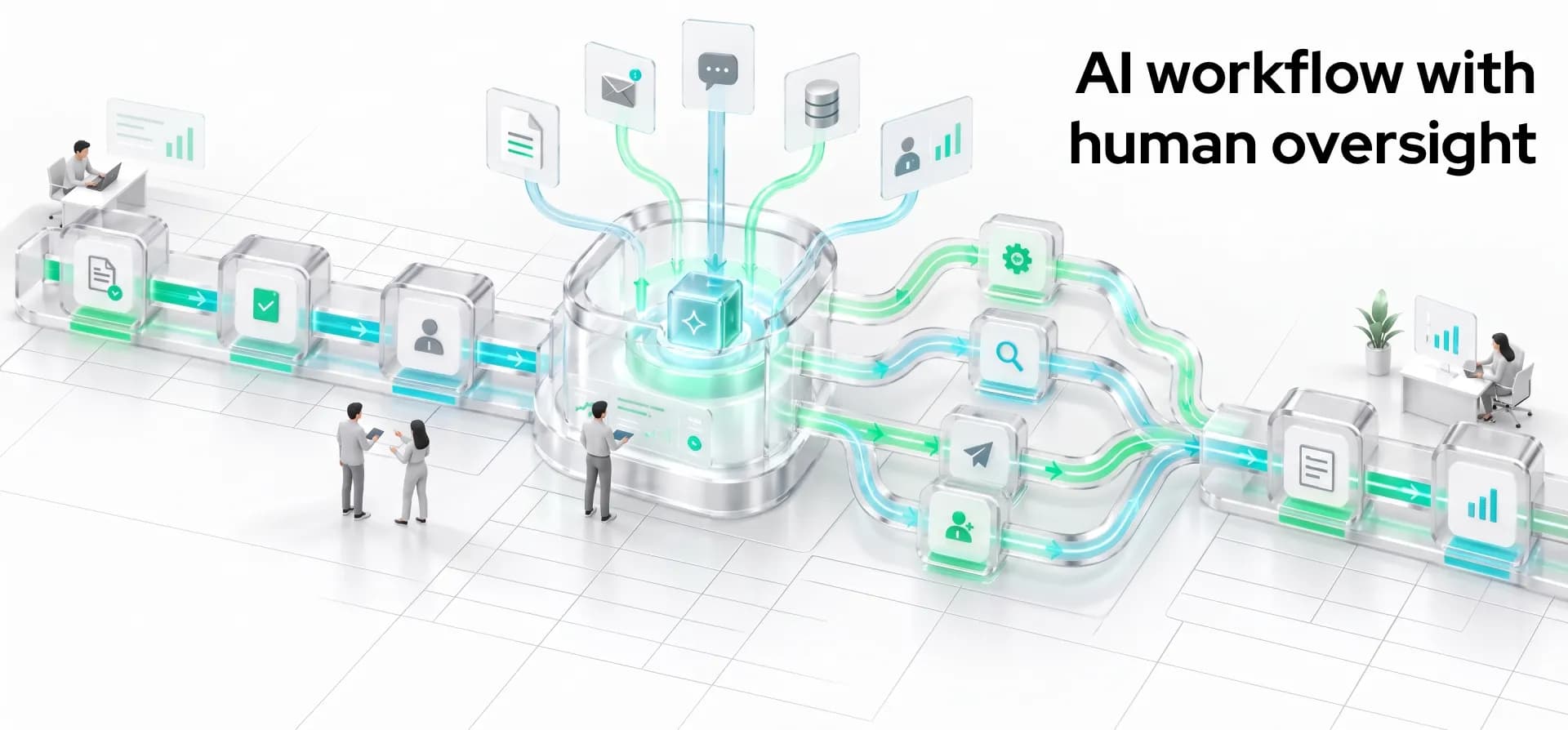
The result is a broader strategic question for IT leaders: instead of evaluating AI as another category in the technology stack, they need to determine how work should move across people, systems, automation, and agents.
Start with the workflow that creates the business outcome
The workflow is where an IT strategy becomes operational. It reveals which steps follow fixed rules, where contextual reasoning can add value, and which decisions still require human ownership.
Consider customer intake: the outcome may depend on receiving a request, validating information, finding missing data, updating a CRM, assigning ownership, scheduling a follow-up, and escalating an unusual case. Improving one step may reduce effort locally. Redesigning how those steps connect can change the cycle time and cost of the entire process.
That distinction matters because AI can create more value when organizations examine the structure of work itself. Research highlighted by MIT Sloan argues that some of AI’s largest effects emerge from changes in how tasks are sequenced, grouped, and handed off between humans and machines.
For an IT leader, a useful workflow assessment separates three categories:
- Deterministic steps, where rules are stable enough for standard automation.
- Bounded decisions, where an agent can use context and take action within clear permissions.
- Human-owned decisions, where risk, accountability, customer sensitivity, or domain expertise requires direct review.
The classification also exposes the exceptions, dependencies, integrations, and approval points that determine whether an automated workflow holds up in production.
What this looks like in a mid-market environment
For mid-market and PE-backed companies, value usually becomes visible first in operational metrics such as response time, throughput, processing cost, conversion, and manual effort.
Auto Approve offers a useful example of the discovery work that can happen before implementation. The auto loan refinancing company was dealing with nearly 1,000 unanswered calls on peak days, along with incomplete interactions, data inaccuracies, and customer drop-off.

Making Sense analyzed call center data and tested business hypotheses to understand where technology and process changes could create value. The analysis identified opportunities for up to a 25% potential reduction in missed calls, 30% faster response times, and a possible 20% increase in loan application completion.
That sequencing mattered: with the operation mapped, a baseline in place, and the friction points named, the team could see where AI, automation, or a change in the process itself would pay off.
Esquire Depositions shows how the same logic can extend into a broader operating model: Making Sense helped the legal services company centralize data, streamline workflows, and introduce AI-driven automation while supporting growth through acquisitions. The resulting platform contributed to a 40% increase in operational efficiency and a 10% rise in enterprise valuation.
These examples illustrate why technology choices become easier to prioritize when each initiative is tied to a measurable business constraint. Architecture, integration, automation, and AI can then be evaluated according to the outcome the company is trying to improve.
A practical framework for updating your IT strategy
Building AI and automation into an IT strategy can begin with a focused sequence that tests the business case while creating the foundation for broader adoption:
- Start by mapping the workflows that generate the most friction or consume significant manual effort. Look for meaningful volume, repeated patterns, measurable baselines, and an exception rate that people can realistically manage.
- Then define the decision architecture. Document which steps follow fixed rules, where contextual reasoning is useful, what systems the workflow needs to access, and which actions require human approval. This is where permissions, escalation paths, ownership, and governance become part of the solution design.
- Next, establish the baseline. Metrics such as cycle time, cost per transaction, error rate, conversion, backlog, and employee hours make it possible to evaluate whether the initiative is actually improving the operation.
- From there, pilot one contained workflow and measure the outcome against that baseline. Making Sense has seen delivery benchmarks including 5x faster time-to-production with AI-enabled development and approximately 30 days from kickoff to a first measurable AI outcome. The achievable timeline in an individual engagement depends on factors such as data readiness, integration complexity, workflow scope, and the number of exceptions the system has to handle.
- Finally, involve the people who manage the process, handle exceptions, or own the customer outcome. They often understand conditions and edge cases that formal process diagrams miss, and their feedback becomes especially valuable once the system begins operating. That involvement also connects the technology roadmap with AI adoption and change management. New workflows can change responsibilities, approval paths, and everyday routines, so implementation needs to account for how employees will interact with the system and who will remain accountable for its outcomes.
The technical foundation follows the workflow
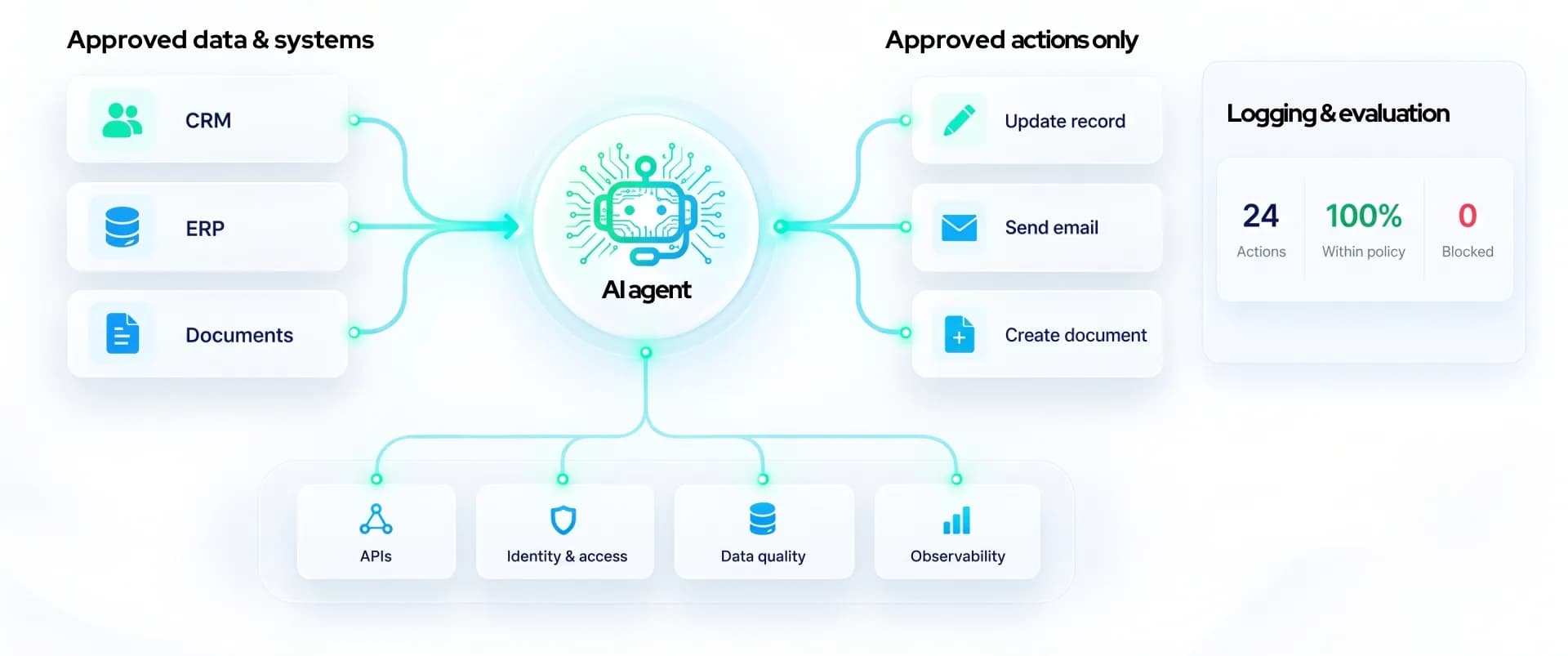
Agentic systems depend on reliable access to data and business systems. For each target workflow, IT teams need to understand what information an agent requires, which systems it has permission to access, what actions it can perform, and how those actions will be logged and evaluated.
That makes APIs, identity and access management, data quality, integration architecture, security controls, and observability directly relevant to the workflow. The technical priority becomes clearer because each component supports a specific operational requirement.
Legacy systems can also be approached incrementally. Integration layers and APIs can connect older platforms with new automated workflows while modernization focuses first on the systems creating the greatest operational constraint. This allows investment to follow demonstrated business impact and gives leaders evidence for deciding what should be modernized next.
For private equity-backed companies, the same sequence can connect technology investment directly with operational efficiency, scalability, customer experience, EBITDA, and enterprise value.
Key questions about agentic AI and IT strategy
What should a modern IT strategy include?
A modern IT strategy covers infrastructure, security, architecture, data, applications, resilience, and technology investment. It should also define how AI and automation operate across business workflows, including system access, governance, human oversight, accountability, and measurable outcomes.
How is agentic AI different from an AI assistant?
An AI assistant typically helps a person complete a discrete task, such as summarizing information or drafting content. An agentic system can coordinate several steps, interact with software tools, use contextual information, and take approved actions within defined boundaries.
Does adopting agentic AI require replacing the existing tech stack?
Many implementations can begin by connecting existing systems through APIs, orchestration layers, and controlled access. Modernization can then focus on the systems creating the greatest constraint for the workflow being improved.
Where should a mid-market company start?
Start with one workflow that has meaningful volume, measurable friction, and clear ownership. Establish the baseline, map the decisions and exceptions, and define the smallest implementation capable of producing a measurable business result.
How quickly can an AI initiative show measurable value?
A contained workflow with accessible data, manageable integration requirements, and clear success metrics can produce evidence within weeks. Making Sense has seen first measurable AI outcomes within approximately 30 days in focused engagements, although the timeline depends on the complexity and readiness of each organization.
Turn AI ambition into an operating model
Effective IT strategies translate AI ambition into specific operating decisions: which workflows should change, what an agent can access and decide, where people remain accountable, and which metrics will determine whether the investment is creating value.
That creates a more useful roadmap than a list of AI initiatives. Each technology decision can be traced back to a workflow, a business constraint, and an outcome the organization can measure. For mid-market and PE-backed companies, that connection is what turns AI and automation into operational leverage that can support efficiency, scalability, customer experience, and enterprise value.
Sep 22, 2026





