
Five Signs Your Tech Stack Will Be a Problem at Your Next Exit
Five technology signals that influence buyer confidence, and how mid-market companies can address them before diligence begins.

Jul 29, 2026
Most mid-market companies run on a tech stack that works fine day to day. The harder test comes when someone looks at it closely: a buyer during due diligence, a new partner, or the leadership team itself trying to figure out where things actually stand. That closer look usually confirms what everyone already knew: the dependencies and workarounds a company learned to live with.
The knowledge is usually already in the building, just split across people who each hold one piece of it: the manager who knows invoicing depends on a nightly export, the analyst who knows the dashboard breaks when that export runs late, the IT lead who has been meaning to bring up the vendor contract since last year. Nobody has ever put those three facts on the same page.
The technology due diligence work we do for private equity funds and strategic buyers pulls those pieces into one place, tests whether each one holds up, and puts a cost and a priority against it: what fixing it would take, what happens if nobody does, and which items actually matter for the plan the business is trying to execute. The blind spots that turn up along the way are a bonus. What leadership walks away with is a documented view of the stack that didn't exist in that form before, and that stays useful long after the review is over.
These are five signs that come up often in a tech due diligence review, and what tends to change once a company gets ahead of them.
1. When a core system is stuck on an old version
When a company runs on a legacy system, or keeps working with a five-year-old version of an ERP that no longer receives updates, there are usually plenty of valid reasons behind why the change or upgrade got postponed. Everything requires time and investment, and both tend to be in short supply. Because everything still works, there's a false sense that there's no problem today, when in fact there is one, it's just that nobody is looking at it. It's more common than most leadership teams assume: Gartner estimates that around 40% of infrastructure systems in the average company are carrying this kind of accumulated debt.
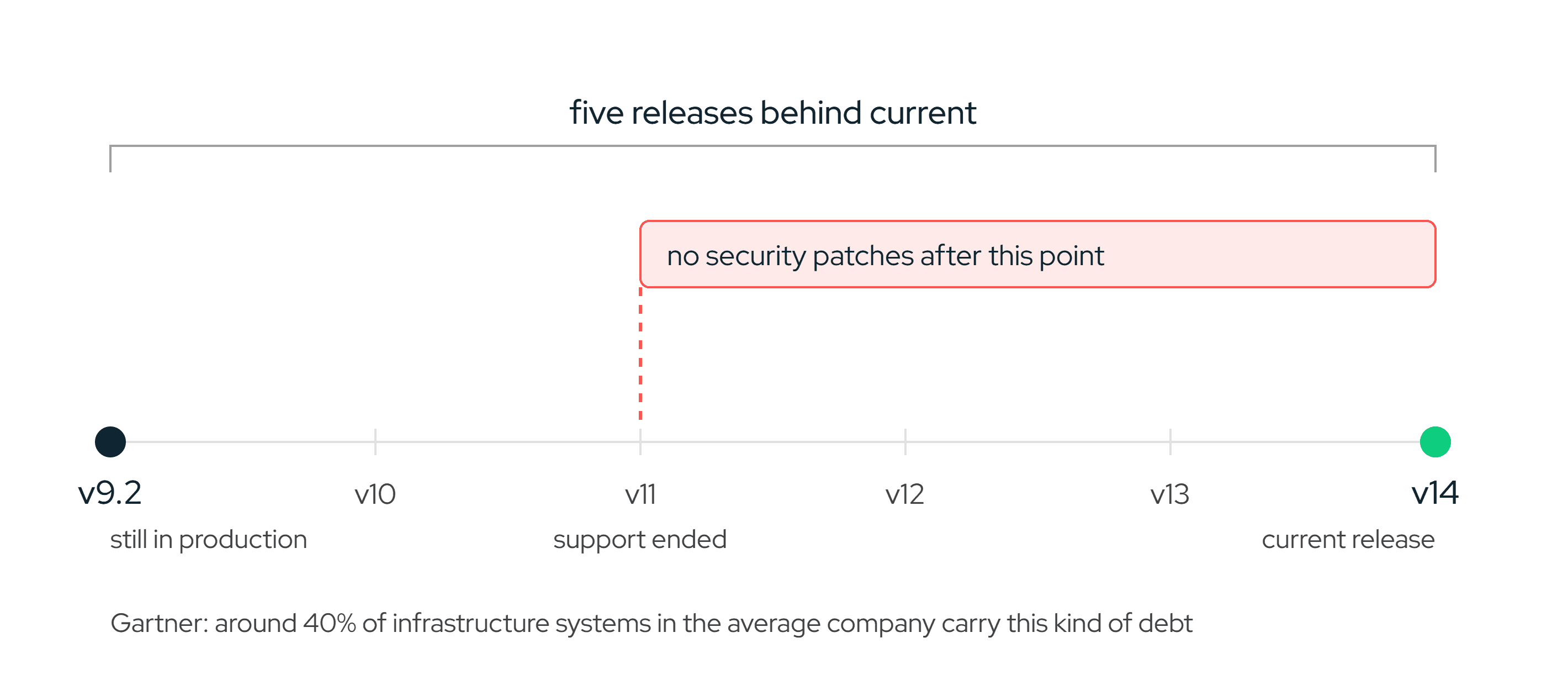
The first risk of running an old system is that outdated versions can rarely install security patches, and this can put the company's data, or even the entire operation, at risk. It might sound alarmist, but there are plenty of examples of companies that underestimated security and ended up paying far steeper consequences for it.
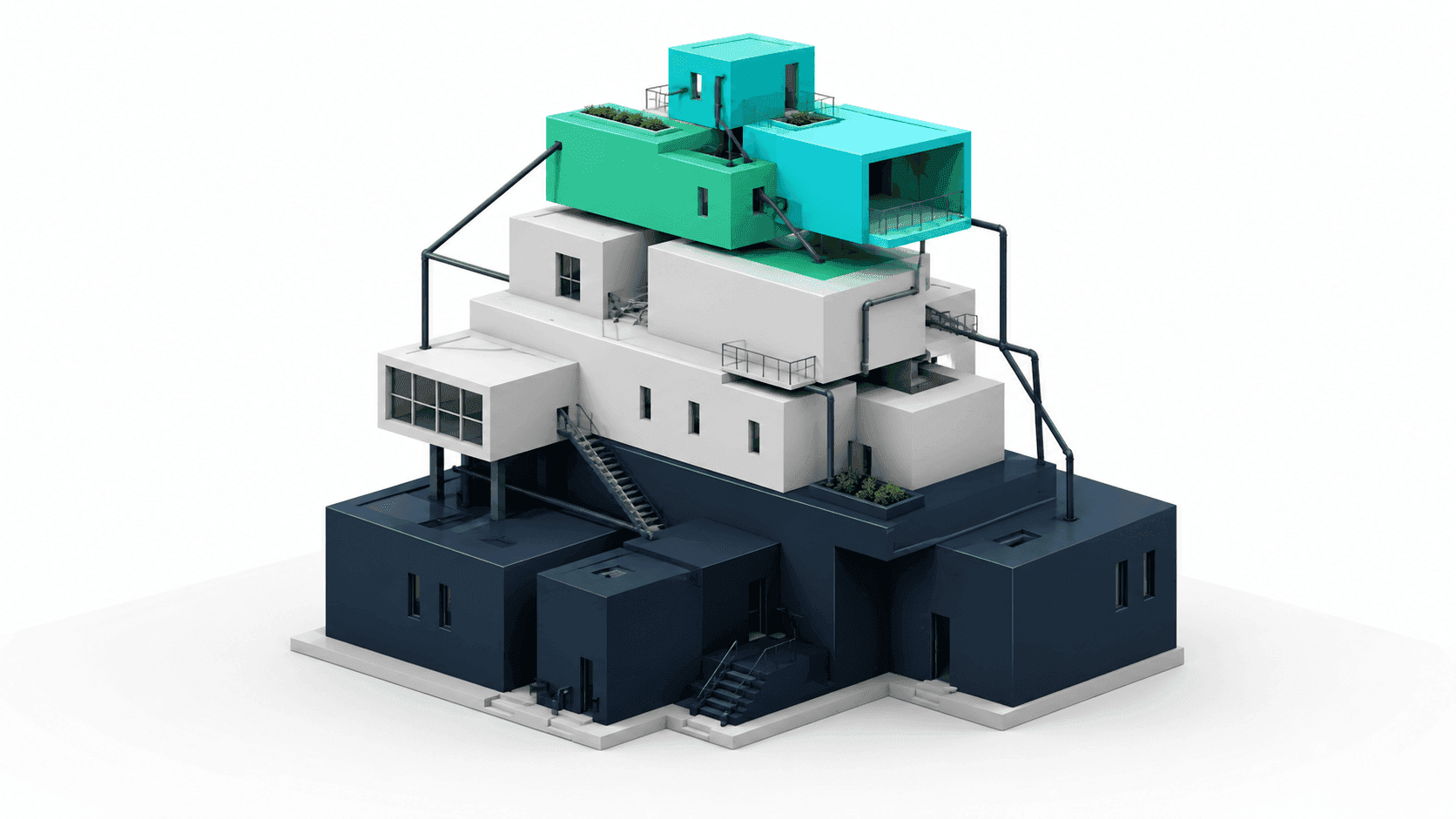
On the other hand, an old system tends to resemble a house that kept getting expanded over time: an extra room added on the terrace, a gas line extension to support a heater nobody had originally planned for, wiring run off an outlet because it had to get fixed as fast as possible. Nothing tidy, nothing planned, no blueprints anyone could review. In a legacy system, this translates into patches covering many functions, workarounds only one developer understands, and ad-hoc integrations that took weeks to build and are better left untouched.
When a system like this turns up during technical due diligence, the first question is how much the business depends on it, and the second is what the full migration plan looks like. The good news is that this no longer has to be a deal breaker. With AI, initiatives that once took months or even years can now begin showing tangible results while an M&A process is still underway.
2. When nobody has put a number on what the shortcuts cost
Technical debt is what accumulates when a team picks speed over structure. This usually happens for defensible reasons, like an integration hardcoded by hand to meet a launch date, but then the fix that was meant to be temporary becomes the way the process runs. Each of those decisions is defensible on its own. What separates companies is whether anyone has added them up and put a number on what carrying them costs.
MIT Sloan Management Review makes the case that technical debt belongs on the C-suite agenda rather than living entirely inside IT, and that the useful conversation is about which debt to fix now, which to postpone with a clear reason and a date to revisit it, and what each of those choices costs the business in the meantime.
Getting to a number doesn't require a formal audit. A few questions get most of the way here:
- How much of last year's development budget went to keeping things running rather than building anything new?
- Which workaround has quietly become load-bearing, the kind that would stop a process cold if someone pulled it out?
- Where does one change require touching two other places by hand, because that connection was never automated?
- How many of last quarter's incidents traced back to the same handful of fixes?
Answering these is worth doing regardless of whether a sale is anywhere on the horizon. It converts a vague sense that the platform is fragile into a list with costs attached, and gives leadership a number to weigh against everything else competing for the same budget.
3. When every team keeps its own tool, and nobody owns the decision to consolidate
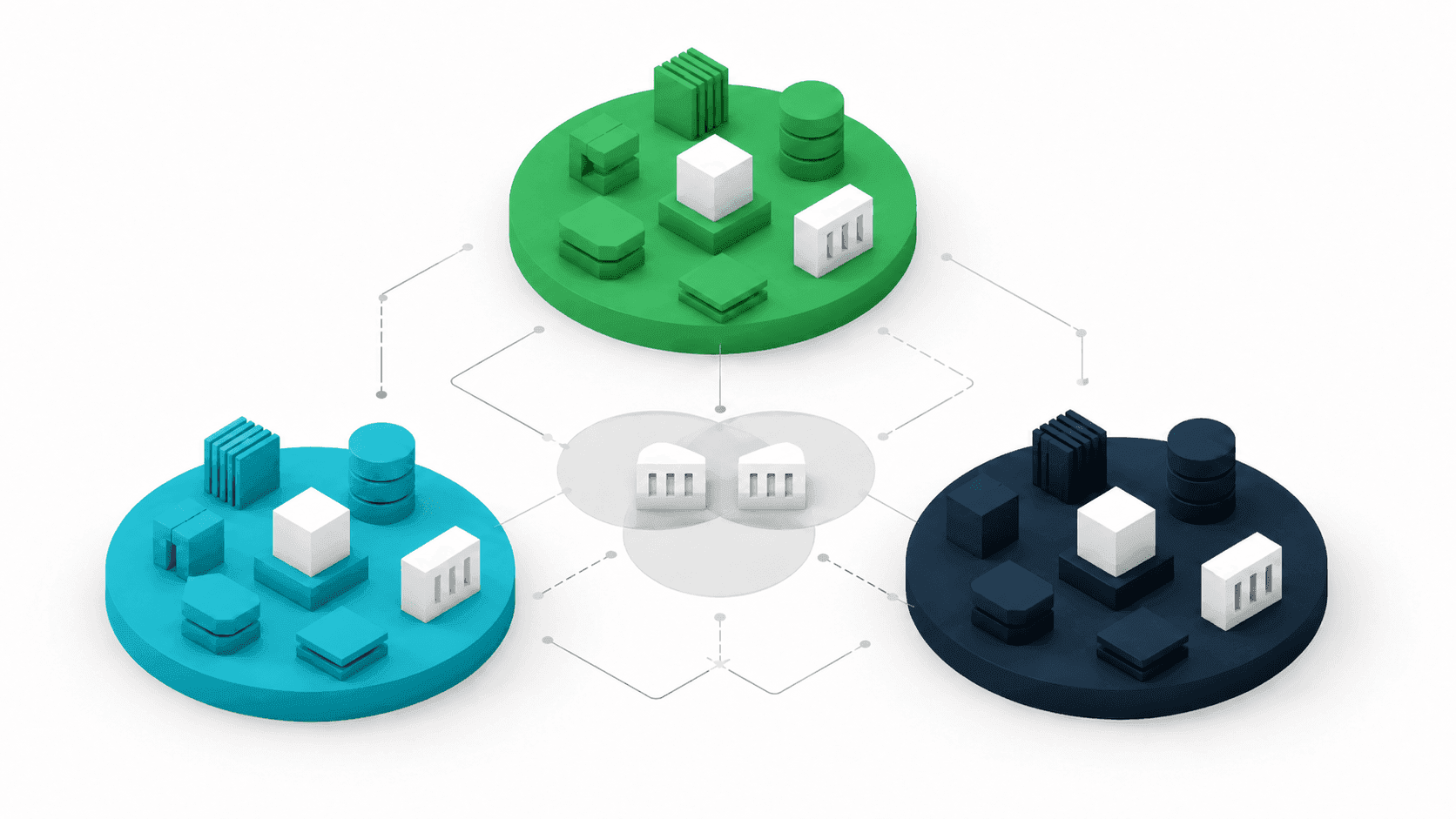
This is a scenario many companies will recognize: the sales team runs its own CRM, tracking customer data, leads, new deals, and the status of every account. Marketing, meanwhile, prefers a different email platform, one with better design options and AI-powered content creation. Customer Success agreed to pay for two CRM licenses, but kept a separate tool that gives it a clearer read on each customer's health. The unification question has come up in more than one meeting, but it's never landed on a consensus, so everyone keeps using whatever tool they feel most comfortable working in.
The real cost shows up later, and this might sound familiar:
- Duplicate, inconsistent records: the same customer exists in two platforms with two different records. That leads to reports that don't reconcile across teams, and decisions made on data that doesn't match.
- Lost visibility between teams: support can't see what sales promised the customer. The result is an inconsistent customer experience, with answers that contradict what the customer already heard from another team.
- Fragile integrations: every integration built to connect the tools becomes one more point of failure whenever either side updates. That means unexpected breakages, and engineering time spent maintaining bridges instead of building new functionality.
- Recurring cost: paying for three tools that each handle part of the same job is a quiet expense, one that weighs on the budget and could instead be optimized, or redirected toward building new features.
Detecting these overlaps isn't complex, if anything it's the opposite: these are things that come up in the first conversations. What's complex is solving it, and that requires understanding whether one tool can really absorb what all of them were doing, and whether consolidating means paying for a migration on top of the licenses. This is exactly what the company never stopped to resolve, and it's what a buyer is trying to understand.
4. When two systems give different answers to the same question
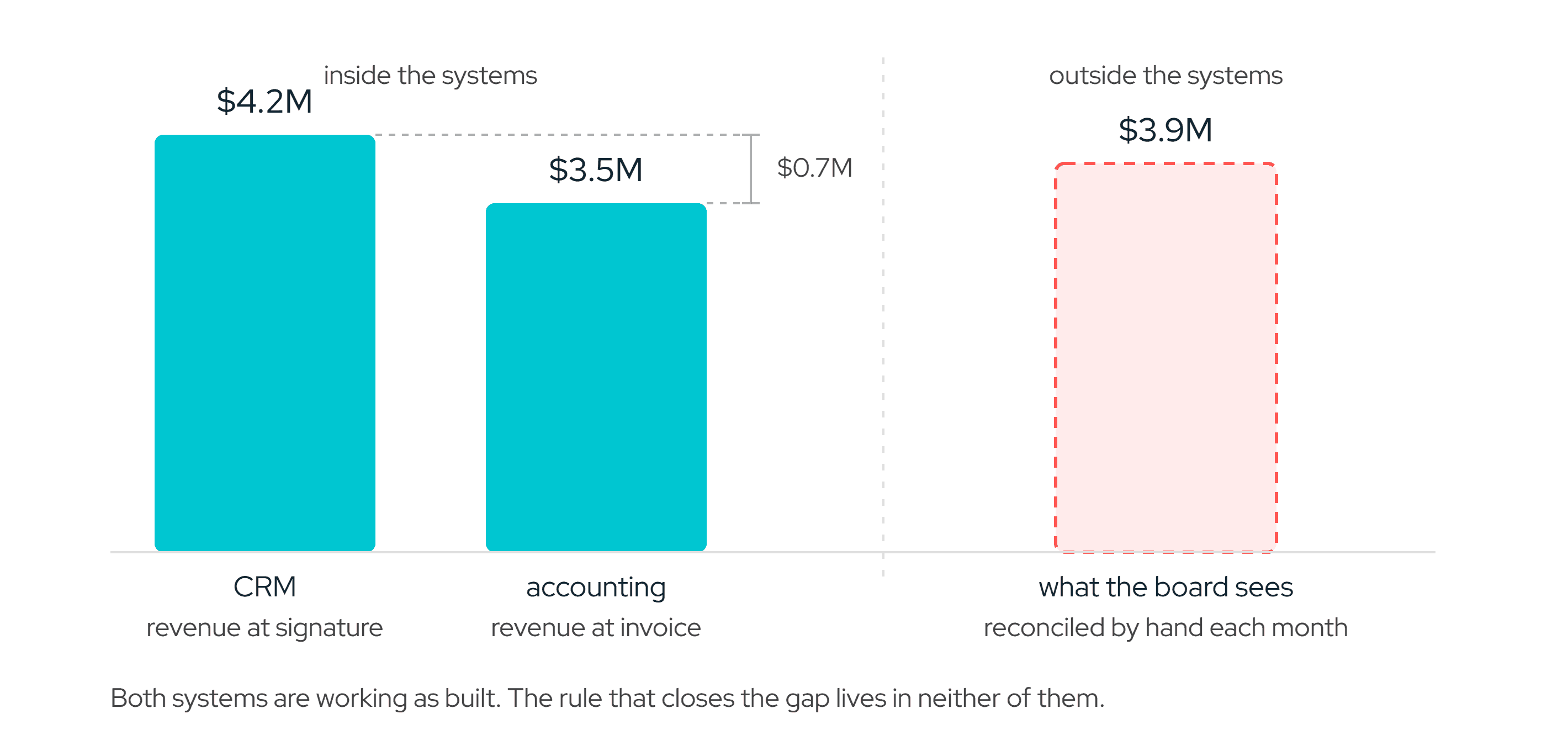
Ask what revenue was last month, and in plenty of mid-market companies the answer depends on which system you ask. The CRM reports one figure, the accounting system reports another, and the number that reaches the board comes out of a spreadsheet where the two get reconciled by hand every month.
Both systems are usually working exactly as built, but they count different things: one books revenue at signature, the other at invoice, and the gap between them is legitimate. Here's what's missing: the rule for closing that gap. And since it was never written into either system, it gets solved by hand every month, outside the software. When we ask how the number was built and the answer runs through three exports and a manual adjustment, a buyer has to decide how much weight to give a figure that only exists after someone reconciles it by hand, not one either system generates on its own.
The fix here is mostly configuration: for each metric, choose one system as the official source of the number, and build the rule that today gets applied by hand to close the gap between systems directly into the software. When a buyer asks to see where each figure comes from and every one of them can be reproduced consistently, putting this part of diligence together takes the company a morning. If instead each number depends on a different manual adjustment, made at the time by a different person, rebuilding all of that from scratch to support figures that were already reported takes an entire week.
5. When a manual process only scales by adding people
It might seem like automating everything is table stakes today, but not every process deserves that kind of investment, especially the ones that are occasional, low-volume, or can be handled with a simple workaround that doesn't create dependencies.
The rest, the processes that stay manual with no good reason, are harder to justify, usually because nobody ever owned the decision to change them. But the real problem here isn't technical, it's a business problem: for a buyer planning to double the business in three years, this means the growth plan comes tied to a technology investment that isn't part of the deal, but has to happen anyway for the acquisition to actually pay off.
This is where due diligence can flag a risk the buyer isn't willing to take, or change the terms of the negotiation. Either way, the company ends up paying for repetitive manual work that should have been automated a long time ago.
What to do before any of this reaches a data room
Across all five of these signs, there's a pattern that repeats, and it has nothing to do with lack of investment: it comes down to a lack of ownership, communication, and prioritization. When everything seems to run fine and there's no visibility into technical debt, updating the company's core system simply doesn't make it onto the roadmap.
A due diligence process helps bring the situation into view, understand where the biggest risk sits, and plan a strategic roadmap to build the technology stack the company actually needs. Either way, the technical team will end up involved, so it's worth having them start mapping these questions early:
- Are there recurring manual processes that could be automated?
- Are there CRMs, ERPs, or other systems with monthly or annual license fees that could be consolidated? How many of those CRM or ERP features actually get used, enough to justify the license cost over building something custom?
- Which systems stay in place just because they've always worked, even though they don't run optimally and carry integration or security issues?
- Does the CTO send reports that give visibility into the stack's technical debt? Is there an upgrade roadmap?
There's an advantage here that companies didn't have a few years ago. AI tools now handle a good share of the slow, repetitive work in a modernization project, so the gap between deciding to fix something and having it fixed is shorter than it used to be. Working out why a process behaves the way it does, when nobody ever wrote it down, still takes as long as it always has.
A technology due diligence assessment done well before a transaction gives the company a cost against each fix and a plan it can work through on its own schedule. Run during a deal, the same findings arrive as questions someone has to answer under time pressure, and by then the buyer has already built them into the price.
Ready to see how your stack would hold up in a buyer's diligence? Schedule a call with our team and we'll walk through it together.
Jul 29, 2026