

Merger IT Integration as a Strategic Value Lever for Private Equity
In private equity, IT integration defines whether synergies materialize or stall. Here’s how to approach merger IT integration as a true value creation lever.

Feb 25, 2026
Mergers and acquisitions are built on a promise: synergies, efficiency, growth, and ultimately higher valuation. Financial modeling may define the upside. Merger IT integration determines whether that upside materializes.
In private equity, this dynamic becomes even more critical. Value creation plans are time-bound. Hold periods are finite. EBITDA expansion depends on operational alignment. Yet merger IT integration is still frequently treated as a downstream task, something to address after closing once financial consolidation is complete.
In our experience working with private equity-backed companies, sequencing creates structural risk.
Merger IT integration is not an operational afterthought. It is a strategic lever that directly influences speed to synergy, cost structure optimization, scalability, and exit readiness. Increasingly, it serves as a primary driver of how quickly portfolio companies translate deal thesis into measurable value.
Why merger IT integration defines deal success
When two organizations merge, their systems rarely align organically. Different ERP platforms, CRM environments, data models, cybersecurity standards, and reporting frameworks coexist. What initially looks like technical misalignment quickly becomes operational friction.

Without a structured merger IT integration approach, financial reporting becomes inconsistent, customer data remains fragmented, and cross-selling initiatives stall. Duplicated workflows inflate costs, while leadership loses real-time visibility across the combined organization.
We frequently see this pattern in post-close environments: integration plans focus heavily on finance, while operational systems remain loosely connected. The result is delayed synergy realization and operational inefficiency that compounds over time.
The impact is measurable. Revenue synergies are postponed. Cost-saving assumptions fail to materialize. Teams navigate redundant systems. Customer experience suffers during transition.
Integration determines whether the deal thesis becomes operational reality.
Why merger IT integration is especially important in private equity

Strategic acquirers may tolerate multi-year integration horizons. Private equity firms cannot.
Defined hold periods, explicit value creation plans, and clearly defined exit targets naturally compress execution timelines, which means that every quarter spent stabilizing fragmented systems reduces the effective window available for margin expansion and strategic growth.
At the same time, portfolio companies often inherit legacy architectures, and bolt-on acquisitions tend to compound technical complexity. Without a structured merger IT integration framework, that complexity accumulates across the platform as technical debt, increasing operational risk and slowing the organization’s ability to scale.
This is why technology assessment must begin before closing. A rigorous evaluation of architecture scalability, cybersecurity posture, data maturity, and integration complexity reduces post-close surprises and clarifies sequencing.
Leading investors increasingly embed these findings directly into the value creation plan, ensuring integration priorities are funded, governed, and executed from day one.
This is the purpose of our Technology IT Due Diligence Services, which align technical realities with the investment thesis before capital is deployed. In several diligence processes we’ve supported, early identification of integration friction reshaped synergy assumptions and prevented unrealistic post-close expectations.
In private equity, merger IT integration is not only about consolidation. It is about protecting the investment thesis from operational erosion.
Merger IT integration across the private equity lifecycle
Effective merger IT integration evolves across the investment lifecycle.
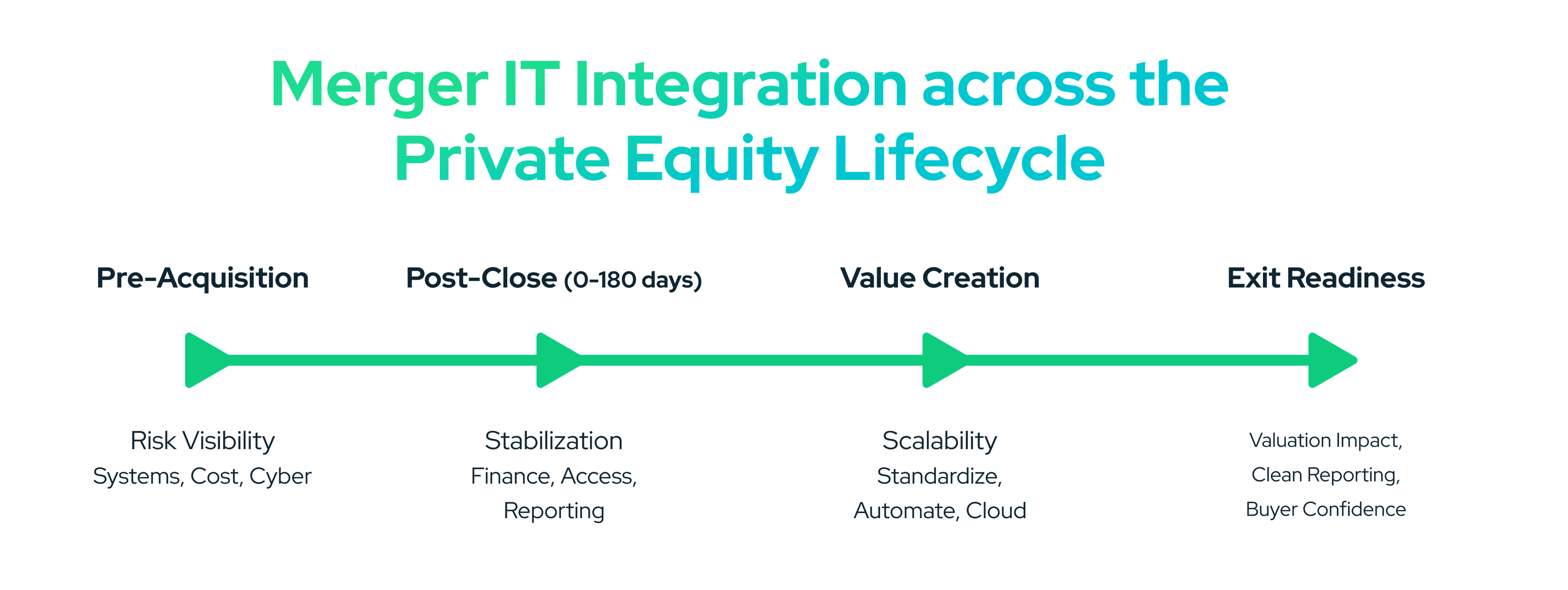
Pre-acquisition: risk visibility
Before closing, investors must understand:
- How interoperable are existing systems?
- What is the true cost and timeline of integration?
- How complex is data harmonization?
- Is cybersecurity exposure manageable?
- Can the architecture scale under projected growth?
At this stage, the objective is clarity. Unrealistic synergy projections often stem from insufficient technical insight during diligence. Integration complexity should inform deal modeling, not surprise operators post-close.
Post-close stabilization: first 100–180 days
Immediately after closing, stability takes priority. Financial systems must align. Access management must be consolidated. Reporting standards must be unified. High-impact interoperability must be established without disrupting ongoing operations.
In our experience, this window is decisive. When merger IT integration milestones are clearly defined in the first 100–180 days, organizations reduce value leakage and build confidence across teams. When integration remains loosely defined, uncertainty slows decision-making.
This phase minimizes operational disruption and establishes the foundation for scalable growth.
Value acceleration: standardization and enablement
Once stability is achieved, merger IT integration becomes a growth enabler. Platform standardization across portfolio companies reduces cost structures. Cloud migration increases scalability. Process automation drives margin improvement. Data harmonization enables advanced analytics.
This is also where integration unlocks AI readiness. Without clean architecture and unified data models, AI initiatives often stall. As discussed in our article on AI Implementation Challenges, scaling intelligent systems requires disciplined execution and operational clarity.
Across private equity platforms, integration maturity is increasingly the gating factor between isolated AI pilots and enterprise-scale intelligent operations. Merger IT integration provides the structural foundation that makes that transition possible.
Exit readiness: integration as valuation driver
As companies approach exit, technology maturity becomes increasingly visible. In our experience, we see two distinct scenarios play out.
Some organizations enter the exit process with fragmented systems, inconsistent reporting structures, and accumulated technical debt. In these cases, buyer diligence becomes more complex, perceived risk increases, and confidence in scalability weakens.
Others arrive at exit with merger IT integration executed early and documented clearly. Unified systems, clean reporting frameworks, and scalable architecture simplify diligence conversations and strengthen the valuation narrative.
We have seen exit processes accelerate significantly when integration maturity is embedded well before the sale process begins. Buyers value operational clarity. They value visibility. They value scalable infrastructure that supports continued growth.
Merger IT integration is not only about operating efficiency. It is about defining which of these two exit scenarios your portfolio company will represent.
Governance and operating models for successful IT integration

Technical integration is a critical step toward value realization, but it rarely delivers sustained business impact on its own. Governance discipline plays an equally important role in ensuring that integration progress translates into measurable outcomes.
Much like aligning systems without aligning decision ownership, technical progress without clear governance rarely translates into sustained business impact.
In portfolio environments, we often see integration momentum slow when ownership and accountability are not clearly defined. Without executive sponsorship and structured decision rights, merger IT integration can drift between IT and operations, losing strategic prioritization.
Successful integrations tend to share common governance characteristics, including executive sponsorship with clear decision authority, a defined integration management structure, KPIs explicitly tied to business outcomes such as system consolidation milestones and reporting cycle acceleration, and structured escalation paths for operational and technical conflicts.
Operating partners, CIOs, and portfolio leadership must align around a shared integration roadmap. When merger IT integration is embedded into the value creation plan rather than treated as a parallel initiative, execution becomes measurable and disciplined.
Integration is not merely a systems exercise. It is an operating model transformation aligned with EBITDA growth.
How to choose the right integration strategy
There is no universal merger IT integration model. Strategy must reflect the deal thesis, synergy magnitude, and hold horizon.
Below is a comparative framework frequently applied in private equity contexts:
| Strategy | Best Fit Scenario | Strategic Consideration in PE |
| Full consolidation | Long hold period and strong cost synergy thesis | Maximizes operational leverage but requires disciplined execution |
| Best-of-breed selection | Complementary capabilities across entities | Preserves innovation while reducing duplication |
| Standalone with interoperability | Short hold period or limited operational overlap | Minimizes disruption but limits deep synergy capture |
| Phased hybrid | Complex multi-entity roll-up strategy | Prioritizes high-impact integrations first while managing risk |
Choosing an overly aggressive model may inflate operational risk. Choosing an overly conservative model may suppress value creation potential.
Merger IT integration strategy must align explicitly with the investment thesis.
Common merger IT integration pitfalls and how to avoid them
Even well-structured integration plans can lose momentum when priorities are misaligned.
One common pattern is prioritizing financial consolidation while deferring operational system alignment. While finance integration may progress quickly, fragmented operational platforms can delay meaningful synergy capture.
Another frequent challenge is underestimating data complexity. Delayed data harmonization often becomes the primary blocker to unified reporting and scalable decision-making.
Cybersecurity exposure and over-customization introduce additional long-term risk if not addressed early in the integration roadmap.
Each of these challenges can be mitigated through disciplined planning, early governance alignment, and integration roadmaps tied directly to measurable business outcomes.
Turning integration into a value creation engine
Merger IT integration is where financial modeling meets operational execution.

When technology remains fragmented, synergies tend to stall, while aligned systems create the conditions for operational leverage to compound over time. In private equity environments, that distinction directly influences EBITDA growth, scalability, and exit valuation.
Integration should not be viewed as a technical cleanup initiative. It is a structured value creation discipline that protects the investment thesis and accelerates measurable impact across the portfolio.
At Making Sense, we partner with private equity firms and portfolio companies across the full lifecycle, from diligence through post-M&A integration and modernization.
If you would like to explore how a disciplined IT integration strategy can reduce risk, accelerate value creation, and strengthen exit positioning across your portfolio, contact us to continue the conversation.
Feb 25, 2026