

How Private Equity Portfolio Companies Accelerate Value Through Digital Strategy
Digital strategy has become a core accelerator of value in private equity portfolio companies. This article explores how PortCos turn technology into execution and EBITDA impact.

Feb 4, 2026
Private equity value creation has always been execution-driven.
Over the last decade, technology has become one of the most effective ways to accelerate that execution, improving speed, consistency, and scalability across portfolio companies. The challenge is rarely awareness. It is focused.
This article explores how private equity portfolio companies use digital strategy as a practical value accelerator, where focus tends to matter most, and how leading funds embed digital thinking across the investment lifecycle.
What is a portfolio company in private equity?
In private equity, a portfolio company is the operating platform through which the fund’s value creation thesis is executed during the holding period.
From an operating perspective, portfolio companies are defined by:
- Time-bound objectives tied to the investment horizon
- Capital discipline and prioritization pressure
- A constant focus on translating operational improvements into financial outcomes
In this context, technology decisions are evaluated pragmatically. What matters is whether technology helps the business execute faster, scale with control, and reduce operational and exit risk.
Digital strategy only matters insofar as it strengthens those outcomes.
Why digital strategy has become a core value driver in PE
In practice, we see digital strategy create value in private equity when it directly improves execution in three specific ways.
1. Speed to impact
Manual processes and fragmented systems slow execution by increasing handoffs, rework, and cycle times across core operations. This delays the moment when improvements translate into measurable results.
Digital initiatives accelerate impact by:
- Automating repetitive, high-volume workflows
- Simplifying execution paths across teams and systems
- Reducing operational friction that slows day-to-day work
This allows portfolio companies to capture gains earlier in the holding period, when compounding effects are strongest.

2. Scalable growth
Organic growth and add-on acquisitions introduce complexity quickly. Without a digital foundation, growth amplifies inefficiencies instead of value.
A focused digital strategy enables scalable growth by:
- Standardizing core processes across the organization
- Supporting faster integration of acquisitions
- Enabling revenue growth without linear cost increases
The result is growth that expands margins instead of eroding them.
3. Exit confidence
Technology posture is increasingly visible in buyer diligence. Legacy systems, opaque data, and fragile architectures translate directly into perceived risk.
A clear digital strategy improves exit readiness by:
- Increasing transparency and reporting confidence
- Reducing dependency on key individuals
- Demonstrating operational scalability
Outcome: a tighter link between operational execution and valuation.
Digital maturity assessment: the starting point for every PortCo
Before accelerating value, portfolio companies need clarity on where execution breaks down today and where it will break as the business scales.
A digital maturity assessment is a strategic diagnostic, not a technical audit. It aligns digital priorities with the value creation plan.

It typically evaluates four dimensions:
| Dimension | What it reveals |
| Core systems & architecture | Whether platforms can support scale without friction |
| Data & visibility | If leadership can rely on timely, consistent insights |
| Processes & automation | The level of process efficiency and automation maturity |
| Organization & governance | Whether ownership and decision rights are clear |
This baseline allows funds and management teams to:
- Prioritize initiatives based on value, not novelty
- Sequence execution realistically
- Reduce post-close surprises
Key digital levers that accelerate value creation
Across portfolio companies, a consistent set of digital levers drives the most impact:
- Core system modernization
Reduces friction, improves data integrity, and lowers long-term operating risk. - Data centralization & decision enablement
Creates a reliable source of truth for forecasting, pricing, and execution decisions. - Process automation
Cuts cost, cycle time, and error rates, often translating directly into margin expansion. - Digital product & customer experience improvements
Reduce friction, increase adoption, and support revenue growth. - Targeted AI & advanced analytics
Applied where data and processes are ready, focused on measurable ROI.
Common thread: these levers create value because they change how work gets done.
How private equity firms integrate digital strategy into the investment lifecycle
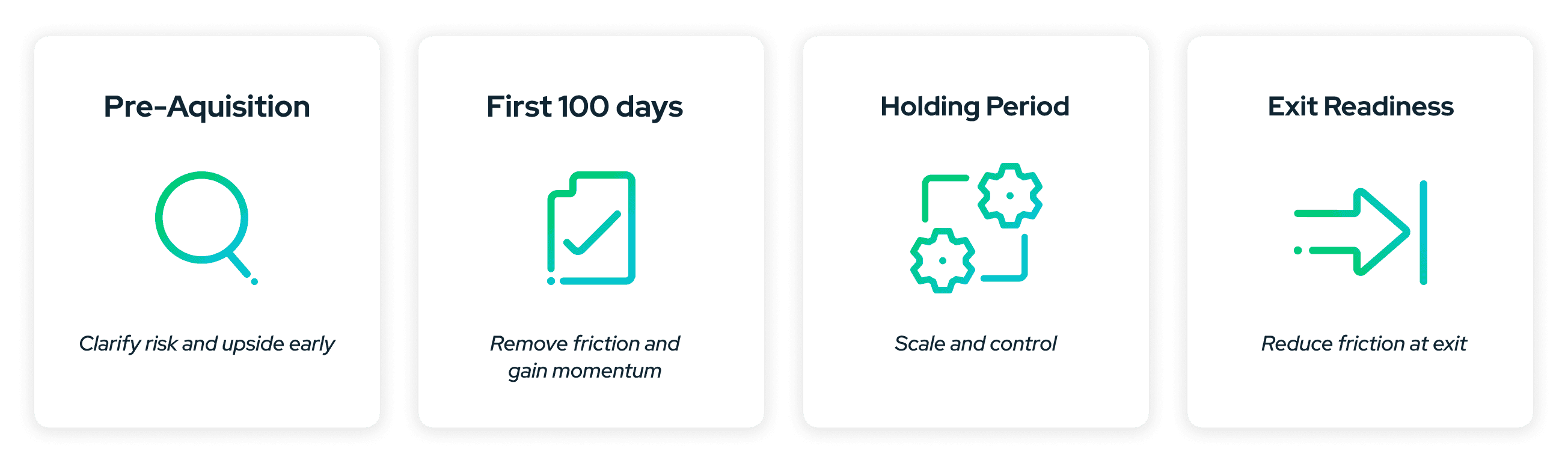
Leading PE firms treat digital strategy as a continuous value creation lever, not a post-close initiative.
Pre-acquisition
- Technology due diligence surfaces risk and upside early
- Informs valuation and post-close priorities
First 100 days
- Digital initiatives align with the value creation plan
- Core systems are stabilized
- Data visibility improves
Holding period
- Technology supports scale and add-on integrations
- Automation protects margins
- Reporting becomes consistent and reliable
Exit preparation
- Digital readiness reduces buyer friction
- Technology risk is lower and better articulated
Across leading private equity firms, digital strategy is increasingly treated as a continuous thread across the investment lifecycle rather than a post-close afterthought.
Common digital execution pitfalls in PE portfolio companies (and how to avoid them)
Even when portfolio companies recognize the importance of digital strategy, execution often breaks down in predictable ways. In our experience working with PE-backed organizations, value is rarely lost because of a lack of ideas. It is lost because of how digital initiatives are governed, sequenced, and owned.
This is the top five most common digital execution pitfalls we see in PE portfolio companies.
1. Treating digital as a collection of projects
Many portfolio companies approach digital initiatives as independent projects rather than as part of an integrated value creation effort. Teams modernize systems, implement tools, or automate processes in isolation, without a shared execution narrative.
This typically leads to:
- Parallel initiatives competing for the same resources
- Limited cumulative impact on EBITDA
- Increased complexity instead of simplification
How to avoid it:
Anchor digital initiatives explicitly to the value creation plan, with clear financial and operational outcomes tied to each effort.
Read our related post How Technology Portfolio Management Empowers Private Equity Firms.
2. Over-indexing on tools instead of operating impact
Another common pattern is focusing too heavily on technology selection rather than on how work actually changes. New platforms are introduced, but processes, roles, and decision-making remain the same.
Symptoms include:
- Low adoption of new systems
- Workarounds and shadow processes
- Minimal impact on cycle time or cost
How to avoid it:
Design digital initiatives around execution flows first, then support them with the right technology. Measure success in operating metrics, not deployment milestones.
3. Lack of clear ownership and governance
In PE-backed environments, unclear ownership quickly erodes momentum. When it is not explicit who owns outcomes, initiatives stall or drift.
Common governance issues include:
- Ambiguity between corporate IT and business leadership
- Over-reliance on a few key individuals
- Slow decision-making due to unclear escalation paths
How to avoid it:
Establish clear ownership, decision rights, and success metrics upfront. Digital initiatives require the same discipline as financial or operational initiatives.

4. Trying to do too much, too early
Under pressure to deliver results, some portfolio companies attempt to address every digital gap at once. This often overwhelms teams and dilutes impact.
The result is:
- Extended timelines
- Change fatigue
- Incomplete initiatives that never fully deliver value
How to avoid it:
Sequence initiatives based on value and dependency. Early wins should reduce friction and create capacity for more complex efforts later in the holding period.
5. Disconnect between fund-level expectations and PortCo reality
Finally, misalignment between investor expectations and portfolio company capacity can create execution friction. Digital roadmaps that look good at the fund level may not reflect operational realities on the ground.
This can lead to:
- Unrealistic timelines
- Resistance from management teams
- Erosion of trust between stakeholders
How to avoid it:
Ground digital strategy in a realistic maturity baseline and align expectations early between investors, boards, and management teams.
How private equity firms measure digital value creation in portfolio companies
One of the most common questions we hear from private equity teams is how to determine whether digital initiatives are actually contributing to value creation. Unlike traditional cost reduction programs, digital impact is often distributed across operations, decision-making, and scalability, which makes it harder to assess without clear metrics.
In practice, leading PE firms evaluate digital value creation across three complementary dimensions:
1. EBITDA and cost efficiency impact
At the most fundamental level, digital initiatives are expected to support EBITDA improvement, either directly or indirectly. This impact typically shows up through:
- Reduction in operating costs driven by automation
- Lower error rates and rework
- Improved productivity without proportional headcount growth
- Faster cycle times in core operational processes
While not every digital initiative maps cleanly to a single cost line, funds expect a clear narrative that links execution improvements to financial outcomes.
2. Operational visibility and decision quality
Digital maturity also affects how quickly and confidently leadership teams can make decisions. From a PE perspective, improved visibility reduces execution risk.
Common indicators include:
- Consistency and reliability of management reporting
- Shorter time to close and forecast cycles
- Fewer manual adjustments and reconciliations
- Greater confidence in operational and financial data
These improvements may not immediately translate into EBITDA, but they significantly reduce risk and support more disciplined execution throughout the holding period.
3. Scalability and exit readiness
Finally, digital value creation is assessed through the lens of scalability and exit readiness. Buyers increasingly scrutinize whether performance is dependent on heroic effort or supported by scalable systems.
From this perspective, funds look for:
- Technology platforms that can support growth post-exit
- Reduced dependency on key individuals
- Standardized processes and data models
- Lower perceived technology risk during diligence
Strong digital foundations strengthen the equity story and reduce friction at exit, even when their impact is not fully reflected in near-term financials.
Bringing the metrics together
The most effective funds avoid treating digital metrics in isolation. Instead, they connect operational indicators, financial outcomes, and risk reduction into a single value creation narrative.
When digital initiatives are measured this way, they move from being “technology projects” to becoming a core component of the investment thesis.

How Making Sense supports private equity PortCos with digital acceleration
In private equity environments, digital strategy creates value only when it is tightly connected to execution.
At Making Sense, we work with private equity firms and portfolio companies to help translate digital priorities into concrete operating and financial outcomes. This typically involves understanding where technology limits execution, focusing initiatives on value creation priorities, and sequencing delivery within the realities of PE timelines.
Our work typically spans:
- Technology due diligence and maturity assessments
- Post-close execution and modernization
- Data, automation, and AI applied to real operating problems
Digital acceleration is not about doing more initiatives. It is about ensuring the few that matter actually work.
Feb 4, 2026