

Legacy System Modernization Approaches: Choosing the Right Path
A practical guide to legacy system modernization approaches, helping CTOs and investors choose between rehosting, refactoring, or rebuilding based on risk, impact, and long-term value.

Feb 12, 2026
Modernizing legacy systems is rarely a greenfield decision: in most mid-market companies, legacy platforms still run core operations, support revenue, and concentrate years of business knowledge. The real challenge is not whether to modernize, but how to do it in a way that reduces risk, protects day-to-day operations, and supports future growth.
This article explains the main legacy system modernization approaches, compares their trade-offs, and outlines how CTOs and investors decide between them. The goal is to help leaders choose a path that improves efficiency, enables scalability, and strengthens long-term value, instead of creating new technical or operational constraints.
What legacy system modernization really means today
The term “legacy system” is often misunderstood. It is easy to associate it with outdated technologies or old programming languages. In practice, systems become legacy less because of their age and more because of the constraints they impose as the business evolves.
A system typically turns into a legacy platform when it starts to:
- Limit scalability or degrade performance as demand grows.
- Make integrations slow, fragile, or expensive to maintain.
- Depend on a small group of long-tenured individuals to function reliably.
- Reduce visibility into data, workflows, and operational health.
- Increase risk every time a change or release is required.
Many organizations continue to run profitable businesses on legacy platforms. The problem emerges when those systems stop being an operational foundation and start becoming a bottleneck for growth, acquisitions, automation, or new digital experiences.
Legacy system modernization, then, is not about rewriting everything. It is about evolving systems so they support where the business is going, not just where it has been, a challenge we’ve explored in depth when looking at how teams approach modernizing legacy systems without disrupting ongoing operations.

The main legacy system modernization approaches explained
While every modernization journey is unique, most strategies fall into three broad approaches. Each comes with different implications for risk, cost, speed, and long-term flexibility.
Rehosting (lift and shift)
Rehosting moves an existing system to a new infrastructure environment, typically from on-premise servers to the cloud, with minimal changes to the application itself.
This approach is often chosen when:
- Infrastructure costs are high or unpredictable.
- Data centers are approaching end of life.
- The organization needs quick wins without changing core functionality.
| Aspect | Summary |
| Primary benefits | Fast execution with lower upfront effort, reduced infrastructure management overhead, and minimal disruption to users and existing workflows. |
| Main limitations | Core architectural constraints remain unchanged, technical debt is preserved, and long-term scalability or integration challenges persist. |
Rehosting is often a tactical move. It buys time and stability, but rarely unlocks transformational value on its own.
Suggested graphic
Infrastructure diagram showing the same application moved from on-premise to cloud with no internal changes.
Refactoring (replatforming or code optimization)
Refactoring focuses on improving parts of the system without fully rebuilding it. This may include modularizing components, improving data access layers, optimizing performance, or introducing modern APIs.
Organizations typically choose refactoring when:
- The system is business-critical and cannot be replaced quickly.
- There is a need to improve scalability or integration incrementally.
- Teams want to reduce risk while making continuous progress.
| Aspect | Summary |
| Primary benefits | Balances risk and long-term improvement, enables gradual modernization without a big-bang rewrite, and improves maintainability and team velocity over time. |
| Main limitations | Requires strong architectural discipline, benefits materialize progressively rather than immediately, and complexity must be actively managed to avoid fragmentation. |
Refactoring is often the most sustainable path for mid-market companies, especially when modernization needs to happen alongside ongoing operations.
Rebuilding (re-architecting or replacing)
Rebuilding replaces the legacy system entirely with a new architecture and, often, a new product vision. This approach is the most ambitious and the most risky.
It is usually considered when:
- The existing system fundamentally limits growth.
- Business models or user expectations have changed significantly.
- Regulatory, security, or scalability requirements cannot be met incrementally.
| Aspect | Summary |
| Primary benefits | Delivers a clean architecture aligned with current and future needs, enables workflow and user experience redesign, and eliminates accumulated technical debt. |
| Main limitations | Involves higher cost and longer time to value, significant change management, and increased execution risk if scope is not tightly controlled. |
Rebuilding can create outsized value, but only when driven by clear business outcomes rather than technology ambition.
Suggested graphic
Timeline showing legacy system sunset alongside phased rollout of a new platform.
Comparative analysis: rehost vs refactor vs rebuild
Understanding these approaches in isolation is useful. Choosing between them requires a comparative lens.
Suggested table (core conversion asset)
| Criteria | Rehost | Refactor | Rebuild |
| Time to value | Fast | Medium | Slow |
| Upfront cost | Low | Medium | High |
| Risk level | Low | Medium | High |
| Scalability gains | Limited | Moderate to high | High |
| Impact on users | Minimal | Controlled | Significant |
| Fit for M&A | Tactical | Strong | Strategic |
This comparison highlights a key reality: modernization is a spectrum, not a binary decision. Many successful initiatives combine approaches over time, starting with rehosting or refactoring and rebuilding only where it creates clear leverage.
Decision criteria used by CTOs and engineering leaders
CTOs rarely choose a modernization approach based on architecture alone. The decision is shaped by a set of practical constraints and strategic priorities.
Common evaluation criteria include:
- Business criticality
How much downtime or instability can the organization tolerate? - Growth expectations
Is the system expected to support new markets, users, or acquisitions? - Integration needs
Does the platform need to connect with modern tools, partners, or data pipelines? - Team capabilities
Does the internal team have the skills to maintain and evolve the system? - Compliance and security requirements
Are regulatory standards becoming more demanding? - Product roadmap alignment
Will the system support future features without constant workarounds?
CTOs tend to favor approaches that preserve optionality. A strategy that allows teams to learn, adjust, and de-risk over time often outperforms a rigid long-term plan.
How private equity firms evaluate legacy modernization
For private equity firms, legacy systems are not viewed as a purely technical concern. They are evaluated as both a value creation lever and a source of execution risk that can directly affect deal outcomes.
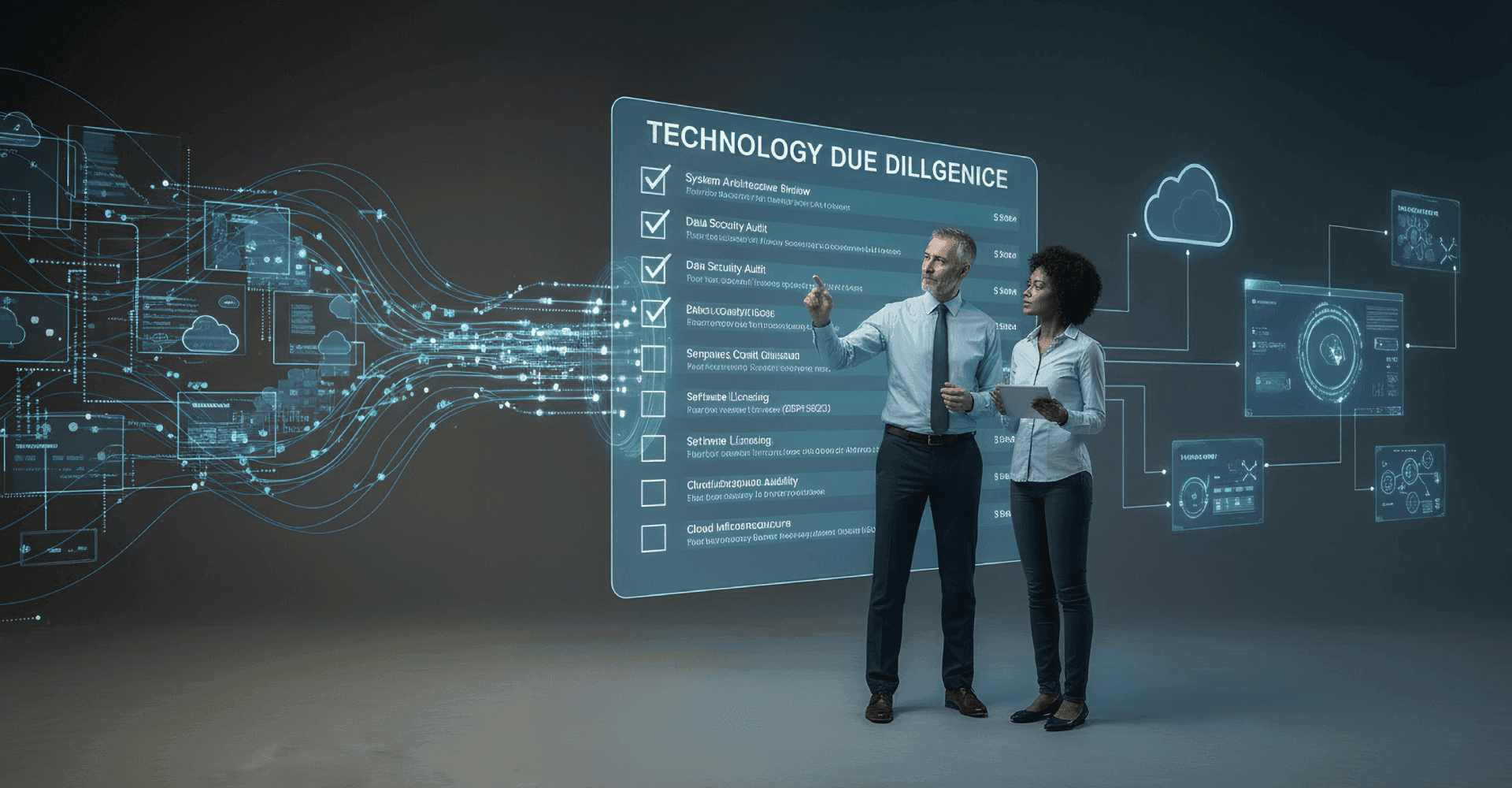
During due diligence: identifying risk and constraints
In the diligence phase, technology assessments are designed to surface risks early and understand how legacy platforms may constrain growth plans. The analysis typically focuses on whether existing systems can:
- Scale reliably under growth or consolidation scenarios.
- Operate without depending on undocumented processes or a small group of key individuals.
- Support acquisitions without introducing disproportionate cost or integration effort.
- Enable timely, reliable data for reporting and decision-making.
When limitations around reporting, automation, or integrations surface late in the process, the consequences are tangible. Valuation adjustments, extended diligence timelines, and delayed growth initiatives are common outcomes when technology risk was not clearly understood upfront.
Post-acquisition: modernization as a value creation lever
Once the deal closes, the lens shifts from risk identification to execution. Modernization decisions are reframed around their ability to deliver measurable impact within a defined investment horizon, including:
- Speed to operational improvements and execution clarity.
- Direct impact on EBITDA through efficiency gains and automation.
- Readiness to support bolt-on acquisitions and system integrations.
- Overall exit readiness aligned with the fund’s timeline.
These considerations reflect how legacy modernization becomes part of the value creation plan in M&A-driven environments, a dynamic we’ve explored when looking at how organizations approach legacy modernization as part of post-acquisition growth strategies.
Turning modernization into a strategic advantage
The most effective modernization efforts do not treat technology as an isolated initiative. They position it as part of a broader operating model, directly connected to how the business plans, executes, and scales.
Organizations that consistently extract value from modernization tend to follow a few shared principles:
- Start with a discovery phase that aligns modernization decisions with business priorities, not assumptions.
- Prioritize systems based on the value they enable or constrain, rather than their age or technical stack.
- Avoid big-bang rewrites unless the business case is clear, validated, and time-sensitive.
- Measure progress through operational outcomes, such as efficiency gains or faster execution, instead of purely technical milestones.
At Making Sense, legacy system modernization is approached as an evolving journey rather than a one-off project. By combining technology advisory, architecture design, and execution, teams can modernize incrementally while keeping operations stable and maintaining a clear focus on value creation, an approach reflected in how we work across legacy system modernization initiatives with mid-market and private-equity-backed organizations.
Conclusion: modernize with clarity, not urgency
Legacy system modernization is not about doing more technology work faster. It is about making the right decisions at the right time, with a clear understanding of trade-offs.
Rehosting can stabilize operations. Refactoring can unlock steady gains. Rebuilding can reset the foundation. The right path depends on business context, growth ambitions, and risk tolerance.
Organizations that treat modernization as a strategic decision, rather than a reactive fix, are better positioned to scale, integrate, and create long-term value.
Schedule a meeting to discuss the right modernization path for your legacy systems.
Feb 12, 2026