
Our Approach to Discovery for Better Product Decisions
How Making Sense approaches discovery to reduce risk, bring focus to early choices, and set delivery teams up for success, based on real product and execution experience.

Jan 22, 2026
Many product initiatives reach delivery carrying unnecessary uncertainty. Early on, teams often move forward without a shared understanding of what problem truly matters, which assumptions remain open, or which compromises are being made along the way.
Discovery exists to create leverage at that stage. It provides a window to make better decisions while uncertainty is still manageable and change remains relatively inexpensive. When this opportunity is missed, teams tend to rely on partial information, accelerate into development, and absorb the cost later through rework, misalignment, and delayed outcomes.
Years of working across complex product and delivery environments have shaped how we think about product discovery. Rather than a fixed process or a checklist of activities, it functions as a deliberate way to establish focus and align business, product, and technology around the decisions that matter most.

One approach, different decisions
There is no single discovery path that works for every product or organization. The challenges, constraints, and risks are different depending on whether a team is validating an idea, scaling an existing product, or realigning around shifting business priorities.
What remains consistent is not the sequence of activities, but the intent behind them. Our approach to discovery adapts to the context while staying anchored on the same goal: helping teams determine which decisions need to be made now, which uncertainty deserves attention, and which trade-offs are acceptable given the business reality.
This flexibility is deliberate. Treating discovery as a rigid process often creates a false sense of certainty, while ignoring the specific risks of each situation. By adjusting the scope, depth, and focus of discovery, teams gain clarity where it matters most, without over-investing in areas that won’t materially affect outcomes down the line.
Starting with the right questions
Discovery does not begin with solutions or activities. It begins when teams intentionally pause to question what they believe they already know. As teams move forward, assumptions tend to solidify, even when they have never been tested or explicitly discussed.
This initial moment exists to create a shared baseline before any direction is defined. It surfaces what problem is truly being prioritized, what success actually means, and where perspectives are still misaligned across business, product, and technology.

In our work with Sony Interactive Entertainment, the video game and entertainment division of Sony, early conversations initially pointed toward tooling and experience gaps. Taking the time to step back revealed that the core challenge was operational fragmentation across teams, which ultimately changed both the direction of the initiative and the criteria used to evaluate success.
When this work is skipped, discovery turns reactive and delivery inherits decisions that were never consciously made. Treating these questions as an explicit starting point sets the conditions for everything that follows, including how uncertainty is handled, trade-offs are made, and execution unfolds.
How Making Sense navigates discovery in practice
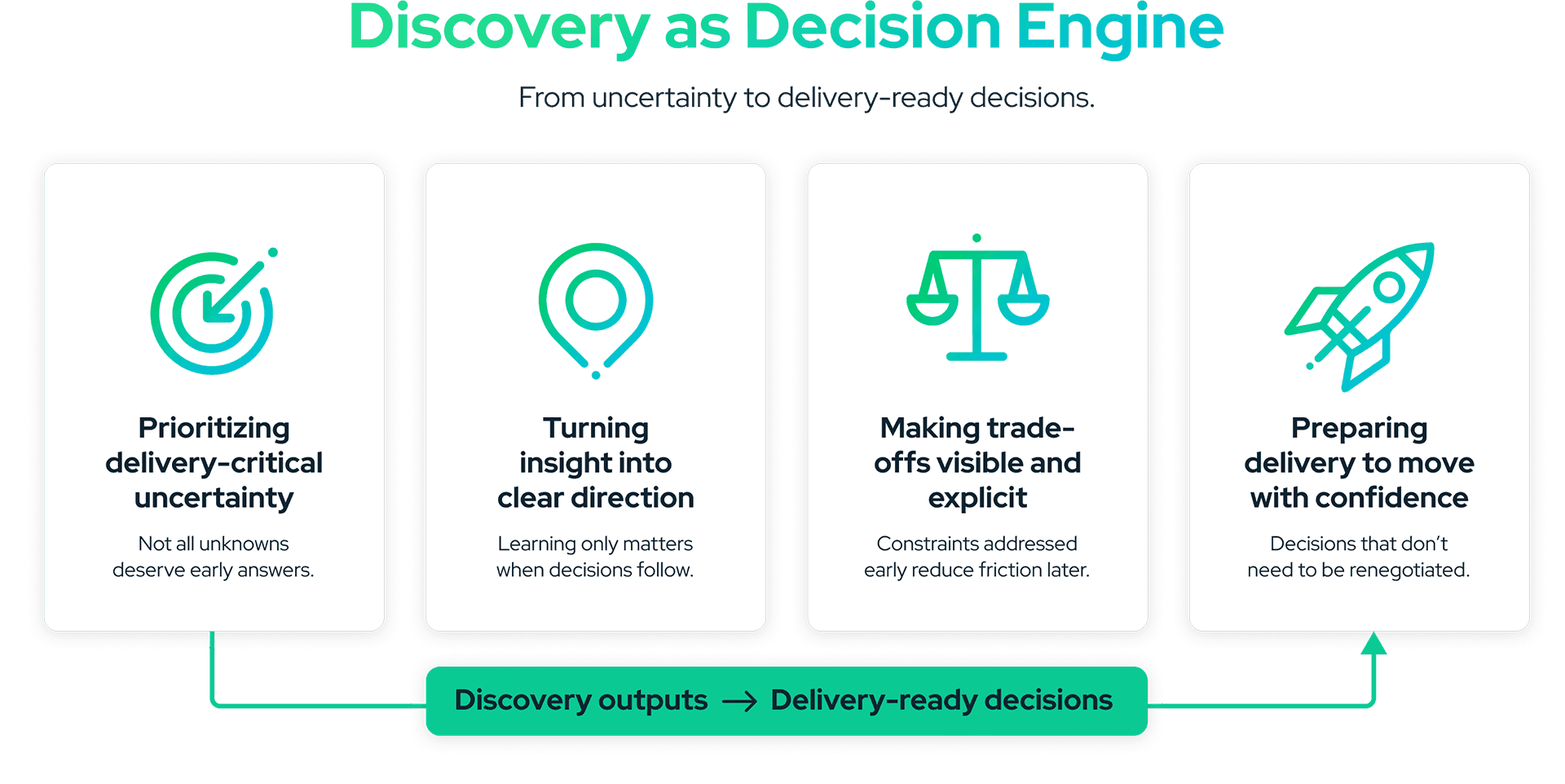
Once the right questions are on the table, discovery moves forward through a sequence of decisions. Each step builds on the previous one, progressively reducing risk and increasing clarity before delivery begins.
1. Prioritizing uncertainty that affects delivery
Discovery is not about eliminating all unknowns, but about deciding which questions must be addressed in order to move forward responsibly. Early on, teams face many unknowns, but only some of them meaningfully affect outcomes.
Our focus at this stage is to distinguish what can remain flexible from what requires early clarity. This prevents a common pattern we’ve seen repeatedly: teams progressing with confidence while critical assumptions remain implicit.
In our work with SECO, a logistics company operating at scale, what initially appeared to be a technology limitation became, through early exploration, a question of operational efficiency and scalability. Clarifying that distinction early helped the team focus on the constraints that truly affected execution, rather than over-investing in solutions that would not have addressed the core issue.
By prioritizing uncertainty instead of treating all unknowns equally, discovery becomes a mechanism for focus rather than delay.
2. Turning insight into direction
Generating insights is only useful if they translate into direction. One of the most frequent breakdowns we encounter is when discovery produces valuable information, but no clear decisions follow from it.
At this stage, the emphasis shifts from learning to choosing. Decisions start to take shape, along with the reasoning behind them. What problems are we committing to solve, and why? What outcomes define success, and what makes them the right ones now? What options are we explicitly not pursuing, based on what we’ve learned so far?

These decisions shape scope, influence estimates, and provide a reference point for delivery teams. Without them, development often starts with speed but lacks a shared sense of direction, increasing the risk of teams drifting away from the original goals as delivery progresses.
We saw this clearly in our work with Esquire, a legal services company operating in a highly time-sensitive environment, where early alignment around which workflows truly needed improvement helped the team avoid spreading effort across multiple initiatives and instead concentrate on changes that delivered measurable operational impact. You can explore this case in more detail and see how those early decisions translated into operational impact.
3. Making trade-offs explicit
Every product decision implies a trade-off, whether acknowledged or not. Discovery creates the space to surface those trade-offs while change is still inexpensive.
We’ve learned that unspoken constraints and implicit expectations tend to resurface later as friction, scope creep, or misalignment between stakeholders. Addressing them early allows teams to align around reality, not aspiration.
This is where discovery adds strategic value, by making constraints visible and turning them into explicit, actionable inputs for decision-making.
4. Preparing delivery to move with confidence
Discovery does not end when alignment is achieved. It ends when delivery can move forward without needing to reinterpret or renegotiate core decisions.
The outputs of discovery inform technical approaches, reduce ambiguity in estimates, and help teams anticipate where flexibility is needed versus where consistency is critical.
When done well, this transition shortens feedback loops during development and reduces the need for course correction once execution is underway.
Discovery as an early investment in execution
Discovery is often treated as something teams need to get through in order to start building. In practice, its real value shows up later, when delivery moves forward with fewer surprises, clearer priorities, and decisions that don’t need to be revisited under pressure.
From our experience, the real difference comes from how intentionally discovery time is used, rather than how much of it is allocated. When discovery is approached as a decision-making space rather than a set of activities, it becomes a way to protect focus, align expectations, and reduce the accumulated risk that typically surfaces once execution is already underway.

Seen this way, discovery moves beyond a preliminary phase. It shapes how work unfolds over time, influencing not only what gets built, but how confidently teams are able to build it.
If these challenges sound familiar, discovery is often the right place to pause and rethink how decisions are being made. We regularly work with teams in situations like this, when clarity matters more than speed.
If you’re navigating similar questions, we’re always open to a conversation.
Jan 22, 2026