
How Should Mid-Market Companies Prioritize Their 2027 Technology Budget?
As companies plan for 2027, the challenge is deciding which technology investments can create meaningful business value now, which ones enable future growth, and which can wait.

Sep 24, 2026
AI is competing for capital alongside cybersecurity, legacy modernization, data infrastructure, automation, customer-facing products, cloud initiatives, and core systems that already support the business. At the same time, companies are under pressure to improve margins, increase productivity, and create room for growth without allowing operating costs to expand at the same pace.
The investment appetite is clearly there. According to the National Center for the Middle Market at The Ohio State University, 91% of middle-market companies now use AI in some capacity, up from 83% just six months earlier. Operational efficiency and cost pressure are also the most common reasons companies give for adopting it.
A useful 2027 technology budget should answer four questions:
- What protects the value the business already has?
- What removes meaningful operating constraints?
- What enables the next stage of growth?
- What foundations need to be in place for those investments to scale?
Where should a technology budget start?
Technology planning can quickly turn into a list of platforms, projects, and capabilities competing for funding. AI agents, cloud migration, data platforms, workflow automation, application modernization, new digital products, and security improvements may all have legitimate business cases. A better starting point is the constraint each investment is supposed to remove.
Where is the business losing time or margin? Growth gets harder when a system that worked fine at one volume starts requiring a person at every step, and that cost usually shows up in headcount rather than in the technology budget. Customer experience tends to break at a specific handoff. Somewhere else in the operation, a single system carries enough concentrated risk that a failure interrupts revenue or creates compliance exposure.
That leads to a simple question leadership teams can apply to every proposed initiative:
What business metric should change if we fund this?
The answer might be cost per transaction, processing time, conversion, system downtime, customer retention, time-to-market, employee capacity, or another measurable outcome. An initiative without a clear connection to business performance needs further definition before it competes for capital.

This is also where a structured Discovery process becomes valuable. Clarifying the problem, dependencies, expected outcome, and realistic delivery path early gives leadership a stronger basis for comparing initiatives that may look very different on a technology roadmap.
Protect the technology the business already depends on
Some investments earn priority because the cost of leaving the underlying problem unresolved keeps increasing.
A legacy application may still perform its core function while requiring expensive maintenance, creating integration problems, slowing product changes, or preventing the company from operating efficiently at greater scale. Security weaknesses, unreliable infrastructure, and critical systems with concentrated technical knowledge can create similar exposure.
Modernization priorities should therefore be tied to the business consequences of the current environment.
Valley Agricultural Software (VAS) had built its dairy management applications over more than three decades, and by the time the company was serving three thousand dairies, the apps were holding data on ten million cows across a platform that predated most of the standards it needed to meet. Making Sense moved those applications into a modern cloud environment and rebuilt the experience around them. Operational costs came down 30% against the pre-migration baseline, and the platform now supports active users in more than 100 countries.
The age of a system says very little on its own. What sharpens the case for a 2027 budget is the economic weight of the constraint: what maintenance costs every year, which dependencies or security exposures it creates, how much speed the team loses, and what the current setup rules out.
For companies facing similar constraints, both custom software development and legacy system modernization can cover anything from extending a valuable existing platform to rebuilding capabilities that have become a barrier to scale.
Where does automation actually pay off?
Once critical technology risks are covered, the next question is where an investment can meaningfully change the economics of the operation. This is where AI and workflow automation can become particularly relevant.
The latest Middle Market Indicator shows U.S. mid-market revenue growing 11% year over year while employment growth moderated to 7.2%. The National Center for the Middle Market points to a growing focus on productivity, technology, workforce development, and process improvements as companies look for ways to increase output more efficiently.
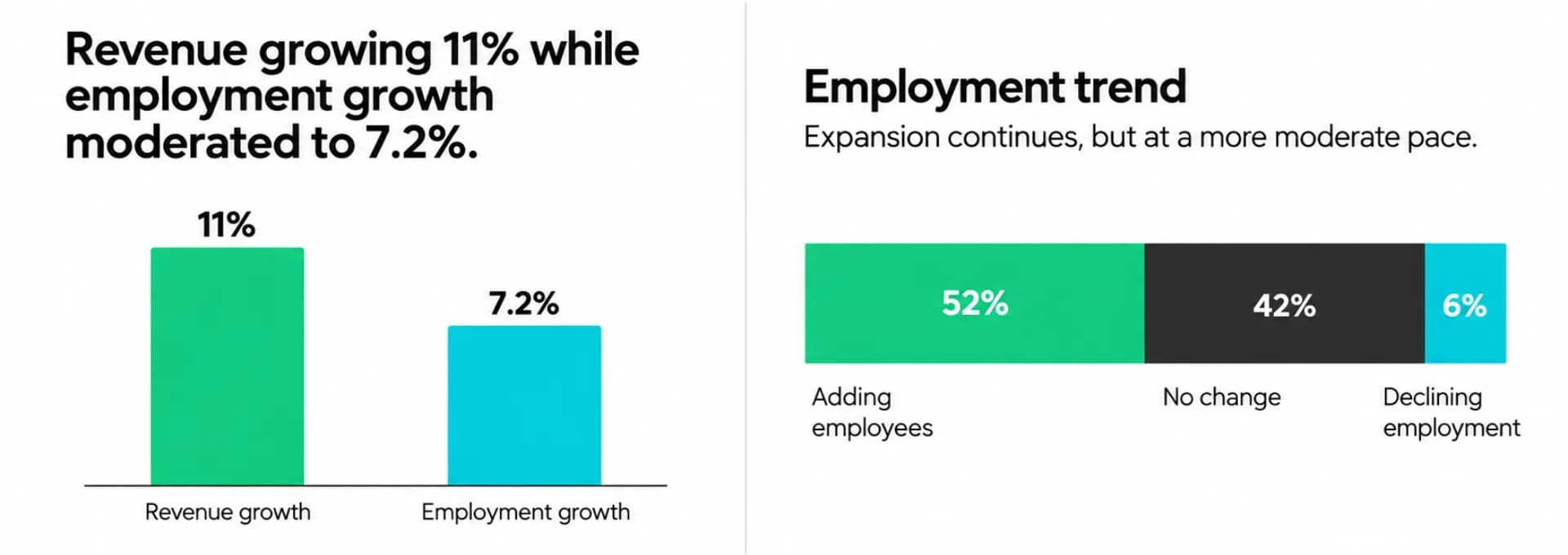
For budgeting purposes, that means looking closely at high-volume workflows where employees spend substantial time moving information, validating data, coordinating across systems, producing repetitive outputs, or handling predictable decisions.
Three conditions tend to separate the workflows worth automating from the ones that only look like it:
- The work happens frequently enough for small improvements to compound.
- The current cost, time, or error rate can be measured.
- The business can absorb exceptions without requiring automation to solve every possible scenario.
Esquire Depositions offers one example. As the legal services company expanded organically and through acquisitions, fragmented systems and manual workflows made it difficult to scale efficiently. Centralizing data and introducing automation contributed to a 40% improvement in operational efficiency and a reported 10% increase in enterprise valuation.
This is the standard AI initiatives should compete against in a technology budget: measurable operating impact.
The broader market is still learning where that impact materializes. Stanford’s 2026 AI Index found that 88% of surveyed organizations use AI in at least one business function, while deployment of AI agents remains in the single digits across nearly every function.
For mid-market companies, focused use cases with clear economics can provide a more reliable basis for investment than broad adoption targets. A useful starting point is identifying the workflows where intelligent automation can remove meaningful operational friction and where baseline metrics already make ROI visible.
Fund the foundations required for the next investment to work
A technology budget also has to fund the work nobody puts on a slide. An AI workflow depends on someone being able to pull the data it reads, which sounds trivial until three systems disagree about what a customer record is. Automation exposes the process inconsistencies that were survivable while a person absorbed every exception by hand. A product initiative that needs to serve ten times the users often needs its architecture rebuilt first, and that rebuild is invisible in the business case for the product. These dependencies belong in the investment decision from the start, not as a surprise discovered during delivery.
Recent research highlighted by MIT Sloan illustrates why. Researchers found that software developers using AI tools could produce substantially more code, yet that additional productivity did not translate proportionally into more completed software. Bottlenecks shifted toward human-led stages later in the development lifecycle.
The same principle applies beyond software development: improving one step of a workflow creates limited value when the next step cannot absorb the additional capacity.
For 2027 planning, leadership teams should evaluate the complete path around each major investment, including data, integrations, architecture, security, governance, process design, and user adoption. Those supporting capabilities may deserve budget because they determine whether the headline initiative can generate a return.
That broader assessment is particularly important when defining how AI and data will work together, since readiness often determines how quickly an organization can move from an attractive use case to measurable business impact.
What should a growth-oriented technology budget fund?
Efficiency is only one lens for technology spending. Some of the strongest investments expand what the company can sell, where it can operate, or how quickly it can respond to new opportunities.
That could mean launching a digital product, improving conversion, entering another geography, enabling self-service, supporting acquisitions, or building a platform capable of handling significantly greater volume.
Many middle-market organizations already have large technology programs underway. Capital One’s 2026 U.S. Middle Market Mid-Year Snapshot surveyed 1,001 U.S. financial decision-makers at companies with $20 million to $2 billion in annual revenue. The research shows mid-market businesses moving beyond several years centered heavily on cost efficiency, with part of the market placing renewed emphasis on topline growth.
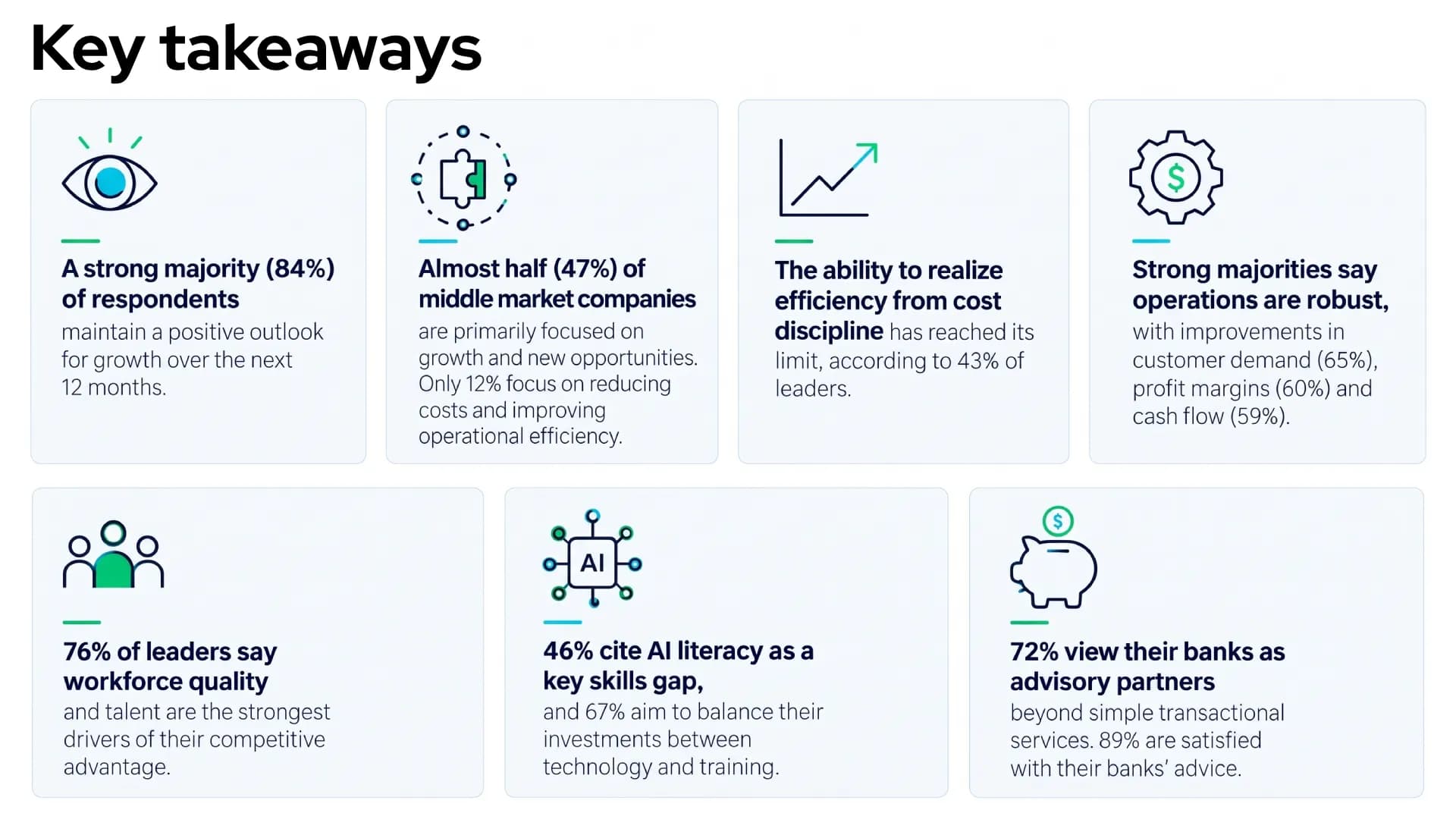
As existing technology capabilities mature, budget decisions increasingly need to connect them to growth.
Vetsource provides a useful example. Expanding its veterinary e-commerce platform beyond the United States required an architecture that could accommodate different currencies, tax rules, payment methods, catalogs, and regulatory requirements. Making Sense built those capabilities into a configurable platform, helping reduce time-to-market for future country launches by 80%. In the UK, the platform maintained fulfillment above 94% while orders grew 68% per month during the first six months. You can read more about the technology behind that expansion in our article on the technology questions companies should address before international expansion.
The investment created reusable capacity for expansion, which is exactly the type of connection a growth-oriented budget should make explicit.
A practical framework for ranking the 2027 technology portfolio
Once initiatives have been identified, leadership teams can compare them using the same five dimensions:
| Dimension | Question to ask |
| Business impact | Which measurable business outcome can this investment improve? |
| Urgency and risk | What happens if we delay it for another 6 to 12 months? |
| Time-to-value | How quickly can the business begin capturing meaningful benefits? |
| Readiness | Do the data, systems, processes, and people required to make it work already exist? |
| Measurability | Can we establish a baseline and determine whether the investment succeeded? |
From there, initiatives can be sequenced into three groups: fund now, sequence next, and keep exploratory.
That distinction matters because several attractive opportunities may have strong potential while still depending on foundational work. Sequencing them preserves the opportunity without committing a significant budget before the organization is ready to capture the value.
The 2027 budget should make the business easier to scale
The strongest technology budgets create a coherent portfolio of investments tied to how the company wants to operate and grow.
By the end of 2027, leadership should be able to point to concrete changes: lower operating friction, greater capacity, stronger customer experiences, faster execution, reduced technology risk, or new sources of growth.
Getting there starts before individual projects receive funding. It requires understanding where technology is constraining the business today, which outcomes matter most, and which investments create the conditions for the next ones to succeed.
If you’re planning your 2027 technology budget and need help identifying where investment can create the most business value, our Discovery process can help you assess priorities, dependencies, and expected outcomes before committing resources. Talk to our team.
Sep 24, 2026