

AI for DevOps: How Intelligent Automation Reduces Costs and Accelerates Delivery
AI for DevOps adds intelligence to delivery pipelines, helping teams cut operational costs, reduce toil, and accelerate releases without increasing risk or complexity.

Jan 13, 2026
As software organizations scale, delivery speed and cost efficiency tend to move in opposite directions. More services, more dependencies, and more infrastructure usually translate into higher operational overhead and slower release cycles. In this environment, DevOps teams are expected to ship faster while maintaining reliability and keeping costs under control.
That pressure is changing how DevOps works at scale, and it lands hardest on teams running custom software development, where every release carries code nobody else maintains and no vendor is going to patch. AI for DevOps offers a practical way to bring intelligence into those workflows, shifting teams from reactive execution toward more adaptive, data-driven operations.
What is AI for DevOps? A modern view of intelligent software delivery
AI for DevOps refers to the application of machine learning models, generative AI, and predictive analytics across DevOps workflows to improve decision-making, reduce manual effort, and anticipate issues before they impact delivery or end users.
Unlike traditional automation, which relies on static rules, AI-driven DevOps systems learn from historical data, behavioral patterns, and real-time signals across the software delivery lifecycle. This enables a shift from basic task automation to smarter, context-aware execution.
In practice, AI for DevOps is not a single capability but a combination of different AI approaches already used across business contexts, such as predictive analytics, anomaly detection, and generative models, each applied where it adds the most leverage inside the software delivery lifecycle.
Core benefits of AI for DevOps
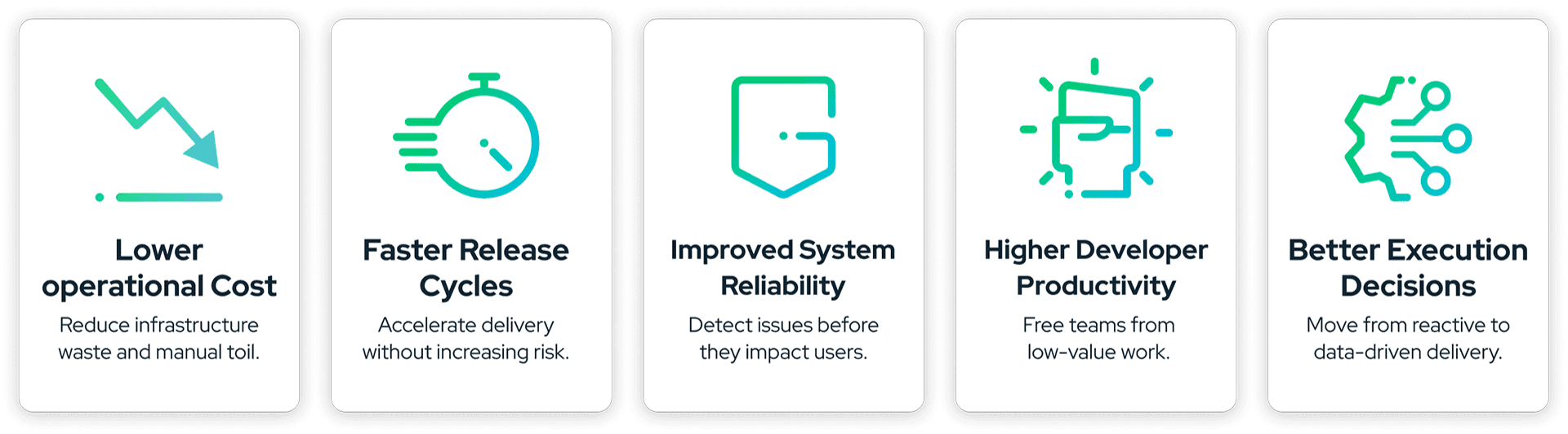
When implemented with clear intent, AI for DevOps delivers outcomes that extend beyond tooling improvements and directly impact business performance:
- Lower operational costs by identifying infrastructure inefficiencies and reducing manual toil
- Faster release cycles through intelligent testing, pipeline optimization, and accelerated root cause analysis
- Improved system reliability via early detection of anomalies and failure patterns
- Higher developer productivity by offloading repetitive, low-value tasks
- Better execution decisions supported by predictive insights rather than reactive firefighting
Over time, these benefits compound, turning incremental efficiency gains into sustained delivery improvements.
How AI adds intelligence across the DevOps lifecycle
AI creates the most value when applied across the full DevOps lifecycle rather than in isolated stages.
Planning and code
In the early stages, AI supports teams by improving clarity and reducing cognitive load:
- Auto-generation and maintenance of technical documentation based on code and commit history.
- Code analysis to surface potential defects, security issues, or architectural inconsistencies earlier.
- Context-aware recommendations that help developers navigate large or legacy codebases faster.
The result is less time spent understanding the system and more time spent improving it.
Build and test
Testing and automated build pipelines (the processes that validate software before release) often become bottlenecks as systems grow more complex, not only because of the tests themselves, but due to the ongoing maintenance, permissions management, and security controls required to keep these pipelines reliable.
AI adds value at this stage by reducing the operational overhead around these workflows, for example by:
- Keeping build and testing pipelines up to date as dependencies, configurations, and environments change
- Detecting configuration drift, permission issues, and security risks before they break the pipeline
- Identifying flaky or unstable stages and explaining why failures occur, instead of just flagging them
- Reducing manual intervention needed to maintain CI/CD workflows as scale increases
The result is not just better testing, but more resilient and lower-friction DevOps pipelines that support faster, more predictable delivery.
Release and deploy
During deployment, AI helps teams move faster with confidence:
- Predicting deployment risks based on prior incidents and system behavior.
- Recommending remediations when deployment issues occur.
- Surfacing early signals from deployments that help teams anticipate issues and take corrective action before they escalate.
This reduces last-minute decision-making during releases and helps teams deploy more consistently as systems evolve.
Operate and monitor
Operations is where AI often delivers the most visible ROI:
- Anomaly detection that flags unusual behavior before users are impacted.
- Alert correlation that groups incidents by probable root cause, reducing noise.
- Automated log and metric summarization to speed up troubleshooting.
This shifts incident management from reactive response to proactive prevention.
Learn and improve
Finally, AI supports continuous improvement by closing the loop:
- Automated incident summaries and post-mortems generated from tools like Slack and PagerDuty.
- Trend analysis that highlights recurring failure modes or inefficiencies.
- Insights that inform where automation or architectural changes will have the highest payoff.
Over time, the DevOps workflow becomes more resilient, not just more automated.
Challenges and considerations when implementing AI for DevOps

The upside comes with a caveat that shows up clearly in the data. DORA's 2025 State of AI-assisted Software Development report, based on responses from close to 5,000 technology professionals, found that 90% now use AI at work and over 80% believe it has made them more productive. It also found that higher AI adoption correlates with an increase in software delivery throughput and an increase in delivery instability at the same time: more change failures, more rework, longer cycles to resolve what breaks.
DORA's reading is that AI behaves as an amplifier. Teams with solid delivery foundations get acceleration. Teams carrying technical debt and process chaos get more of both, faster. Which puts the common pitfalls in sharper relief:
- Over-automation: Applying AI everywhere without a clear problem statement often increases complexity instead of reducing it.
- Poor data quality: AI systems are only as good as the data they learn from. Inconsistent logs or metrics limit impact.
- Tool sprawl: Introducing new AI tools without integrating them into existing workflows creates friction.
- Lack of human oversight: AI should support decisions, not replace accountability or engineering judgment.
A recurring mistake is treating AI as a platform purchase rather than an operating model shift. Successful teams focus on outcomes first, then choose where intelligence adds the most leverage.
How to successfully adopt AI for DevOps
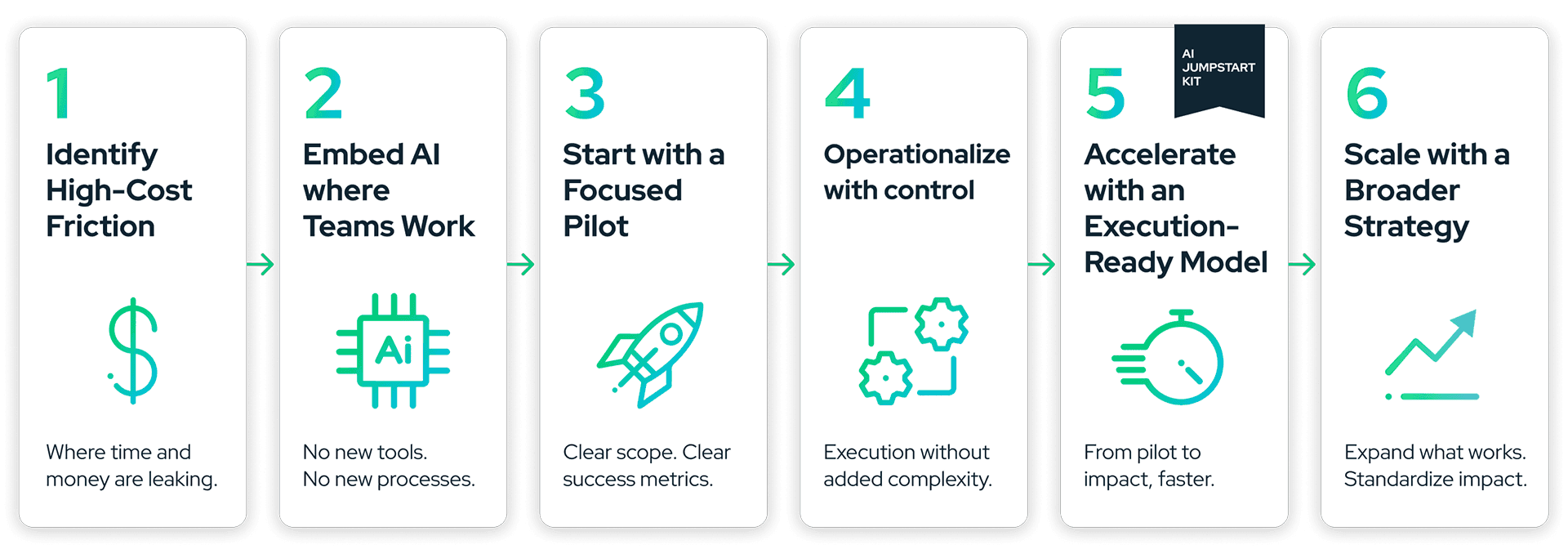
1) Pinpoint where friction is most expensive
Start by mapping where DevOps effort is getting diluted—cloud spend, slow testing cycles, incident response, or repetitive developer tasks. The goal is to focus on the constraints that create measurable cost and delivery drag.
2) Embed AI into existing workflows and tools
The fastest results come from applying AI where teams already operate (CI/CD, observability, ticketing, collaboration), rather than adding standalone platforms that create new processes and adoption risk.
3) Run a focused pilot with clear success metrics
Choose one or two high-impact use cases and define what “better” means upfront: faster delivery, fewer incidents, lower cloud cost, reduced toil, or improved release reliability. Narrow pilots beat broad initiatives because they create signals quickly.
4) Operationalize without increasing complexity
As teams move from experimentation to execution, the challenge is not understanding what AI can do—it’s making it work inside delivery constraints. Keep the scope tight, validate outputs, and ensure ownership stays with engineering teams.
5) Use an execution-ready format to accelerate time-to-value
This is the foundation behind Making Sense’s AI Jumpstart Kits for DevOps. They apply production-ready AI capabilities directly to real DevOps workflows, combining proven components with targeted customization to deliver measurable impact quickly.
6) Scale incrementally and connect it to a broader strategy
Once results are visible, expand to adjacent workflows and standardize what works. DevOps gains tend to hold only when they connect to how software actually gets built: pipelines, architecture decisions, and custom software development practices are the same system seen from different angles. Improving one while leaving the others alone usually moves the bottleneck instead of removing it.
From smarter DevOps to scalable delivery performance
AI for DevOps is not about adopting tools in isolation. It is about building delivery systems that can scale intelligently, control costs, and remain reliable as complexity grows.
Organizations that see consistent results are those that move beyond experimentation and adopt execution models that embed intelligence directly into everyday DevOps workflows. When applied with focus and discipline, AI reduces operational friction, shortens feedback loops, and allows engineering teams to spend more time improving products instead of managing operational noise.
For teams under pressure to deliver more with the same resources, AI-enabled DevOps has become a core lever for sustainable delivery performance, particularly in custom software development environments where the engineering team owns the whole stack.
Jan 13, 2026